ARTS / CULTURE & LEISURE
New dating of crania fossils from Hubei redefines East Asia’s early human history
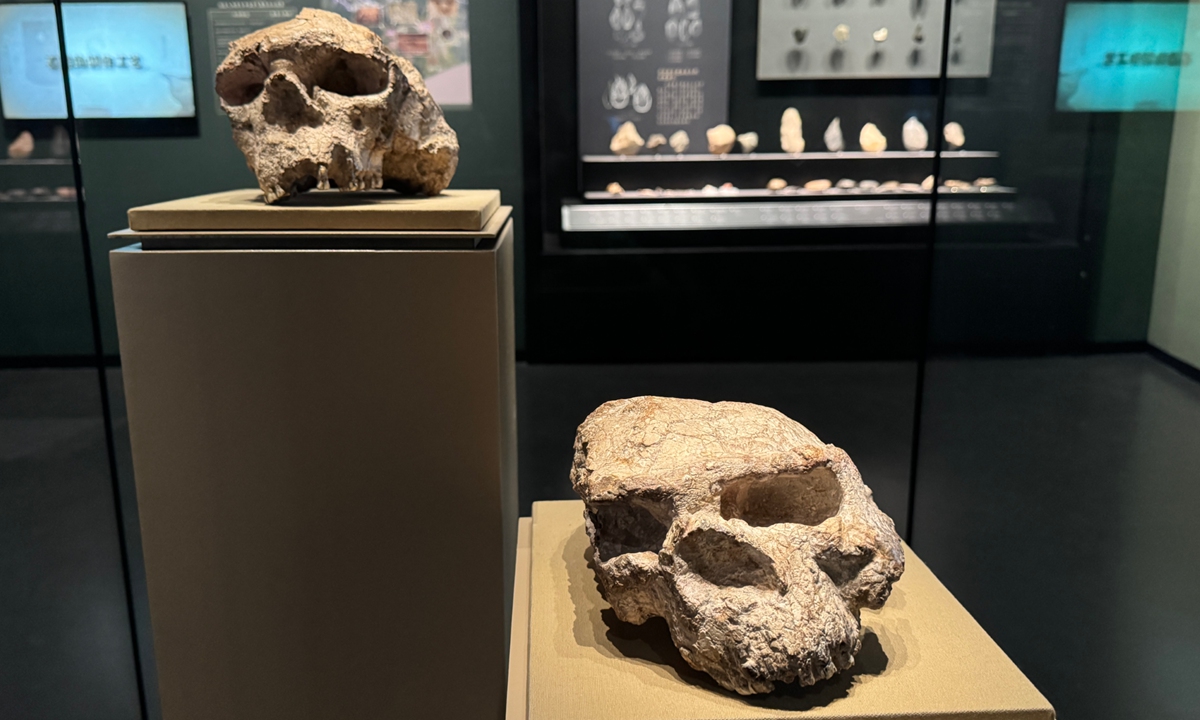
Photo: VCG
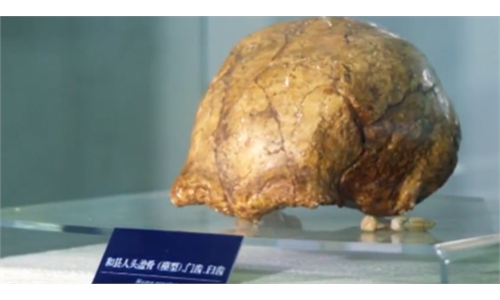
Through the analysis of quartz gravel samples from ground strata, a China-US research team has recently pushed back the date of the Yunxian site in Central China's Hubei Province.The origin of three unearthed Homo erectus crania, the Yunxian site stands as one of the most important early Pleistocene hominin sites in East Asia. These crania fossils were dubbed "Yunxian Man," with the third and most recently excavated specimen, unearthed in 2022, representing the most complete hominin skull fossil of its age ever found in inland Eurasia.
To better investigate the site, the China-US research team used a cosmogenic nuclide burial dating method to re-date the site's geological context - particularly the age of the site's strata. They extracted 10 quartz gravel samples from the stratum that yielded the Yunxian Man fossils. By measuring their cosmogenic nuclide concentrations and constructing an isochron dating chart, researchers found the depositional age of the stratum to be around 1.77 million years old.
This discovery significantly pushes back the age of the site, as previous dating generally suggested "the Yunxian remains dated back no more than 1.1 million years," paleontologist Huang Wan, told the Global Times. Prior to the discovery, the age of Yunxian fossils had been a "debatable question" due to a lack of concrete numerical dating results, Feng Xiaobo, the lead researcher of the project, told the Global Times.
The newly determined age not only provides specific dating results, but also confirms that the Yunxian Man fossils are "the oldest homo erectus crania discovered in situ in eastern Asia to date," said Feng. He also added that the discovery will reshape people's understanding of early human migration in East Asia.
For a long time, the theory that humans originated in Africa and then migrated outwards has been the widely accepted view in academia. Amid this context, uncertainty persists regarding the specific dispersal routes and timing into Eurasia, especially East Asia. This uncertainty, in turn, triggers a host of questions concerning the evolutionary history and origins of East Asian homo erectus.
The newly determined 1.77-million-year record confirms that "Yunxian Man represents the earliest homo erectus in the world, and that China is one of the crucial origin regions of early humans," Feng stressed.
"This achievement represents a significant step toward clarifying the debate and addressing the question of whether China's earliest humans migrated from the West and Africa, or were indigenous to the region."
The research findings have been published in the academic journal Science Advances. The study was jointly conducted by researchers from China and the US, representing institutions such as Purdue University.
Located in Shiyan, Hubei Province, the ruins where the Yunxian Man fossils were found was originally called the "Xuetang Liangzi site." This large-scale open-air Early Paleolithic spot uniquely integrates hominin fossils, ancient mammalian fossils, and stone artifacts. The three hominin skull fossils, unearthed at the site in 1989, 1990 and 2022, were formally named by the academic community as "Yunxian Man No.1, 2, 3" respectively.
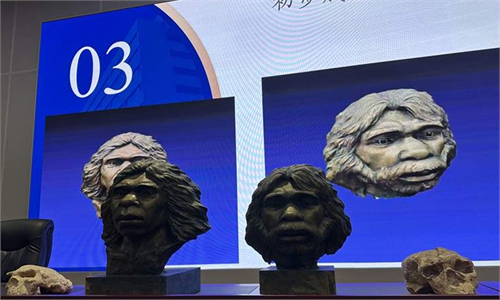
In 2024, after researching the hominin skull fossils for eight years, researchers successfully reconstructed the appearance of "Yunxian Man No.1 and No.2." The findings indicate that the former belonged to a female aged 25 to 45 years old, while the latter belonged to a male aged 25 to 45 years old.
Additionally, researchers estimated the cranial capacities of the two Yunxian Man fossils as 1,094 milliliters and 1,152 milliliters respectively, larger than that of Peking Man, who lived approximately 700,000 to 200,000 years ago.
Based on this, researchers suggest that Yunxian Man, who lived along the banks of the Han River, enjoyed a relatively "favorable environment with a more abundant food supply, which would have been conducive to brain development," said Feng.
RELATED ARTICLES