ARTS / CULTURE & LEISURE
Chinese New Year deepens resonance with participation of furry family members
By Published: Feb 24, 2026 10:57 PM

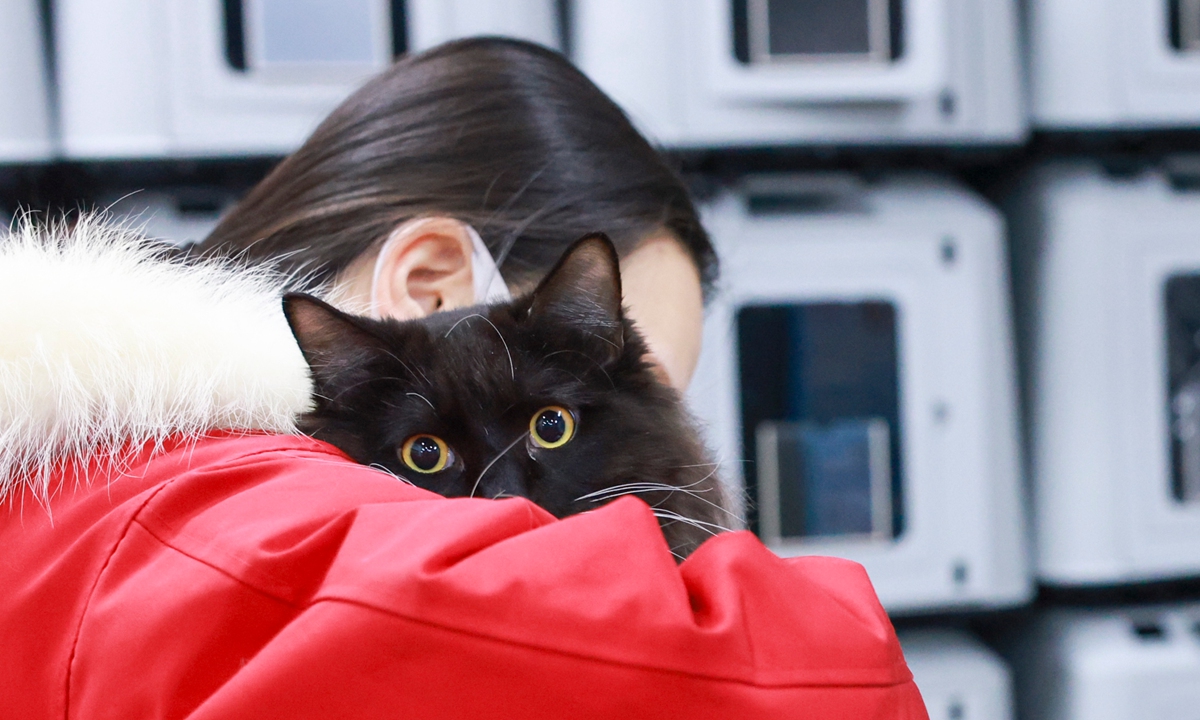
Photo: VCG
The Year of the Horse in 2026 marked an interesting scene in Beijing: The city's first-ever pet-themed temple fair drew waves of pet lovers and their four-legged companions. Here, working dogs paraded before admiring crowds, owners and their pets solved couplets together, and cultural creative products fused intangible heritage with modern pet aesthetics. Temple fair staples like handicrafts and lantern riddles melded seamlessly with the lively presence of cats and dogs. This was not just a novelty event; it was a harbinger of another facet of Chinese New Year.Qi Zong, a Beijing resident and owner of a corgi, spent a long time at the pet fair on the second day of the Spring Festival. While his pet dog was chasing and playing with other dogs, he also had a great time chatting with many dog owners. Qi told the Global Times that this was the first time that he experienced a pet-themed temple fair. Celebrating the festival in this way with his pet dog and being in such a large pet community gave him a unique sense of belonging.
Alongside this, the phenomenon of "traveling home with pets" has gone viral, with lots of Chinese netizens sharing videos on how they took their pets back to their hometowns on social media. Sales of specialty pet banquets and festive costumes soared, as families embraced their pets as full-fledged members at reunion dinners and in Chinese New Year's portraits.
In recent years, pets have become an indispensable part of life for a growing number of Chinese people. According to a 2026 report on China's pet industry, the population of urban pets (dogs and cats) reached 126 million in 2025. The pet economy is also emerging as a new growth point in China's Spring Festival consumer market. Data from one e-commerce platforms shows that transactions for pet clothing, grooming and hygiene products, and toys have increased year-on-year by 115.60 percent, 40.35 percent, and 18.51 percent, respectively, setting a record high for pet-related consumption.
Today, pet ownership is increasingly about emotional support. Many pets are now considered family members and serve as important emotional anchors, Ma Jianwen, a registered counselor of the China Association for Mental Health, pointed out. Beijing's pet-themed temple fair, coupled with the nationwide surge in pet reunion trends, are dynamic new stages for growing demand.
The explosive growth of New Year's pet-related products is the concrete manifestation of an "emotional necessity." From auspicious couplets themed around animals to gourmet pet banquets and matching human-pet outfits, each transaction is more than mere commerce; it is an act of emotional communication. The core of the Spring Festival has always been emotional connection, a time for expressing love, longing, and reunion. Yet the ways of expressing that bond have become more diverse. The popularity of products and experiences tailored for pets reflects the pursuit of a warmer, more individualized Spring Festival, one enriched by contemporary values of companionship and care.
By making space for new forms of celebration, new consumption habits, and new rituals, Chinese New Year is not losing its flavor, but rather, deepening its resonance. The participation of pets in festivals does not dilute the seriousness of tradition - it humanizes and vitalizes it, making the ancient festival not only a link with the past but a celebration rooted in the complexities of the present.
The author is a reporter with the Global Times. life@globaltimes.com.cn
RELATED ARTICLES