MOFCOM restricts exports to 40 Japanese entities over military ties; Move a stepped-up response to security policy shift in the country: experts
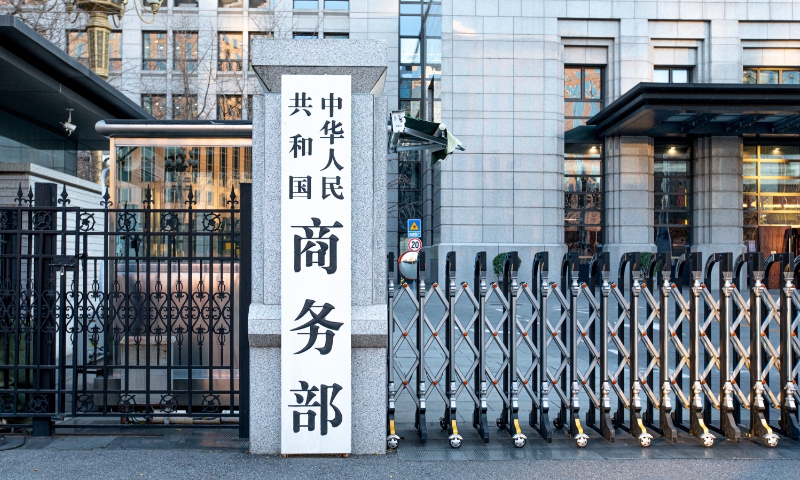
The Ministry of Commerce of China File photo: VCG
China on Tuesday put 40 Japanese entities, including Mitsubishi Heavy Industries Shipbuilding Co and SUBARU Corporation, on two lists in light of the growing trend of militarization in the country.
Announced on Tuesday, the first working day after the Chinese Spring Festival holidays, the measures are a strong manifestation of China's determination to keep Japan's militarism in check and safeguard its national interests and will precisely blunt the spearhead of Japan's remilitarization drive, Chinese analysts said.
China's Ministry of Commerce (MOFCOM) on Tuesday placed 20 Japanese entities, including multiple affiliates of Mitsubishi Corp, on its export control list, banning the export of dual-use items to them over their role in enhancing Japan's military capabilities.
The move takes immediate effect from Tuesday under China's Export Control Law and regulations on export control of dual-use items, to safeguard national security and interests and fulfill non-proliferation obligations. It requires exporters to halt shipments of dual-use goods - items with both civilian and military applications - to the listed entities and prohibits foreign organizations or individuals from transferring or providing Chinese-origin dual-use items to them, according to a statement published by MOFCOM on Tuesday.
Separately, on Tuesday, MOFCOM placed 20 Japanese entities, including SUBARU Corporation, Mitsubishi Materials Corporation and TDK Corporation, on a watch list after authorities said they were unable to verify the ultimate end users and end uses of exported dual-use items, according to a separate statement by the ministry.
Global Times reporters found that the 20 Japanese entities on the control list basically cover Japan's naval, ground, air and even space military capabilities, and that many of these companies are developing offensive weapons that pose a threat to peace and stability in East Asia.
Some analysts noted that the listing has severe consequences for the operation of related companies should it rely on Chinese supply chains for parts or inputs.
China's measures are aimed at curbing Japan's attempts at "remilitarization" and nuclearization, and are fully justified, reasonable and lawful, a MOFCOM spokesperson said.
A Chinese Foreign Ministry spokesperson said on Tuesday that China took these measures in accordance with laws and regulations. The purpose is to stop Japan's attempts to remilitarize itself and possess nuclear weapons. What China does is completely legitimate, justified and lawful, the spokesperson said.
A Bloomberg report on Tuesday noted that the MOFCOM's latest move marks the first time Japanese firms have been added to the Chinese export control list since its January 2025 debut.
The move follows a January 6 announcement by MOFCOM on the tightening of controls on dual-use items exports to Japan. Per the measures, organizations and individuals from any other country or region that in violation of the stipulations, transfer or provide dual-use items of Chinese origin to organizations or individuals in Japan, will be held legally accountable.
Severe warning
The Financial Times noted that the announcement by China's MOFCOM hit Japanese share prices, with MHI falling as much as 4.3 percent, Kawasaki Heavy shedding as much as 5.5 percent and IHI Group and NEC dropping more than 7 percent. Subaru lost 3 percent.
Japanese media The Sankei Shimbun noted that the move "marks China's strengthened countermeasures against the Takaichi administration."
Tokyo claimed that it has lodged a strong protest with China over listing the entities, and demanded its withdrawal, with Japan's deputy chief cabinet secretary Kei Sato claiming on Tuesday that the Chinese move is "absolutely intolerable and extremely regrettable," adding that the Japanese government will assess the possible impact and consider necessary responses.
A Chinese expert said the routine response just laid bare of the futileness of the Japanese government in face of China's righteous counterstrike.
Lü Chao, a professor at the Liaoning Academy of Social Sciences, told the Global Times on Tuesday that the fresh move by MOFCOM serves as a severe warning to Japan, in particular to the Japanese business community, of China's determination to safeguard its national interests and contain rising militarism and right-wing politics in the country.
Chen Zilei, Director of the Research Center for Japanese Economics at the Shanghai University of International Business and Economics, told the Global Times on Tuesday that the measures are a necessary, appropriate and lawful response to Japan's recent security policy shift and rhetoric, and they are aimed at preventing economic and technological links from fueling military expansion while firmly safeguarding China's national security and regional peace.
As a response to the Japanese government's recent repeated erroneous and dangerous remarks and actions, China's policies are targeted, rather than a blanket ban, Chen said.
The Japanese government has rolled out a series of security policy shifts, including attempting to revise the three national security documents, reviewing the country's long-standing Three Non-Nuclear Principles, and expanding defense production capacity.
According to Reuters on February 20, Takaichi claimed there is "growing Chinese coercion" in her first post-election speech to parliament on Friday, while pledging to overhaul Japan's defense strategy, ease curbs on military exports and strengthen critical supply chains.
In practical terms, Japan's moves go beyond a strictly defensive posture and point to a growing trend toward military expansion, Chen noted, stressing that such actions infringe on China's national security interests and threaten peace and stability in Asia, thereby justifying China's necessary and legitimate response.
Economic woes
According to the MOFCOM spokesperson, the measures announced on Tuesday are taken in accordance with the law, and target only a small number of Japanese entities and apply solely to dual-use items and do not affect normal China-Japan economic and trade exchanges. Japanese entities operating in good faith and in compliance with the law have no need to worry.
The latest restrictive measures from MOFCOM come as Japan's retail and tourism industry continues to feel the pain from the current political tensions.
Kyodo News, citing data from the Japan's National Tourism Organization, reported that the estimated number of visitors from Chinese mainland to Japan plunged 60.7 percent year-on-year, to 385,300 visits. The number of foreign visitors to Japan in January was down 4.9 percent from a year earlier, marking the first year-on-year decline for the month in four years as Chinese tourists stayed away, according to Xinhua.
With the Japanese government showing no repentance or willingness to retract its erroneous remarks on China's Taiwan region by its leader, and even with growing boldness in militarism and radical political endeavors and engaging in increasingly aggressive provocations against China, Lü said that more economic sectors of Japan could start to feel the growing pinch as a result of the erroneous actions of certain Japanese politicians.
RELATED ARTICLES