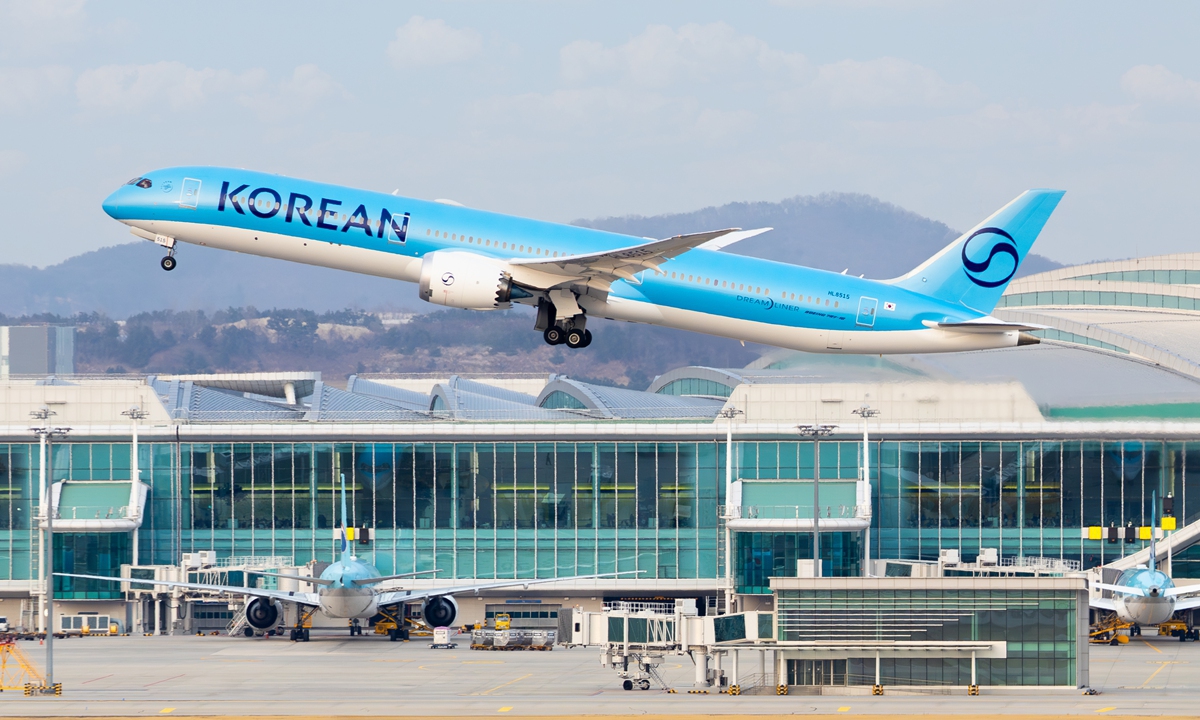
Photo: Courtesy of Korean Air
Jeju Air said that it will expand its China routes by operating the Incheon-Yichang route and Daegu-Guilin route starting in April, the Yonhap News Agency reported on Monday. The airline also decided to resume the Incheon-Shijiazhuang, Busan-Shijiazhuang, Jeju-Beijing, and Incheon-Guilin routes next month.
This move follows Asiana Airlines' earlier decision to expand its China network by adding 28 weekly flights during the summer schedule, a 20 percent increase from the winter schedule.
Since the frequency of personnel exchanges directly shapes the dynamics of cooperation in areas such as the economy, trade, and culture, these decisions by South Korean airlines represent more than just a business response to rising demand. They reflect deepening China-South Korea economic ties and signal both sides' commitment to greater cooperation and personnel exchanges.
The sharp increase in passenger volume on Jeju Air's China routes offers compelling evidence of this growing potential for cross-border engagement. The airline saw its passenger count climb from about 305,000 in 2023 to 573,000 last year.
In recent months, the visa exemption policies of China and South Korea have sparked strong enthusiasm among people for cross-border tourism and business trips and provided strong support for airlines to expand their services. According to statistics from South Korea's Ministry of Justice, bilateral personnel exchanges exceeded 7.28 million visits in the first 11 months of 2025, up 24.7 percent year-on-year, reflecting a strong recovery in mutual visits, the Xinhua News Agency reported. As the visa exemption policies continue to take effect, demand for cooperation in the economy, trade, culture and other sectors is expected to expand further, unlocking greater development potential for bilateral ties.
The airlines' expansion of China routes is not just a bet on tourist traffic but also an investment in a profound trend of China-South Korea economic integration. As China remains South Korea's largest trading partner, with bilateral trade consistently exceeding $300 billion annually, and South Korea maintains its position among China's key trade partners, the two nations' industrial complementarity has become increasingly pronounced. From traditional manufacturing and agricultural trade to cutting-edge fields such as new energy and the digital economy, collaboration opportunities continue to expand. Business executives need to discuss deals, technicians need to solve on-site production questions, and researchers need to collaborate on joint ventures. As South Korean companies expand their investment into China's digital and green economies, and as collaboration in finance and services deepens, the demand for people-to-people exchanges becomes a necessity.
Looking deeper, this positive trend underscores a certain resilience in the bilateral relationship. Despite a complex international and regional landscape, geographical proximity and economic complementarity make the two countries permanent, inseparable neighbors. Strong economic and trade bonds, deeply integrated industrial and supply chains, and solid people-to-people exchanges constitute the fundamental ties that underpin the steady growth of bilateral relations, driven by market forces and people's livelihood needs.
Furthermore, government policies have played a crucial complementary role in nurturing this momentum. Beyond visa exemptions, mechanisms for economic dialogue and other institutional frameworks continue to remove barriers and lower the costs of cooperation. This synergy between policy guidance and market demand ensures that the enthusiasm for people-to-people exchanges translates into deeper economic cooperation, while creating a predictable environment for business planning. South Korean carriers' optimistic projections for sustained passenger growth stem directly from the tangible policy dividends and promising market outlook of China-South Korea collaboration.
With the continuous advancement of these policies, exchanges and cooperation between the two countries in tourism, the economy, trade, culture, and science and technology will surely expand in scope, depth and quality, fostering a more comprehensive, mutually beneficial development pattern for China-South Korea relations.
RELATED ARTICLES