GT Voice: Increase of trade in electrical, mechanical items reflects China-SK complementarity
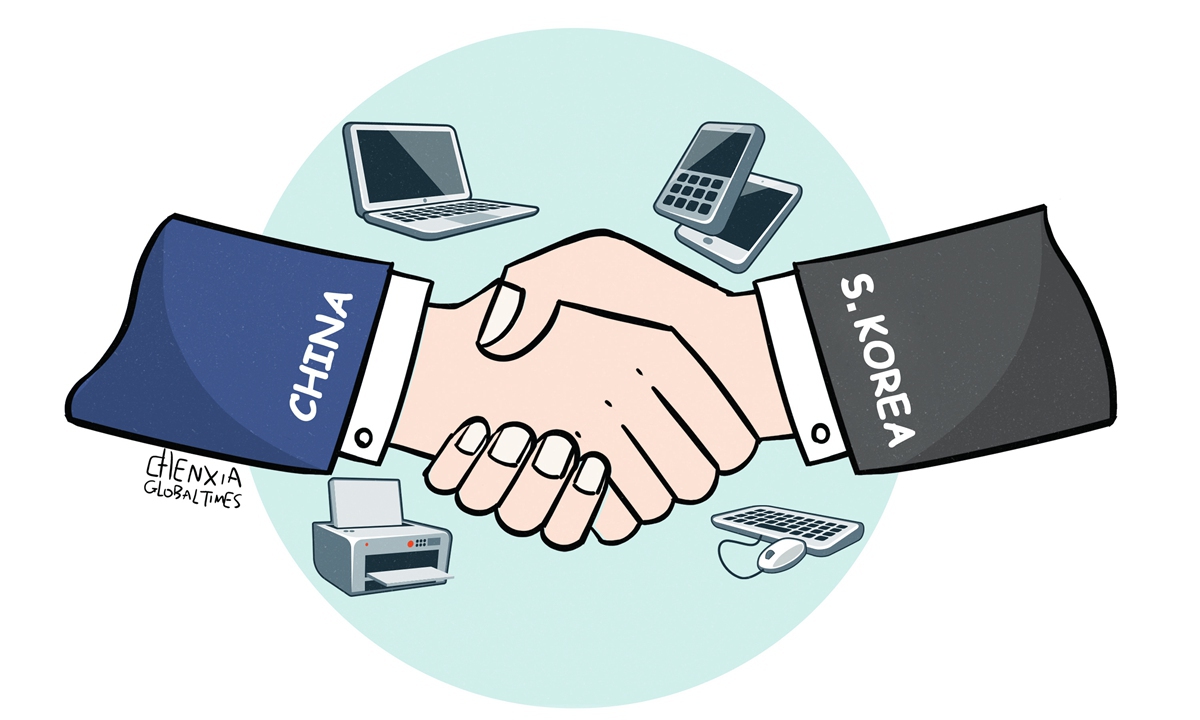
Illustration: Chen Xia/GT
Mechanical and electrical products have emerged as key drivers of trade growth between China and South Korea. In the first 11 months of 2025, bilateral trade of these items reached 1.43 trillion yuan ($204.8 billion), up 5.9 percent year-on-year, and this segment constituted 67 percent of total bilateral trade, up 2.7 percentage points year-on-year, data from China's General Administration of Customs showed on Sunday.Specifically, China's imports of electronic components from South Korea grew by 9.9 percent, with imports of computer parts up by 7.4 percent. China's exports of electronic components to South Korea jumped 10 percent, while those of auto parts rose by 8.9 percent.
As an important component of industrial manufacturing, mechanical and electrical products are widely used in key areas such as semiconductors, auto parts, and consumer electronics. The continuous expansion of this trade reflects the high degree of complementarity between China's and South Korea's industrial chain structures.
China boasts the world's most complete industrial system as well as a super-large market, while South Korea possesses leading technological and brand advantages in semiconductors, display panels, high-end chemicals, and precision manufacturing. This complementarity has fostered robust industrial partnerships, enabling both sides to jointly produce competitive end products for the global market.
The fact that mechanical and electrical trade now accounts for 67 percent of bilateral trade clearly indicates that industrial collaboration has become the central pillar of economic relations, signaling an unprecedented level of interdependence.
The concrete actions of South Korea's business community also reflect importance it attaches to this close economic bond. This week, more than 200 South Korean business leaders have joined an economic delegation accompanying South Korean President Lee Jae-myung on his visit to China, the Yonhap News Agency reported. This underscores a strong consensus and urgent expectation within South Korea's economic circles to deepen cooperation with China, expand their market presence, and solidify industrial chain collaboration.
What makes this development particularly noteworthy is that it comes amid a complex and volatile global economic environment, where rising protectionism and geopolitical tensions pose serious challenges to highly globalized supply chains. Nevertheless, China-South Korea trade in mechanical and electrical products has bucked the trend, achieving a "double increase" in both scale and proportion, highlighting the strong resilience of the two countries' industrial and supply chains.
This resilience stems from several key sources of support. First, China, as one of the world's largest consumer markets, provides steady growth momentum for South Korean companies through its continuously upgrading demand.
Second, the two economies have developed deeply intertwined supply chains in critical technological fields, from semiconductors to new-energy vehicle batteries, creating a mutually dependent industrial ecosystem.
Third, regional cooperation frameworks such as the Regional Comprehensive Economic Partnership and China-South Korea free trade agreement continue to deliver benefits, including zero tariffs on most goods traded between the two sides, further facilitating cross-border industrial cooperation.
Moreover, the steady growth in mechanical and electrical trade is serving as a vital foundation for China and South Korea to expand their collaboration into emerging fields, promoting the extension of bilateral cooperation from traditional sectors to joint innovation in the high-end value chain.
As an essential part of high-tech, high-value-added supply chains, the deepening of mechanical and electrical cooperation has naturally driven the linkage between the two countries in cutting-edge fields such as the green economy, the digital economy, and intelligent manufacturing.
For example, in the field of the green economy, China and South Korea have made solid progress in cooperation in electric vehicles, hydrogen energy, energy conservation, and environmental protection. In 2023, Hyundai Motor Group completed its first overseas hydrogen fuel cell system production base in Guangzhou and signed a number of cooperation agreements with Chinese partners, demonstrating tangible alignment and complementary strengths in green innovation.
Such progress illustrates how trade in mechanical and electrical products can catalyze broader technological collaboration, with further potential expected to be unlocked as both nations advance in industrial upgrading and innovation.
By continuing to leverage their structural complementarity, deepening institutional cooperation, and jointly pursuing innovation in new industries, both countries are poised to reap mutual benefits for their businesses while contributing to greater stability and prosperity in the region.
RELATED ARTICLES