USFK denies apologizing to ROK authorities over Yellow Sea standoff, refutes Seoul’s claim; incident reflects fundamental differences between the two sides: Chinese expert
By Published: Feb 25, 2026 05:19 PM

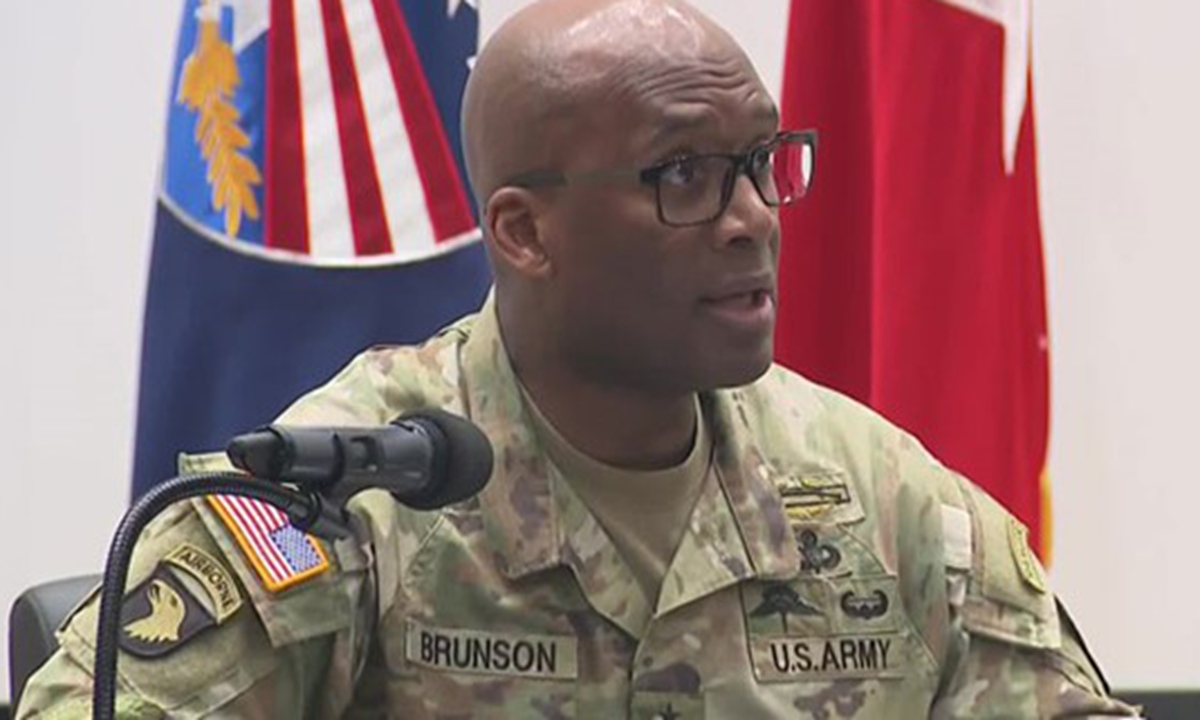
Xavier Brunson, Commander of USFK Photo: screenshot from Yonhap News
The United States Forces Korea (USFK) had reportedly strongly refuted claims by South Korean military authorities that Commander Xavier Brunson had apologized to the South Korean government, instead only expressing "regret" over a recent aerial exercise above the Yellow Sea that resulted in a standoff with Chinese fighter jets, in a statement that South Korean media noted was unusually released in the middle of the night on Tuesday. Earlier, some South Korean media had reported that the USFK had apologized to Seoul over the issue.
The rift reflects frictions as the US prioritizes its own interests while sidelining South Korea's security concerns, said Chinese experts. Instead of miscommunication, the incident reflects fundamental differences between the two sides over strategic interests, alliance ties, and how to characterize the situation.
"Commander Xavier Brunson directly communicated with Defense Minister Ahn Gyu-back to reconfirm that prior notification had been provided to the South Korean side regarding the incident," USFK claimed in a statement. It added, "However, we expressed regret over the failure to report the matter in a timely manner to the Defense Minister and the JCS Chairman." This is interpreted as USFK asserting that it had notified South Korean military authorities in advance about the training plan, according to a report from the Chosun Daily on Wednesday.
The report also noted that the statement was released late on Tuesday and that "It is unusual for USFK to issue a statement in the middle of the night."
A Yonhap News report on Wednesday noted that the statement also claimed it was "regular training" aiming to maintain so-called "highest level of readiness," and "We don't make apologies for maintaining readiness," per report.
Previously, the Global Times learned from sources that the US military recently organized aircraft to conduct activities in the airspace facing China over the Yellow Sea. The Chinese People's Liberation Army (PLA), in accordance with laws and regulations, organized naval and air forces to conduct monitoring and alerting throughout the entire process, and effectively responded to and handled the situation.
According to the Chosun Daily, the USFK conducted a large-scale exercise from the February 18 to 19, dispatching F-16 fighter jets from Osan Air Base. At the time, Chinese fighter jets responded, leading to a temporary standoff between US and Chinese aircraft.
Following the incident, South Korean Defense Minister Ahn reportedly lodged a complaint in a call with Brunson on February 19 over the failure to share details of the exercise with South Korean authorities in advance. The incident led the US military to end the exercise on Thursday, earlier than the planned end on Saturday, per Yonhap.
Subsequent reports from some South Korean media claimed that Commander Brunson had apologized to South Korea over the USFK's air exercise. Korea JoongAng Daily on Tuesday reported that the commander of USFK has delivered an apology to Seoul.
The contradicting statements between the US and South Korea over the incident underscores the frictions with Washington's pursuit of its so-called "Indo-Pacific" strategy in ways that prioritize US interests over South Korea's own security concerns, heightening the risk that South Korea could be drawn into broader regional confrontations, Lü Chao, a professor at the Liaoning Academy of Social Sciences, told the Global Times on Wednesday.
By acting without prior notification on a major issue, USFK placed South Korea in an awkward diplomatic position and a risky strategic situation. Such a vague expression of "regret" cannot resolve the problem, either legally or in terms of alliance relations, said the expert.
Song Zhongping, a Chinese military affairs analyst, said, "The US has treated South Korea's military and air defense identification zones as its own, revealing a hegemonic mindset. That is why Washington felt no need to apologize."
Since South Korea cannot place effective constraints on US forces through agreements, similar incidents are feared to recur, he said. Clearer boundaries on where US drills are conducted are needed to avoid friction, but the fact that US forces operate beyond South Korean control reflects arrogance, the expert added.
In an editorial released on Tuesday, South Korea media outlet The Hankyoreh wrote that this incident represents a clear "military provocation" by USFK, deliberately stimulating China without any proper prior communication with South Korea.
It said this is absolutely not something that can or should be resolved with a one-time protest. If the "strategic flexibility" that the US seeks for USFK is this aggressive and reckless, South Korea can never accept it.
RELATED ARTICLES