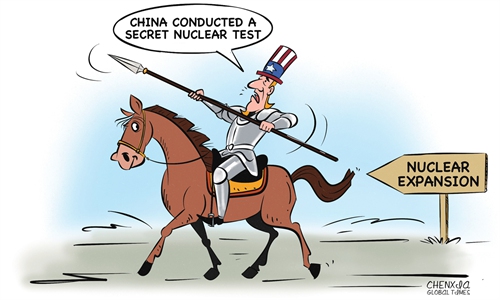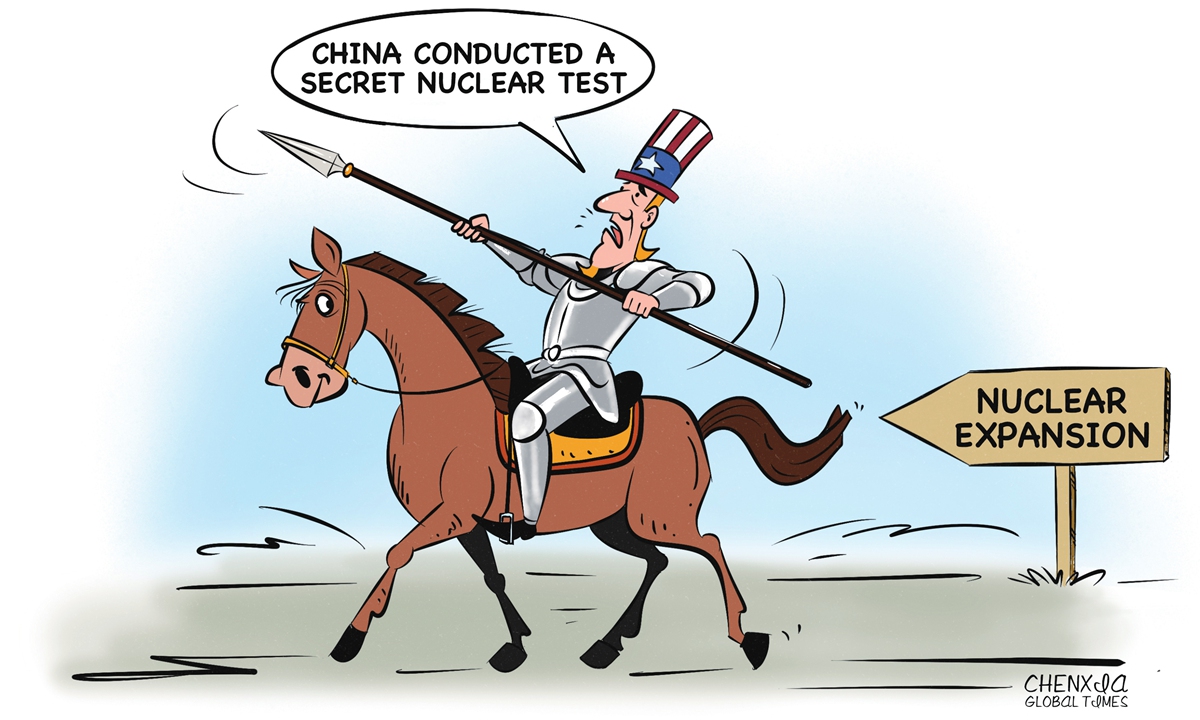
Illustration: Chen Xia/GT
The expiration of the New Strategic Arms Reduction Treaty (New START) on February 5, 2026, has ushered in a dangerous new phase in global nuclear stability. With no renewal or replacement in place, the last legally binding framework that has limited the strategic arsenals of the world's two largest nuclear powers is now void — a fact underscored by Moscow's February 4 announcement that it no longer considers itself bound by the treaty's obligations. In response, the US has chosen to deflect responsibility by pressuring China to join trilateral arms control talks. This approach is not only misguided — it escalates risk at a time when transparency and dialogue are urgently needed.A misplaced focus on China
US officials consistently argue for China's inclusion in a trilateral arms control framework. Yet numbers tell a different story. According to the Stockholm International Peace Research Institute (SIPRI), the US and Russia together possess almost 90 percent of all nuclear warheads. China's nuclear arsenal is by no means at the same level as that of the US or Russia. Demanding that a state with a fraction of the nuclear holdings participate in "equal" negotiations distorts the very principle of proportionate responsibility that should underpin disarmament efforts.
Divergent doctrines tell the true story
This is more than just a number game. Beyond warhead counts, nuclear doctrine reveals a fundamental divide. China remains the only nuclear-weapon state to maintain a consistent no-first-use policy, with no tactical nuclear weapons, overseas deployments, or nuclear alliances. Its stance is defensive by design and transparent in intent.
By contrast, Washington stations an estimated 100 B61 tactical nuclear bombs in five NATO nations under "nuclear sharing" arrangements. It is modernizing all three legs of its nuclear triad, including the development of low-yield W76-2 warheads designed for limited nuclear strikes. The US 2022 Nuclear Posture Review further lowers the threshold for nuclear use by reserving the right to respond with nuclear weapons to non-nuclear attacks.
Credibility crisis ahead of the NPT review
The upcoming Nuclear Non-Proliferation Treaty (NPT) Review Conference in April 2026 will convene amid a crisis of credibility. Yet US actions continue to undermine its non-proliferation credibility. The lapse of New START, compounded by US "nuclear sharing" arrangements — a practice long criticized as contravening the NPT's spirit — further weakens the global non-proliferation regime. Effective arms control cannot be advanced while the foundational principles are undermined.
The way forward: responsibility before unilateralism
As UN Secretary-General António Guterres rightly warned, the lapse of New START represents a "grave moment for international peace and security." Instead of scapegoating China, the US should lead by example, respond positively to Russia's proposal and work with Russia on the follow-up arrangement after the expiration of New START. Nuclear risk reduction must begin with the two largest nuclear powers — not with political theater that ignores strategic reality.
The author is a commentator on international and multilateral affairs, writing regularly for Xinhua News Agency, Global Times, China Daily, CGTN, etc. She can be reached at gesheng1213@gmail.com
RELATED ARTICLES