China pushes back against smears over Ukraine crisis, reiterates its position on calling for ceasefire, promoting peace talks as conflict enters fifth year
By Published: Feb 25, 2026 10:08 PM
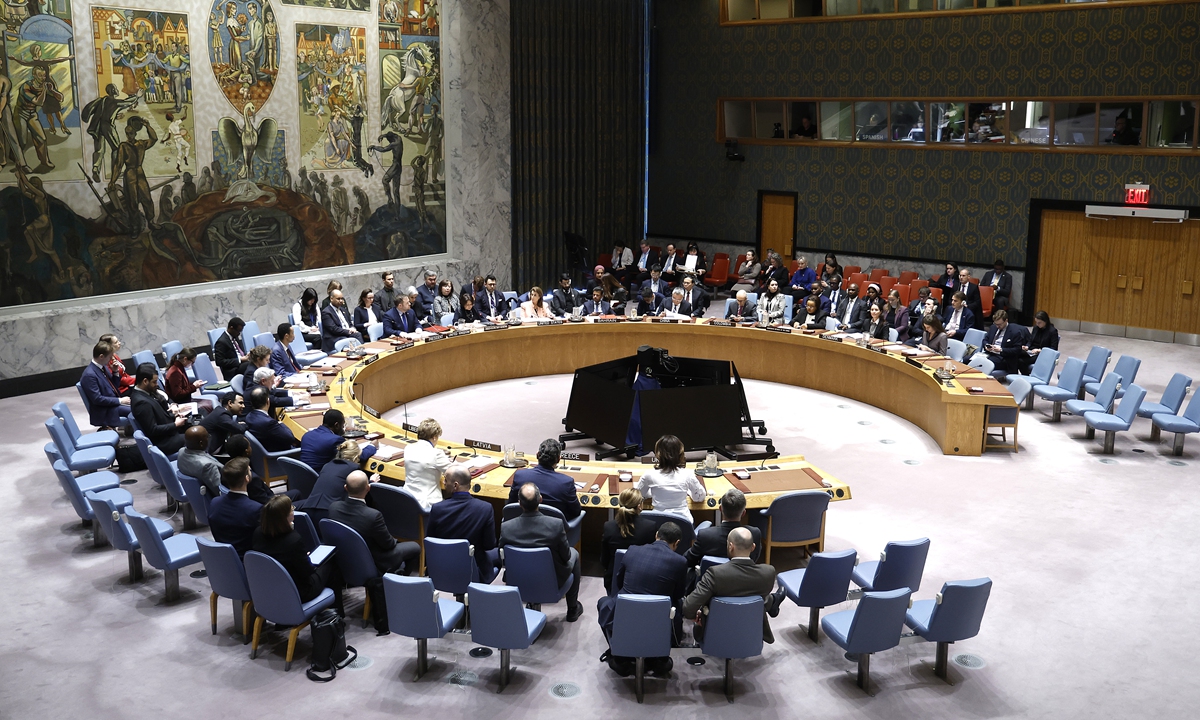
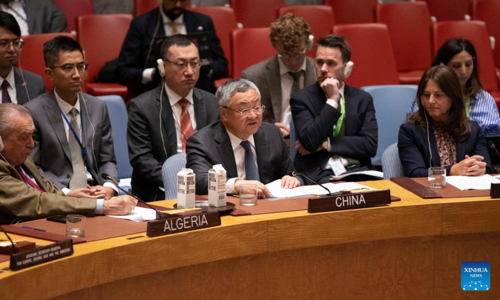
Delegates attend the UN Security Council on February 24, 2026 in New York City, speaking on the Ukraine crisis as the military conflict enters its fifth year. Photo: VCG
China's position on the Ukraine issue has been open, clear and consistent - calling for a ceasefire, an end to hostilities, and the promotion of peace talks and dialogue, and the US smearing of China's stance aims to provoke bloc confrontation and create division and antagonism, China's Permanent Representative to the UN Fu Cong said at a UN Security Council meeting on Tuesday as he pushed back against accusations from the US.
The remarks came as the US and some Western governments intensified criticism of China over the Russia-Ukraine conflict ahead of its fourth anniversary, bringing the issue back into sharp international focus. Chinese diplomats have repeatedly pushed back, issuing pointed rebuttals.
Speaking at the meeting held by the UN on Tuesday, Fu said China has not provided lethal weapons to any party to the conflict and has consistently exercised strict controls over the export of dual-use items.
Fu's remarks came after Tammy Bruce, the US deputy UN envoy said at the UN session that "China remains a decisive enabler of Russia's war machine." "If China truly wants peace, it should immediately end exports of dual-use goods and stop purchasing Russian oil," Bruce said, according to Reuters.
Fu said that as a major global producer, trading nation, and consumer, China maintains normal economic and trade relations with Russia, Ukraine, Europe, and the US. These exchanges follow market and commercial principles, do not violate UN Security Council resolutions, and are legitimate and beyond reproach. China will safeguard its energy security based on its national interests.
Fu stressed that the US has on various occasions fabricated excuses and spread falsehoods to attack and smear China. This is blatant political manipulation aimed at provoking bloc confrontation and creating division.
China once again urges the US to stop shifting blame, deflecting responsibility, and creating conflicts and wars around the world, said Fu.
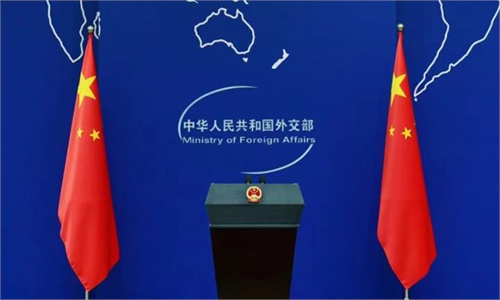
Also on Wednesday, in response to the UK government's expansion of its sanctions list against Russia to add around 250 individuals and companies, including legal entities from China and the UAE, Chinese Foreign Ministry spokesperson Mao Ning said at a regular press conference that China opposes unilateral sanctions that have no basis in international law or authorization of the UN Security Council. China strongly deplores relevant moves of the UK side.
Mao noted that on the Ukraine crisis, China has all along promoted talks for peace and strictly controlled the export of dual-use articles. The normal exchanges and cooperation between China and Russia should not be disrupted or affected. China will do what is necessary to firmly defend its legitimate and lawful rights and interests.
On Monday, when asked to comment on the report that the US Ambassador to NATO said that a call from China could end the Ukraine crisis and that "this war is being completely enabled by China,'' Lin Jian, spokesperson for China's Ministry of Foreign Affairs, said that China did not create the Ukraine crisis, nor is China a party to it.
We stand on the side of peace and dialogue and promote the political settlement of the crisis. China's objective and just stance is widely recognized by the international community, said Lin, noting that the so-called "enabling the war" is nothing but a groundless accusation.
China has consistently advocated for cease-fire, de-escalation, and a political settlement through dialogue and negotiation. However, as the conflict continues, some countries have persistently supplied weapons and military support to the battlefield, prolonging the duration of hostilities. Under such circumstances, diplomatic efforts alone cannot produce immediate results, Yang Jin, an associate research fellow with the Institute of Russian, Eastern European and Central Asian Studies at the Chinese Academy of Social Sciences, told the Global Times.
Commenting on claims by the Russian Foreign Intelligence Service that the UK and France are preparing to transfer nuclear weapons to Kiev, because they believe Ukraine should be supplied with an atomic or at least a "dirty" bomb to claim more favorable conditions for the end of the conflict, Chinese Foreign Ministry spokesperson Mao Ning said on Wednesday that she is not familiar with the specifics. "China always believes that nuclear weapons must not be used, a nuclear war must not be fought, and international non-proliferation obligations should be earnestly observed," she said.
What's changed, what's not
As the conflict entered its fifth year on Tuesday, international media has focused on how much has changed during the war and how the war has changed the world.
The New York Times published an article on Tuesday noting "same war, different message: Trump tonight vs. Biden four years ago," and compared the level of support for Ukraine between the two administrations.
CNN in an article also highlighted the change of the transatlantic relationship, "The NATO alliance, and security on the continent, was founded on the promise the US would, ultimately, again, defend Europe."
"However fast the Trump White House seeks to erase that assurance, Europe remains slow to pick up the slack. Centrist leaders in the UK, France and Germany resist spending a larger percentage of their strained budgets defending against a Russian threat that their far-right populist opponents might think can be easily negotiated away," according to CNN.
Kremlin Spokesman Dmitry Peskov said on Tuesday that Russia and Russians have changed profoundly over the past four years in terms of consolidation and the "maturing of society," in response to journalists' questions about how the country has changed since February 2022, per Tass.
Marking the anniversary, Ukraine President Volodymyr Zelensky said Vladimir Putin "has not achieved his goals," and that Ukraine will do "everything to achieve peace and justice," according to the BBC.
Bloomberg said in a report that US President Donald Trump's efforts to end the conflict "are stalling with peace talks deadlocked and the fighting largely at a stalemate after four years of war."
"There is no indication that Russian President Vladimir Putin is ready to reach an agreement that does not grant his central demands, according to senior European and NATO officials," according to the report.
As the conflict enters its fifth year, much has changed - including multipolarity is no longer merely a trend but a reality; major power consultation and strategic competition are playing an increasingly prominent role; as realism and pragmatism are on the rise, Europe's relationship with the US, the leadership in Washington and the level of American support for Ukraine have all changed. Yet there are things that remain constant: international law and international norms remain an important foundation of international relations, and the "law of the jungle" has not become the dominant principle governing international relations, said Zhang Hong, a research fellow at the Institute of Russian, Eastern European and Central Asian Studies at the Chinese Academy of Social Sciences.
Another thing that has remained unchanged is Western smear of China, said Zhang, noting that when the peace prospects still remain dim after four years, blaming China for the conflict is, in itself, a reversal of cause and effect.
RELATED ARTICLES