Chinese tourists shift to Southeast Asia, ROK for Spring Festival, sidelining Japan: travel agencies
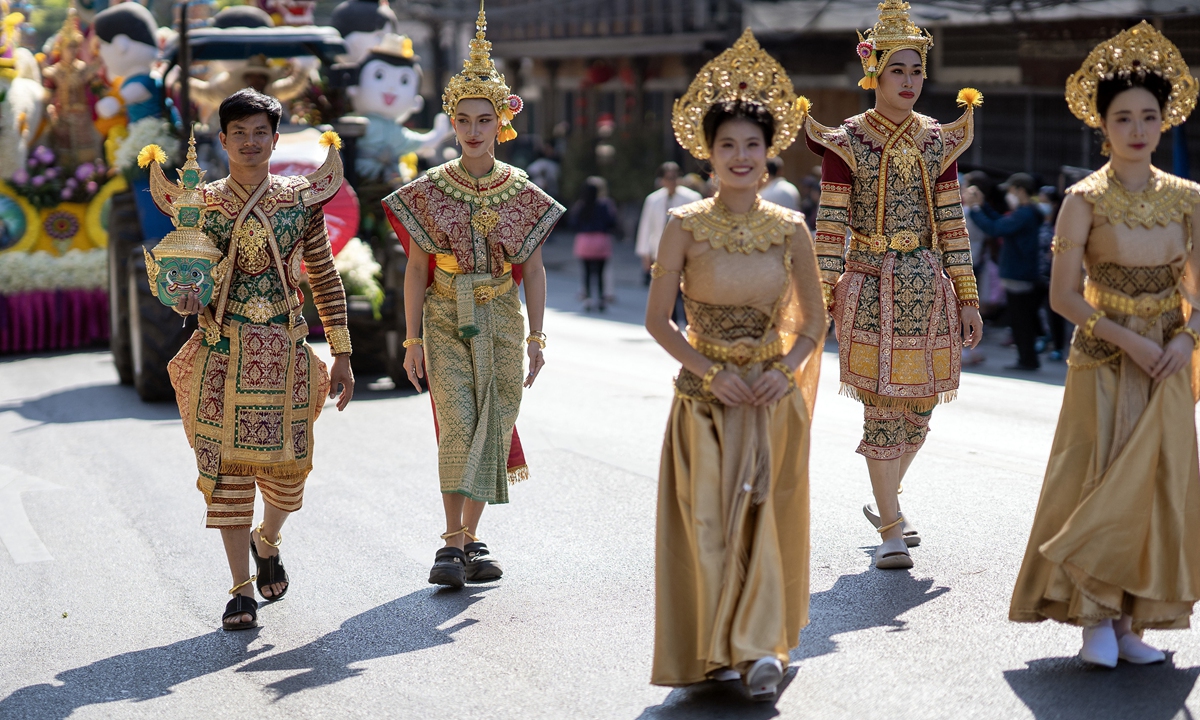
Participants wearing traditional Thai costumes walk in the floral parade during the 49th Chiang Mai Flower Festival parade in Chiang Mai on February 14, 2026. The annual festival features colorful street parade, cultural performances, and elaborate floral displays, drawing large numbers of residents and tourists to the city. Photo: VCG
Southeast Asia emerged as a favored destination for Chinese tourists during this year's Spring Festival holiday, drawing substantial visitor flows diverted from Japan, several travel agencies told the Global Times on Wednesday, after reports said that Japan had lost about 50 percent of its Chinese arrivals.
Chinese outbound travel to Thailand during this year's Spring Festival holiday posted robust growth, with visitor numbers rising by at least 20 percent from a year earlier, according to Wang He, CEO of Fly Elephant, an overseas travel agency based in Singapore that focuses on outbound tours to Thailand, Singapore and other regional destinations.
Wang said that the rebound was evident both in the company's tour groups and at major tourist attractions. "From the size of our groups to the actual footfall at scenic spots, the increase is very clear," he noted. He attributed the surge primarily to the continued recovery of the Chinese outbound tourism market, coupled with relatively affordable airfares.
Shifting preferences among Chinese tourists also played a role. Based on their clients' feedback, some travelers who previously favored Japan opted for alternative destinations this year, driving up bookings to Southeast Asia and South Korea. "We've seen a noticeable rise in Chinese visitors not only to Thailand, but also to Singapore and Malaysia."
Chinese tourism to Japan plunges 50 percent over this year's Spring Festival holiday, the South China Morning Post reported on Tuesday. While the Southeast Asian nation saw roughly 250,000 arrivals from China during the holiday, which ran from February 15 to 23, according to the travel marketing and technology firm China Trading Desk, the report said.
"Concerns over potential political gatherings were one of the factors I considered. I would rather spend my holiday in destinations where policies are stable and the overall climate is more welcoming," Zhang Jianrong, 25, who traveled to Busan, South Korea, during the 2026 Spring Festival holiday, told the Global Times on Wednesday.
Another international travel agency also reported declining bookings to Japan, while Southeast Asian destinations emerged as clear Spring Festival winners.
"Departures to other Southeast Asian destinations all recorded growth during the holiday," Guan Jian, spokesperson of GZL International Travel Service, told the Global Times. Vietnam, Indonesia, and our Singapore-Malaysia combined routes saw pronounced increases, with growth rates exceeding 100 percent, Guan said.
By contrast, travel to Japan continued to decline, according to data compiled by the agency, with group tours in particular having almost entirely ceased, Guan said.
Industry observers interviewed by the Global Times attributed the shift largely to a more stable and welcoming tourism environment, describing it as a "two-way embrace" between destinations and travelers.
Proximity has also played a role. Southeast Asian countries, often categorized within a "four-hour flight circle," have benefited from the convenience of short-haul travel, according to a statement from the travel platform Fliggy sent to the Global Times.
Several mid- to long-haul destinations — including Oman, Kazakhstan, South Africa, Qatar and Argentina — maintained rapid growth during the Spring Festival holiday, with outbound orders to these markets more than doubling year-on-year, Fliggy said.
Meanwhile, another travel platform Qunar said that Chinese tourists flew to nearly 1,000 cities worldwide through the platform from February 15 to 23. The most popular outbound destination cities were mostly in Asia, favored for their short distances, visa-friendly policies, and pleasant temperatures, making them ideal for family trips.
The Global Times reported earlier that during the first week of the 2026 Spring Festival travel rush from February 2 to 8, the number of flights on China-Japan routes dropped by 1,292 compared with the same period last year, a year-on-year decrease of 49.2 percent, per Flight Master.
The number of foreign visitors to Japan in January was down 4.9 percent from a year earlier, marking the first year-on-year decline for the month in four years as Chinese tourists stayed away, the Xinhua News Agency reported on February 18.
According to the Japan National Tourism Organization, the latest figure marked the first time since January 2022 that the monthly total dropped below the level of the same month in the previous year.
RELATED ARTICLES