The term ‘post-Dalai era’ is a fallacious blend of semantic logic and legal implications
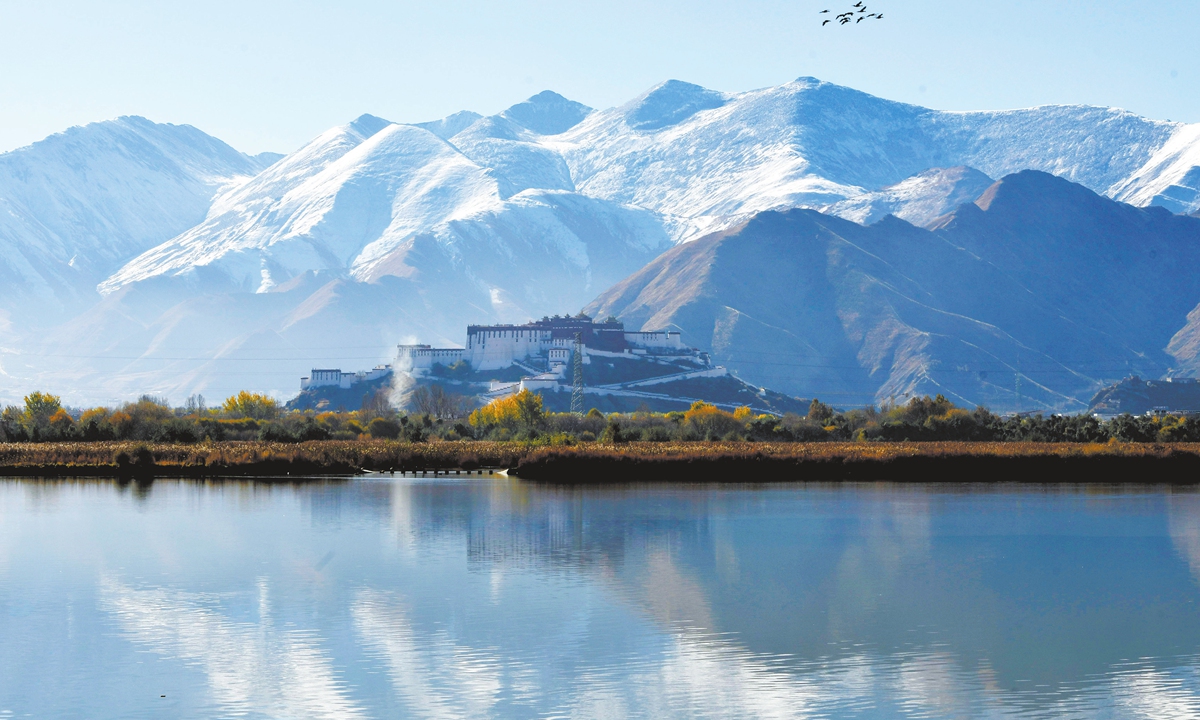
A view of the Lhalu wetland and Potala Palace in Lhasa, Southwest China's Xizang Autonomous Region. Photo: VCG
In recent years, when discussing China's governance of Xizang-related affairs, some Western media outlets often intersect issues concerning the health of the 14th Dalai Lama, extending the topic to a political or societal landscape involving Xizang "without the Dalai Lama." Such narratives deliberately ignore the historical and legal fact that "Dalai Lama" is a traditional religious title created, held and authoritatively conferred by China's central government over a long historical period. By using the individual semantic reference of the 14th Dalai Lama to obscure the historical semantics and legal implications of the "Dalai Lama," they repeatedly and artificially manufacture notions such as a "post-Dalai era" or similar fallacious expressions. In doing so, they distort China's comprehensive legal system concerning Xizang-related affairs and, in practice, perpetuate historical misunderstandings and factual misjudgments worldwide regarding China's governance of Xizang.
"Dalai Lama" represents a convergence of historical semantics and legal meaning, grounded in the legal authority and sovereignty of China's central government.
From a historical perspective, in 1653, the Qing Dynasty government conferred upon the fifth Dalai Lama, Ngawang Lobsang Gyatso, the title "the Dalai Lama, Overseer of the Buddhist Faith on Earth under the Great Benevolent Self-subsisting Buddha of the Western Paradise." Thus, "Dalai Lama" officially became the exclusive title of this reincarnation system. From then on, it became customary for each successive Dalai Lama to be officially confirmed by the central government after reincarnation.
Within the broader trajectory of China's political evolution, China has consistently embodied the continuity of its central government. Accordingly, as a title created and conferred by China's central government, all legal authority associated with "Dalai Lama" belongs, without question, to the central government - past, present and future.
The Western media's use of the term "post-Dalai era" is aligned with the political positioning of Xizang separatist forces. The phrase "post-Dalai era" carries two main implications: First, it refers to the stage when the 14th Dalai Lama is in his late years or when serious concerns arise about his health, during which "Xizang independence" forces prepare for a transition of central power, aiming to maintain the stability and ongoing operations of these separatist movements; second, it specifically pertains to the period following the 14th Dalai Lama's death, with a focus on ensuring the continuity and global activities of such separatist forces.
The danger of using the term "post-Dalai era" lies in the following: First, it is a construct centered on the discourse of the "Xizang independence" forces. It replaces the legal concept of the "Dalai Lama" under Chinese law with the specific individual 14th Dalai Lama, thereby obscuring the fact that the conferral of the title "Dalai Lama" must be authoritatively granted by China's central government. Second, the unreflective use of "post-Dalai era" may inadvertently satisfy anti-China forces seeking to elevate and memorialize a specific individual. This could lead to moral recognition of any potentially unlawful attempts by separatist forces to fabricate succession, facilitating the provision of "legal grounds" for various anti-China forces to attack China on international political platforms.
The term "post-Dalai era" is not a normative concept consistent with China's policy orientation or the legal framework governing Xizang-related affairs. One of the successes of China's governance of Xizang lies in the formal consistency of terminology used in laws and policies. While the passing of any Dalai Lama inevitably results in an interim period during the search for, identification and enthronement of a successor, history shows that China's central government has ultimately and prudently ensured the proper succession of the reincarnation lineage.
The concocted term "post-Dalai era" is neither a mathematical demarcation of a person's lifespan or influence, nor a simple judgment regarding religious succession. Rather, it is an attempt by certain forces to exploit semantic divisions and conceptual ambiguities in China's Xizang-related legal terminology for political maneuvers. The uncritical adoption of this term may empower destabilizing forces behind the scenes. Advancing the law-based governance in Xizang to a higher level requires greater discernment toward internationally contentious and ambiguous references to Xizang-related affairs, ensuring that current policies and concepts remain integrated within a coherent and complete Chinese legal framework.
The author is first-level inspector of relevant national foreign-related departments and investigator of global criminal justice issues. opinion@globaltimes.com.cn
RELATED ARTICLES