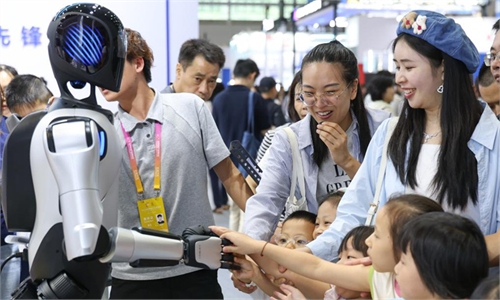
Humanoid robots perform at the 2025 World Robot Conference (WRC) in Beijing, capital of China, Aug. 11, 2025. (Xinhua/Ju Huanzong)
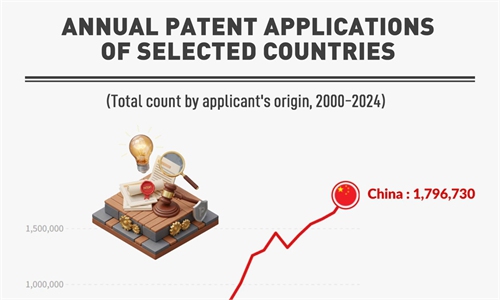
Data released by China National Intellectual Property Administration (CNIPA) showed that China's valid invention patents have reached 5.32 million, making it the first country to surpass the 5 million mark, the People's Daily reported on Thursday.
According to the CNIPA, the number of active invention patents in China kept growing during the 14th Five-Year Plan period (2021-25), equivalent to 16 high-value invention patents per 10,000 people. As of the end of 2025, China's invention patent filings had led the world for many consecutive years, solidifying its position as a major patent filing country, the newspaper reported.
The figures indicate that China is moving from being a major intellectual property (IP) owner to becoming an IP power, Wang Peng, an associate research fellow at the Beijing Academy of Social Sciences, told the Global Times on Thursday.
Notably, China's rise in terms of patents has accelerated: it took 31 years for the country to reach its first 1 million valid invention patents at home, while it reached 5 million in roughly 19 months, according to the CNIPA.
This trend signals a structural shift in China's economic structure and innovation ecosystem, from early patent accumulation driven by scale and speed to a stage focused on quality, application value, and breakthroughs in core technologies. The change has been propelled by sustained increases in research and development spending and vibrant innovation by firms and universities. It also reflects strengthened IP protection and a broader shift from quantity to quality in innovation, Wang noted.
The administration also reported steady growth in high-value invention patents during the 14th Five-Year Plan period. As of the end of 2025, China had 2.292 million high-value patents, and up to 70 percent of these were concentrated in strategic emerging industries.
For instance, China accounts for about 60 percent of global artificial intelligence patents. Robot-related patents account for approximately two-thirds of global filings, and Patent Cooperation Treaty international publications in green and low-carbon technologies have ranked first globally for several years, the administration said.
The figures show that the quality of IP creation in China is improving and the patent structure is being continuously optimized, said Wang, adding that patent creation has strongly supported China's efforts to accelerate high-level scientific and technological self-reliance, which has become an important indicator of the country's push to develop new quality productive forces.
Internationally, this indicates that China is playing a larger role in global tech competition and cooperation, while domestically, it calls for continued optimization of the innovation ecosystem, enhancement of patent quality, and promotion of technology commercialization to ensure that patent growth is truly translated into economic competitiveness, Wang added.
The CNIPA also noted the growing involvement of foreign rights holders in China's IP system. As of the end of January 2026, foreign applicants' holdings of valid invention patents in China surpassed 922,000.
The rising number of foreign firms applying for patents in the country is a proof of China's increasingly improved IP protection, Wang said.
RELATED ARTICLES