ARTS / CULTURE & LEISURE
Veteran scholar Chen Pingyuan: Reading is a way of life requiring long-term patience
Pleasure of reading 'useless' books
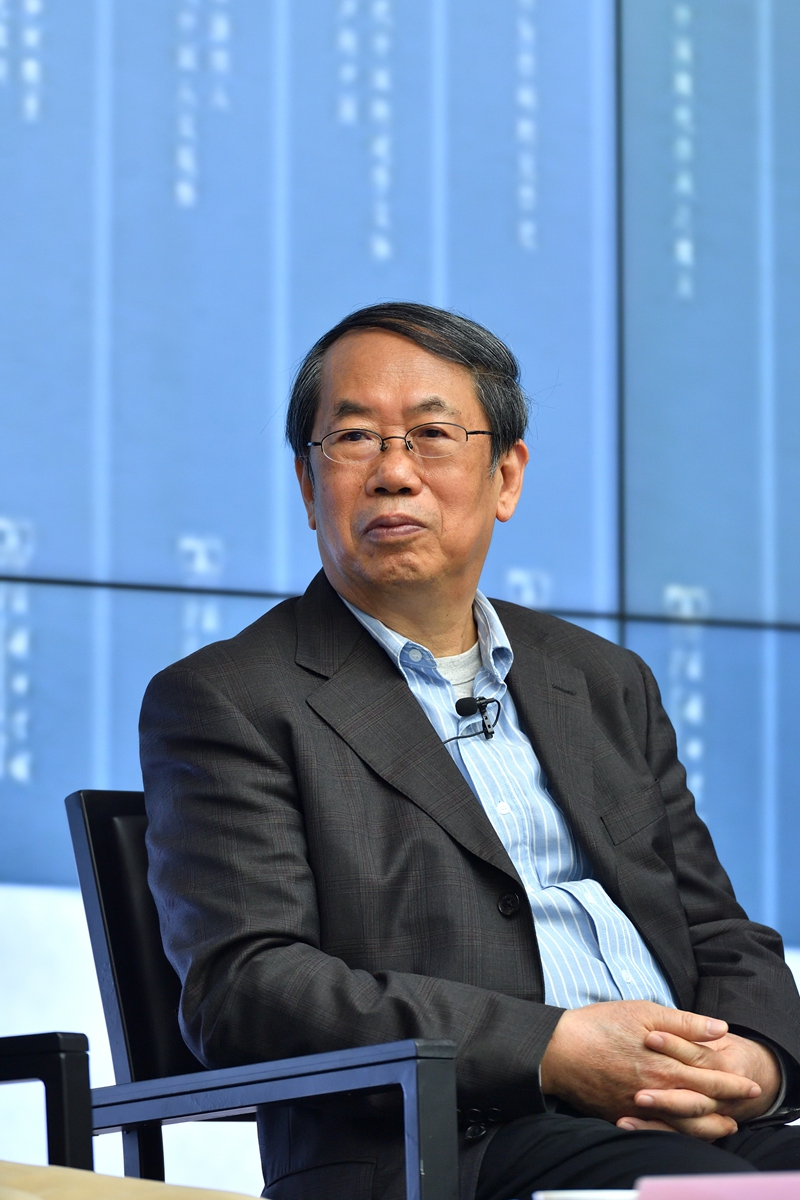
Veteran scholar Chen Pingyuan Photo: VCG
GT: First, congratulations on the unveiling and opening of the "Chen-Xia Study." Could you briefly introduce the current status of the study and its future development plans? (Chen-Xia Study is a special collection room dedicated to the books donated by Chen Pingyuan and Xia Xiaohong, both professors from the Department of Chinese Language and Literature of Peking University).
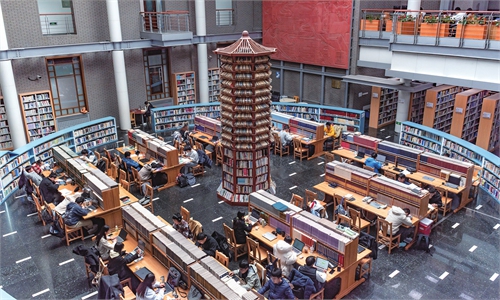
Chen Pingyuan: On December 22, the Central Research Institute of Culture and History, in collaboration with the Beijing Municipal Publicity Department, held the opening ceremony for the "Chen-Xia Study" at the Capital Library of China. In my speech, I noted that the value of the "Chen-Xia Study" lies in the fact that "looking back years later, future generations will be able to use it to understand how an ordinary pair of Chinese readers engaged in 'reading' and 'collecting' at the intersection where the paper era and the digital era waxed and waned from the late 20th century to the early 21st century." Among the 13,000 books, nearly 200 are books we have written or compiled (including foreign translations), along with journals and series we edited, which represent our efforts. More importantly are the books given by friends, mentors, and students that line the bookshelves on either side of the entrance.
These represent an intellectual community and the passing on of the torch. Through them, readers are free to imagine describe and evaluate our "circle of friends." Scholarship in any era is not a solitary endeavor; the vision and caliber of mentors and friends can both uplift and constrain an individual.
Work in this area is ongoing, involving not only continued selection and donation but also in-depth organization and development of the collected books. Additionally, we collaborate with the Capital Library to organize special lectures and other activities to promote nationwide reading.
GT: In your article "Remembering 'Reading' from Thirty Years Ago," you appended a book list, calling those thirty books "the reading memories of a humanities university student in the early 1980s." If you were to recommend a few books for young people today, which ones would you choose?
Chen Pingyuan: "Remembering 'Reading' from Thirty Years Ago" was first published in The Publisher, Issue 12, 2008 (June 15). When it was reprinted in Shenzhen Business Daily on October 30, 2008, I added the subtitle "the reading memories of a humanities university student in the early 1980s." The former is an article, the latter an appendix, intended to preserve historical records, not to recommend a reading list. However, many readers did appreciate those thirty books as "reading memories." I have repeatedly stated that those were merely books I particularly enjoyed reading during my university years, reflecting the intellectual atmosphere of the 1980s. Now, over forty years later, sthe interests and reading goals of the new generations differ significantly from mine back then. Although I have been teaching at universities and supervising graduate students, I never dare to act as a "spiritual mentor" for young people. One must understand that the breakthroughs in knowledge over these decades have been rapid and constant. For the older generation, keeping up with the times is already an achievement; how can we presume to "lecture others" at every turn? I believe young people inherently possess the desire and ability to choose their own spiritual readings and paths forward.
GT: You have long advocated for young people to "start with literary books." Why is reading literature particularly important for a person's growth? What unique functions can literary reading still serve in contemporary times?
Chen Pingyuan: In my view, so-called 'elite reading' precisely refers to works that have no immediate practical use but are meaningful for shaping life experience, cultural taste, and one's spiritual realm." The key is cultivating empathy and compassion, feeling the pain of others as one's own and holding their nobility in high esteem. The so-called goodness of human nature requires nurturing and cultivation. For each individual experiencing (or witnessing) suffering and thus achieving spiritual growth is an extremely important lesson in life."
GT: In today's context, where "searching replaces reading" and "fragmented reading" is common, what do you think is the irreplaceable core value of deep reading? How should we cultivate young people's ability to focus on serious content?
Chen Pingyuan: Over a decade ago, in an interview titled "When Reading is Replaced by Searching, Cultivation is the Biggest Loser" (Wenhui Daily, July 13, 2012), I discussed: In the past, when we read, the pursuit of knowledge and self-cultivation went hand in hand. Now, the knowledge-seeking aspect has been replaced by searching; just knowing a book title or a person's name allows for a search. Reading has come to emphasize its entertainment function more.
In my view, reading today should emphasize maintaining a posture and capacity for thinking, reflection, critique, and relentless exploration. Merely advocating reading more and reading hard is meaningless and might even mislead.
Because there are too many books, you simply can't read them all. Discussing reading today requires more emphasis on the taste for selection, the perseverance to read, and a critical eye than before.
GT: Artificial intelligence is reshaping how people acquire knowledge. What significant changes do you think human reading methods will undergo in the future? Faced with the changes, what attitude should we hold towards new technology?
Chen Pingyuan: Regarding reading, I advocate the ancient concept of "learning for the sake of the self": I firmly believe that reading is a way of life that promotes self-improvement. On the other hand, I realize that technology is advancing rapidly and ordinary people simply cannot compete with AI, so what should one do? Choosing to read for oneself is quite a good choice. Meanwhile, when it comes to how humanities scholars engage with AI, my colleagues and I are feeling our way forward.
This time is naturally no exception. Looking back years later, after the period of turbulence has passed, many of today's ideas and discourses may seem naïve, but they represent humanity's confusion, pain, and struggle in seeking a path, which is worth respect and preservation."
GT: You have long been engaged in literary research and teaching, influencing countless students. Based on your experience, could you offer a few practical reading methods or suggestions for young readers?
Chen Pingyuan: All "reading experiences" vary from person to person, time to time, and place to place; there is no one-size-fits-all approach. In reading, some kinds of skill training yield immediate results but only lead to superficial comprehension. If one has a broad vision and pursues breadth of mind and cultivation, then a good mindset and a willingness to invest time are essential. It's like the Cantonese art of slow-simmered soup.
Turn up the heat too high and the flavor falls flat. Only a patient, gentle simmer allows the flavor to reach its fullest depth. In a sense, reading is like this, too; it requires long-term preparation. One cannot be too impatient, too utilitarian, or have a timetable to expect rapid progress or make a fortune overnight.
RELATED ARTICLES