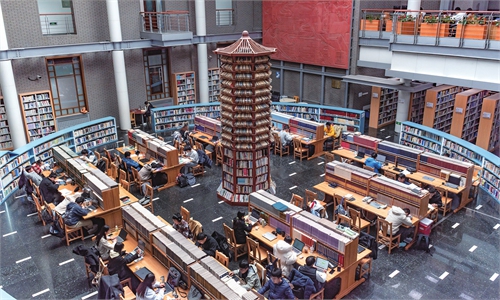
ARTS / BOOKS
Ushering in a nation of readers: Regulations on reading to help foster book-loving society
Ushering in a nation of readers

Two students read books at the Wangfujing Bookstore in downtown Beijing on February 1, 2026. Photo: Li Hao/GT
For Lin, a 62-year-old retired Chinese language teacher who worked at a middle school in Beijing, a visit to the National Library of China (NLC) on Sunday carried meaning far beyond his usual routine.For years, Lin has been a regular reader at the library, but this particular visit coincided with the official implementation of China's newly released Regulations on the Promotion of Nationwide Reading, giving the day a symbolic weight.
Sunday - February 1 - marked the day the regulations formally came into effect. The regulations call on governments at all levels to expand reading facilities, improve public reading services, and foster a more supportive reading environment. Promulgated by the State Council in December 2025, they are part of the country's broader effort to cultivate a book-loving society and strengthen its vision of becoming a socialist cultural powerhouse.
Lin told the Global Times on Sunday that, be it his decades of teaching or his observations at the NLC, the reading atmosphere in China has always been "strong."
"These regulations make nationwide reading more institutionalized. They are a good thing that adds icing on the cake," said Lin.
Lin's perspective reflects a quiet continuity: reading as a long-standing habit in the country. That idea was echoed by Mao Yajun, director of the Capital Library of China, who emphasized that the regulations are not merely about increasing book counts or reading rates. Instead, they aim at a deeper level of social civilization.
"Reading preserves a city's unique cultural bloodline. Through exploring local documents, sharing urban stories and nurturing local writers, reading preserves historical memories and strengthens one's cultural identity," Mao said.
Entering daily life
The continuity of Chinese civilization for over five millennia is closely tied to a long-standing reverence for learning and reading. The regulation aim to foster a society in which reading is widely valued, well-guided and deeply embedded in daily life. It designates the fourth week of April each year as a national reading week, encouraging reading activities nationwide.
Li, a 21-year-old university student majoring in art in Beijing, told the Global Times that every visit to the library allows her to read books by artistic masters, which helps her professionally while also calming her mind.
"Now, whenever I have time on weekends, I come here and stay for hours," she said. For young readers like Li, libraries function as both intellectual resources and spaces of emotional refuge.
The regulations place special emphasis on protecting the reading rights of minors, senior citizens and people with disabilities, stressing the importance of providing services tailored to their needs.
That emphasis on early cultivation was evident inside the National Library, where the Global Times met Wang, a 38-year-old mother, and her 11-year-old son. Like Lin, Wang and her son visit the library frequently. She told the Global Times that they were not there specifically for the regulations' launch, but rather because reading together has long been part of their lives.
Wang explained that she does not deliberately guide her son toward specific genres or titles. "I let him follow his own interests. He started with picture books and fairy tales, and now he's reading both Chinese and foreign classics," she said.
In her view, encouraging reading from an early age plays an important role. "You have to start young and help them build the habit," said Wang.
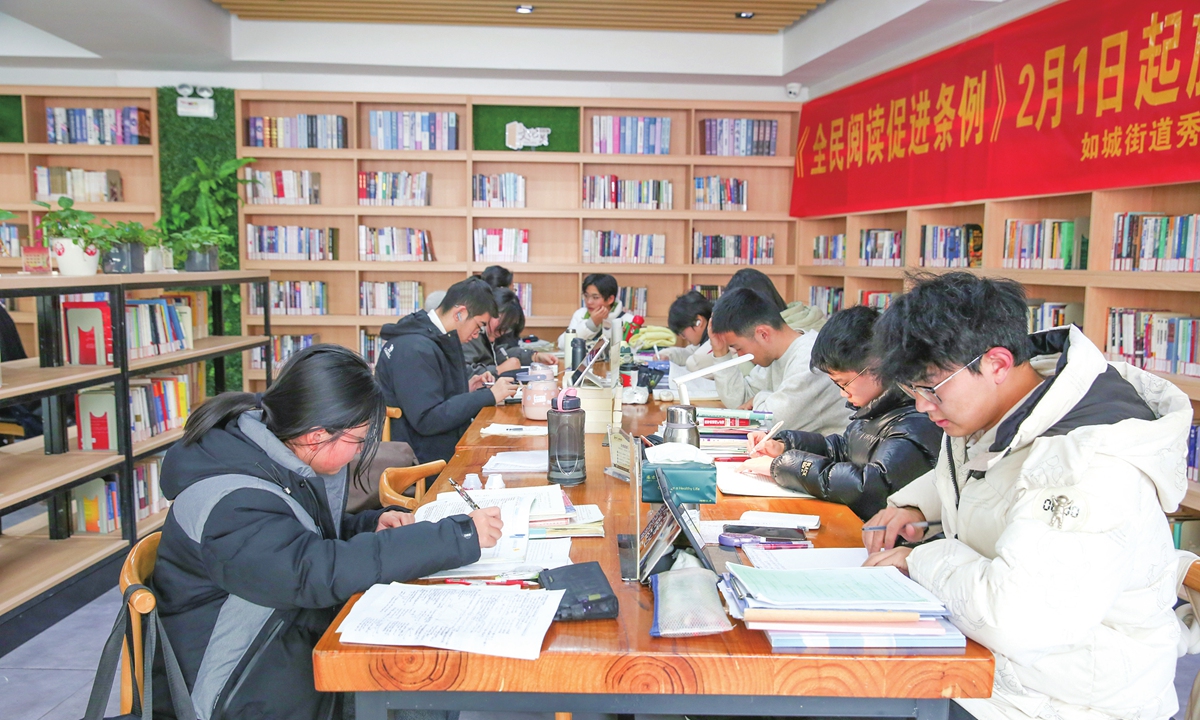
Reading enthusiasts enjoy books in a 24-hour bookstore in Rugao, East China's Jiangsu Province, on February 1, 2026. Photo: VCG
From policy to practiceThe regulations require governments at or above county-level to include funding for reading promotion in their budgets. It also encourages government offices, schools, enterprises and public institutions to establish various reading facilities, while calling on bookstores to upgrade their reading environments and organize related activities.
In Beijing, many brick-and-mortar bookstores responded to the regulations' implementation with a range of public reading events on Sunday, including youth reading clubs and book-sharing sessions.
At the Wangfujing Bookstore in the capital's Dongcheng district, operated by Beijing Publications Distribution Group Co, children took part in a special program where they crafted picture books inspired by traditional Chinese classics.
Cao Yuan, assistant to the general manager of the Wangfujing Bookstore, told the Global Times the activity was a concrete effort to implement the regulations while deepening the promotion of children's reading. "By letting children thread needles and bind books by hand, they can physically engage with the depth of traditional culture," Cao said.
For brick-and-mortar bookstores, Cao said, the regulations provide not only strong policy support but also a crucial development opportunity. On the one hand, they clarify support measures for physical bookstores, helping ease operational pressures and offering institutional support for sustainable development.
On the other hand, the regulations promote coordinated collaboration among libraries, publishers, schools, and communities. This opens up new possibilities for bookstores to expand service scenarios and innovate service models, making the integration of nationwide reading resources more efficient. At the same time, the regulations encourage bookstores to transform from traditional retail spaces into urban cultural hubs.
Similar confidence was expressed by Han Han, the operations manager of Fangzhuang's Yifang Bookstore located in Beijing's Fengtai district. The manager told the Global Times that the introduction of the regulations has greatly strengthened the bookstore's confidence in its future. "That confidence comes from policy guarantees, potential market opportunities, and a shared sense of direction within the industry."
According to Han, the regulations encourage diverse forms of reading promotion activities, which will continuously nurture a reading-friendly social environment, draw more people into bookstores, and help address the long-standing challenge of insufficient foot traffic faced by physical bookstores.
Both bookstore employees agree, however, that promoting nationwide reading is a long-term endeavor that requires persistence. To that end, they are planning a series of regular promotional activities, focusing on enriching content supply and precisely matching readers' needs.
Plans include curated reading lists for different age groups, themed book exhibitions, as well as deeper cooperation with publishers to host new book launches and author meet-and-greet events.
RELATED ARTICLES