China-Europe freight trains get off to a strong start in 2026, with rail network boosting cargo reliability amid global uncertainties
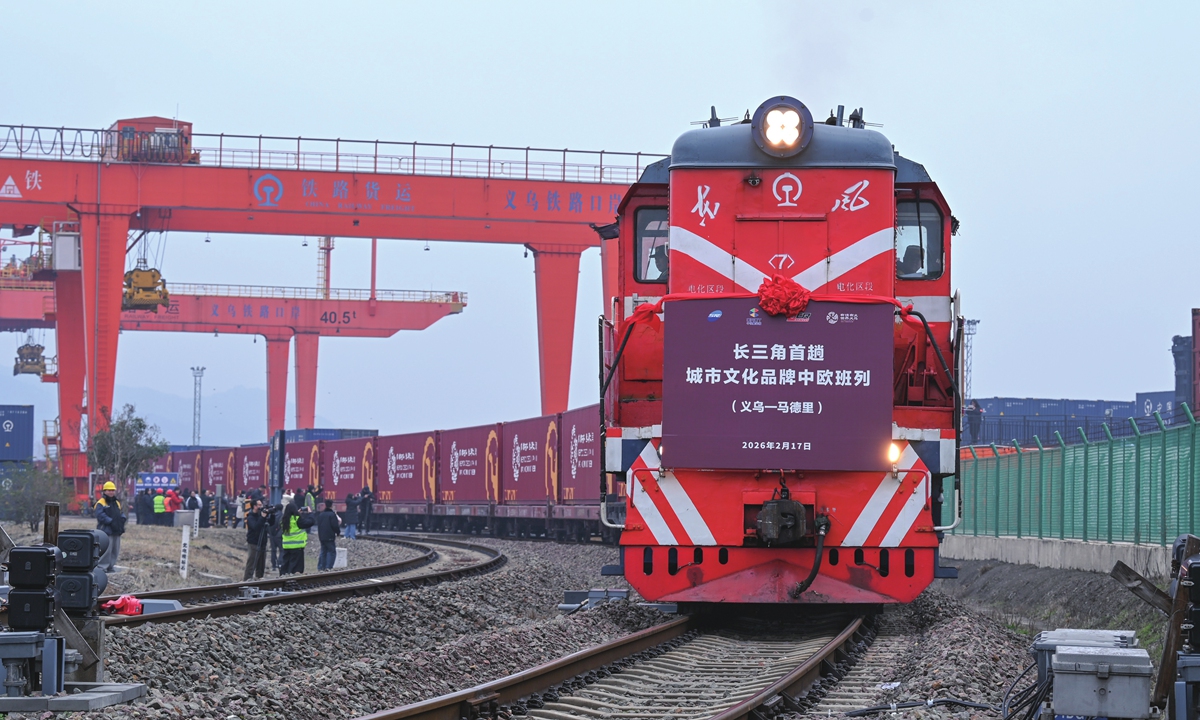
A China-Europe freight train carrying 110 standard containers departs from Yiwu West Railway Station in Yiwu, East China's Zhejiang Province, on February 17, 2026 to headbound for Madrid, the capital of Spain. Photo: VCG
With the sound of a whistle on Thursday, a freight train carrying 55 standard containers of new-energy vehicle (NEV) parts produced by domestic manufacturers departed from the Hefei north railway station in Hefei, East China's Anhui Province, which is a major auto production hub.
This marked one of the earliest batches of cargo dispatched from the region to Europe after the Spring Festival holidays. Its destination is Hamburg, Germany, more than 8,000 kilometers away.
According to a freight forwarder, these parts will be assembled in Europe to meet local demand for NEVs.
As the shipment was urgent, the cross-border freight train provided a reliable and efficient service, with an estimated journey of around 20 days, whereas shipping by sea would take 35 days or more, the source told the Global Times.
This shipment is one example of the China-Europe freight train service.
With the holidays ending this week, many factories resumed work to rush orders, train traffic increased further, according to information collected by the Global Times from freight forwarders, railway bureaus, customs, and media reports across multiple regions.
Against the backdrop of global supply chain uncertainty, the China-Europe freight train service, which is a flagship project and a landmark brand of the Belt and Road Initiative (BRI), has provided reliable logistics support, helping sustain supply chain connectivity and reduce disruption risks across countries and regions, experts said.
Busy delivery
From Hefei in Anhui to Yiwu in East China's Zhejiang Province, and onward to Xi'an, a key transportation hub in Northwest China's Shaanxi Province, China-Europe freight trains have operated continuously and without interruption during and after the Spring Festival, one of China's most important holidays.
In Yiwu, a freight agent surnamed Bao, who has worked as an international trader for many years, hardly got a break even during the Spring Festival.
A large volume of goods has been transported via the China-Europe freight trains, ranging from auto parts to daily necessities, most of which are high value-added products much in demand in the European market, he told the Global Times.
Currently, Yiwu sees about 3,000 freight trains per year, running almost every day. While many routes previously focused on Germany, there are now 26 routes serving more than 50 destinations across Central Asia and Europe, Bao said.
In response to the strong demand for trade, at Alashankou Port in Northwest China's Xinjiang Uygur Autonomous Region, the number of shunting locomotives was increased from seven to eight during the just-concluded holidays, enabling round-the-clock operations.
The average daily number of China-Europe freight trains passing through has reached 22, ensuring safe and efficient customs clearance, the China Railway Urumqi Bureau Group told the Global Times on Thursday. Urumqi is the regional capital of Xinjiang.
Also during the holidays, the Manzhouli Railway Port remained busy, with customs officers staying on duty to ensure the efficient clearance of the cross-border trains, supporting foreign trade at the start of the new year. The smooth operation of the trains not only creates an important corridor connecting Europe and Asia but also supports China's foreign trade in growth and structural upgrading, according to a document that Manzhouli Customs sent to the Global Times on Thursday.
As companies resume production after the holiday, Xi'an International Port Station returned to full activity. Twelve gantry cranes and 20 front loaders worked nonstop, over 3,000 container trucks passed through daily, and staff moved efficiently through sorting, coupling, inspection, and dispatch, the Guangming Daily reported on Thursday.
Amid strong market demand, China-Europe freight trains from Xi'an have already run over 900 trips so far this year, highlighting the resilience of China's foreign trade, the report said.
Tommy Tan, president of Shanghai EPU Supply Chain Management Co, told the Global Times that China-Europe freight trains have seen a slight increase compared with previous years, mainly carrying long-term contract cargo.
As a senior industry insider, Tan said that the growth in cargo volume on the China-Europe freight trains is supported by multiple factors, including the stabilizing trade environment between China and Europe, which provides a solid foundation for transport recovery, and the increasing market recognition of high-quality Chinese products among the countries along the route, which contributes to a positive overall outlook.
Greater capacity
The steady operation of China-Europe freight trains has given Chinese manufacturers a good start in 2026 in reaching global markets, but rising demand also creates new challenges and opportunities for the trains to become even more efficient and capable.
Currently, the capacity of China-Europe freight trains is mainly planned in advance rather than adjusted flexibly based on market orders, which creates capacity constraints and entry barriers, industry insiders said.
However, the situation is improving. Compared with previous years, a significant change in China-Europe freight train operations this year is that the cross-border trains have become an essential part of multimodal transport, complementing road and waterway capacity, and further enhancing the competitiveness of transportation services, said Tan.
At the same time, global demand for freight trains continues to grow, creating greater opportunities for freight train services.
Data show that in 2025, China-Europe and China-Asia freight trains completed 34,000 trips, marking year-on-year increases of 9.8 percent and transporting 3.17 million TEUs, up 7.6 percent. To date, more than 120,000 trains have been operated, connecting 232 cities in 26 European countries and over 100 cities in 11 Asian countries.
The trend highlights that in the current context of global supply chain uncertainty and rising geopolitical risks, China's production and operational systems help stabilize global supply chains, Song Wei, a professor at the School of International Relations and Diplomacy at Beijing Foreign Studies University, told the Global Times on Thursday.
Song said that as a vital transport option, China-Europe freight trains help mitigate disruptions in maritime shipping, high air freight costs, and the challenges of transporting time-sensitive goods. China-Europe freight train connectivity has supported the development of logistics hubs, manufacturing parks and cross‑border e‑commerce along key corridors and cooperative economic zones in many parts of the world, she said.
"With global demand for stable and predictable supply chains on the rise, China-Europe freight trains are set to play an increasingly important role as a stabilizer in the reconfiguration of global value chains. Together with maritime and land transport, they are becoming an indispensable link in global trade," Song noted.
RELATED ARTICLES