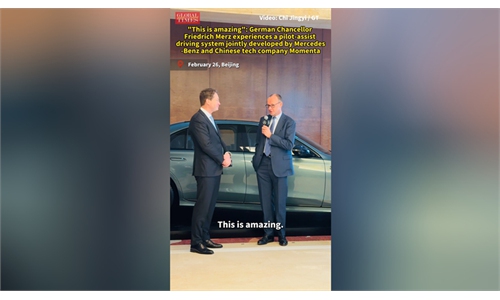
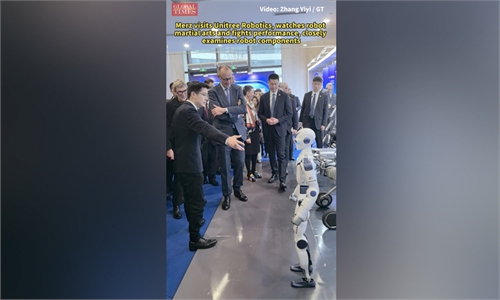
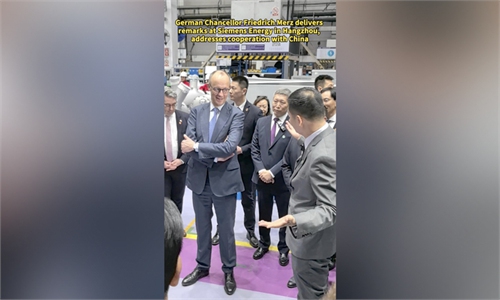
‘Deepening ties with China reinforces Germany’s role as a bridge builder between East and West’
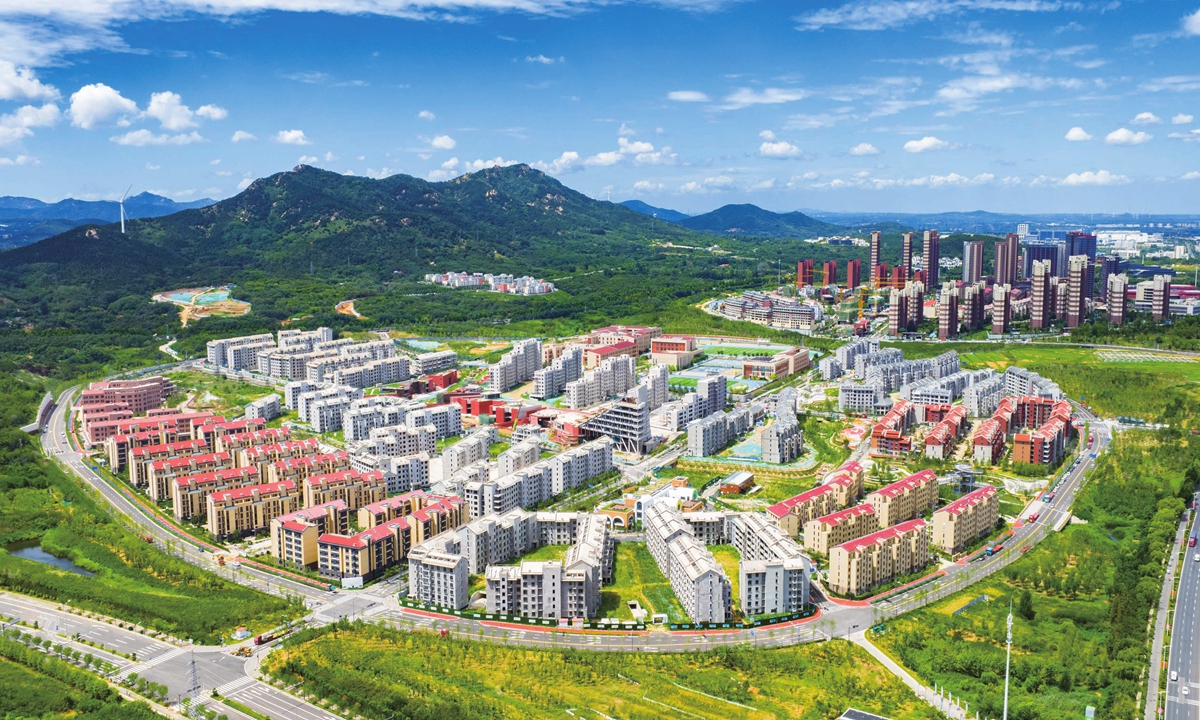
A view of Qingdao Sino-German Ecopark in Qingdao, East China's Shandong Province Photo: cnsphoto
Editor's Note:
German Chancellor Friedrich Merz is on an official visit to China from February 25 to 26, marking his first trip to the country since taking office. He is the latest European leader to visit China, following a series of European heads of state who have traveled there since the end of last year, against the backdrop of a fraying transatlantic relationship and a turbulent world order. Global Times (GT) reporter Wang Wenwen talked to Ulrike Guérot (Guérot), a Berlin-based German political thinker, about the significance of Merz's China trip and Europe's "looking East" wave.
GT: What do you think of the timing of Chancellor Merz's visit?
Guérot: I think the timing is more inspired from the situation in Europe, and Germany in particular, following the recent World Economic Forum in Davos, and the Munich Security Conference, which showed an increasingly deadlocked and stalled foreign policy ambiance. Europe seems lost in its relationship with the US, both economically and politically, and it is stuck with the war in Ukraine which creates a stalemate on the European continent. Traveling to China could give Chancellor Merz some distraction from these problems and the chance to dynamize his chancellorship, especially because he is accompanied by a huge business delegation. The country badly needs some good news on the economic front. Former German chancellor Angela Merkel was always strong in dealing with China. Merz needs to fill her shoes.
GT: Ahead of his China visit, Merz warned the US against igniting a tariff war and hailed future cooperation with China. He believes that "the key term is strategic partnerships." Taking his words into account, what significance does his visit carry for China-Germany relations?
Guérot: The visit holds considerable significance in light of the global challenges. Against a backdrop of rising geopolitical tensions, the resurgence of great-power competition and the fragmentation of global trade into competing blocs, this visit signals a mutual willingness to keep communication channels open.
Although there have been significant verbal missteps by German politicians in the past, Merz still acts pragmatically where pragmatic action alone is required. He understands that Germany's export-driven economy, particularly its struggling automotive and chemical sectors, cannot afford isolation from the world's second-largest economy.
Moreover, good relations with China help to create balance where problems tend to prevail elsewhere. As the transatlantic alliance faces new uncertainties - ranging from potential trade disputes with the US to the instability caused by the ongoing war in Ukraine and a new friction point in Greenland - deepening ties with China diversifies Germany's foreign policy options and reinforces its role as a bridge builder between East and West.

Ulrike Guérot Photo: Courtesy of Guérot
GT: Prior to Merz's visit, BMW Chief Executive Oliver Zipse warned that ignoring China, the world's top auto market, would put at risk future economic success, saying cooperation with Beijing was fundamental. With the German economy facing challenges, especially the automotive industry struggling to transform, what are the future potentials for China-Germany cooperation?
Guérot: Adjustments will come - indeed, they must come - since climate protection and modern technologies do not necessarily represent an insurmountable contradiction. Germany, like Japan and the US, depends on global division of labor and market potential. Anyone who neglects China harms themselves and creates openings that competitors could very easily fill. In the end, both Germany and China should, through mutual openness to investment, optimize supply chains and keep them short.
China's Ministry of Commerce recently expressed its hope that German companies will increase their exports of high-quality products and technologies to China. Promoting product exports is certainly important for both sides, especially since many products - for example, those from China - are manufactured using highly advanced production facilities from Germany.
In my view, the real opportunities lie in the following: What good are modern electric vehicles if the charging infrastructure, due to outdated overall infrastructure, simply does not allow for widespread use? Europe urgently needs a comprehensive modernization of its entire infrastructure, starting with housing construction, energy and grid networks, and high-speed rail lines, among others. Why don't we deepen cooperation precisely in these critical areas?
GT: To what extent can China-Germany relations guide China-Europe relations?
Guérot: Well, Germany has, in many ways, always taken the lead in Europe-China relations, especially since the beginning of the last decade: In 2011, some 45 percent of all European goods exported to China were German. The very fact that Germany is the biggest and economically strongest EU member country underscores this role. But this role comes with a huge task - uniting Europe while dealing with China. In the past, Germany was always ill advised when it tried to go global alone, at the expense of Europe.
The difficulty for Germany in that role today is the same as 15 years ago: It must rally Europe behind it so that other European countries don't do things with China at their detriment.
GT: How do you analyze the "looking East" wave coming from Europe?
Guérot: We are all experiencing the moment of the end of Pax American and the unfolding of BRICS and the common move to a multipolar world. And China is an influential part of the BRICS world. Most European countries would like to adopt to this change but feel themselves retained in a transatlantic corset that hinders a European positioning in this momentum. There are some tentative discussions about Europe "looking East," a post-Atlantic Europe or even a neutral Europe that moves itself out of NATO embracement and redesigns its relations to Russia, India, China and Iran, instead of focusing only on "defense" and on a "rivalry relationship." But these voices are still at the fringe of political specter. Still, in my opinion China should listen to them carefully, as the political ground in most EU countries is fragile these days, and we can expect a major policy shift. Also, China must recognize that European citizens in their majorities, despite their governments policies, are against the one-sided EU support of Ukraine. They wish for friendly relations with both Russia and China, as well as a general shift in Europe's policy orientation to a multipolar world.
China is not a direct neighbor of Europe and is therefore far from posing a threat. On the contrary, a good relationship with China serves as a counterweight in the interplay of global powers. Europe should position itself as mediator in the future multipolar world and I think that many European countries see it that way, which explains their recent travel activities to China.
RELATED ARTICLES