ARTS / CULTURE & LEISURE
Grit, flexibility key for Steel Roses’ title defense

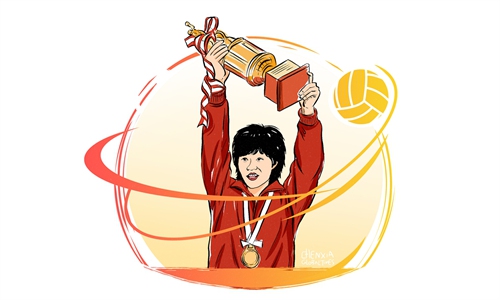
Illustration: Liu Rui/GT
Nicknamed the "Steel Roses" for their resilience displayed at major international competitions, China are drawn with Bangladesh, Uzbekistan and North Korea in Group B and will open their campaign against Bangladesh on March 3. The last group game against North Korea is likely to determine the outlook for the knockout stage.
A total of 12 teams will compete in three groups. The top two teams from each group and two best third-placed teams will qualify for the quarterfinals. The four semifinalists will qualify for the 2027 FIFA Women's World Cup in Brazil, while the four losing quarterfinalists will compete in playoffs for the remaining two World Cup berths.
The eight quarterfinalists will also move on to the Asian qualifiers for the women's football event at the 2028 Los Angeles Olympics.
Captain Wu Haiyan told reporters after arriving in Sydney that the team had completed nearly 42 days of intensive training in Shenzhen, South China's Guangdong Province, and aims to retain the title.
"We were champions in the last edition. We hope to show the character and the spirit of Chinese women's football this time and successfully defend the title," said Wu.
This fighting spirit remains the backbone of China's identity, Liu Yu, a Beijing-based sports commentator, told the Global Times on Thursday.
In tournament football, where margins are thin and knockout rounds are often decided in a single moment, mentality can outweigh statistics. The Steel Roses have repeatedly shown they can withstand pressure and respond when it matters most, Liu noted.
Last-minute heroics and unyielding defensive stands defined their route to the championship during the last edition in 2022 as China rallied back from two goals down to edge past South Korea 3-2 in the final match, returning to the top of Asia after 16 years.
Among the 26-member squad, captain Wu, Zhang Xin and Wang Shuang have been the leading figures in the national team for nearly a decade. Their experience and leadership on the pitch - especially in defense and midfield - provide structure in chaotic moments.
Young players Zhang Linyan and Wang Linlin have grown to be the backbone of the team. Notably, six players are from clubs outside of China. Strikers Wu Chengshu and Wurigumula, who are from French sides Dijon and Montpellier respectively, as well as Yuan Cong from Australian club the Western Sydney Wanderers will provide the rich attacking options that the team has long craved.
Having improved in physical duels and tactical discipline, the players based overseas bring back to the national team faster transitions between attack and defense and a more efficient style of play, helping the entire squad keep pace with the global development of women's football.
During a warm-up game against Australian side the Central Coast Mariners on Tuesday, China went up 3-1 within regular time and chalked up five more goals in the extra 30 minutes with all six players on target.
For Australian Ante Milicic, this will be the first major competition as head coach of the Steel Roses since his appointment in May 2024.
Milicic faced waves of criticism from the media and fans following a humiliating 8-0 defeat to England during a friendly game in London in November. Though Milicic was not dismissed, former China U17 women's head coach Wang Hongliang and former Chinese international Ou Chuliang were added to the coaching staff as assistant coach and goalkeeping coach respectively in the wake of the heavy defeat. The outcome of this tournament could also affect Milicic's position as head coach.
"Obviously, the defeat at Wembley was disappointing, but the most important thing is that we learn from it and gain experience," Milicic told the Xinhua News Agency in January.
The team spirit of "pulling together as one" could be crucial against title contenders: Japan, Australia and South Korea.
In addition to spirit and experience, China has shown a willingness to evolve rather than cling to a single blueprint. Tactical flexibility will be especially critical in the knockout rounds, where each opponent presents a unique puzzle.
The history of the Steel Roses has not been defined by a smooth path, but by overcoming obstacles. The coming weeks in Australia will test their physical endurance and mental fortitude.
The author is a reporter with the Global Times. life@globaltimes.com.cn
RELATED ARTICLES