ARTS / CULTURE & LEISURE
‘Poets and emperors’ hit the road: How China is driving a cool cultural revival
By Published: Feb 26, 2026 10:46 PM

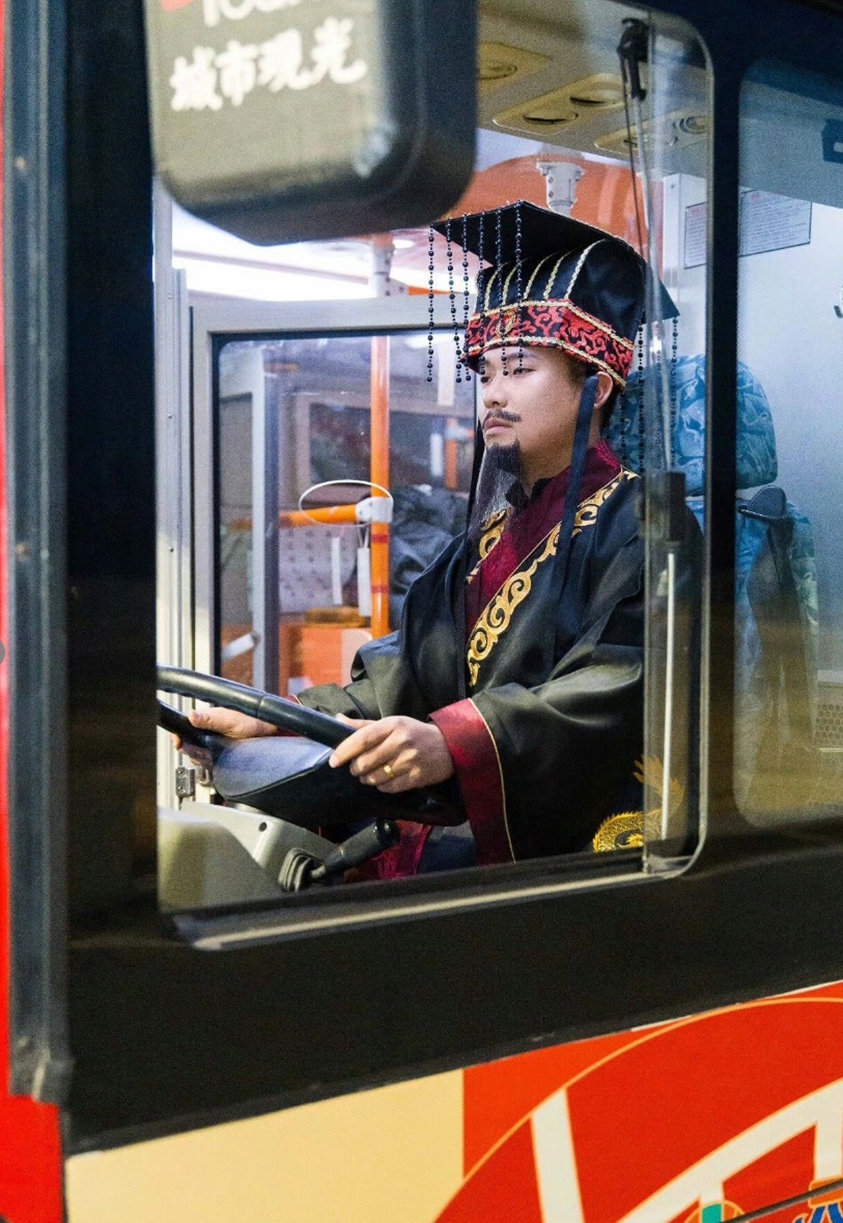
"Emperor Qinshihuang" drives a sightseeing bus.
This Spring Festival, a unique "Poetry Road" sightseeing bus line in Chengdu, Southwest China's Sichuan Province, became a sensation on Chinese social media platforms. A driver dressed as the legendary poet Li Bai of the Tang Dynasty (618-907) navigated the streets, while a tour guide in the guise of another revered poet Du Fu of the same era narrated the journey, weaving historical sites like the Du Fu Thatched Cottage and Qingyang Temple into a living tapestry of verses. The tour offers an immersive trip through a millennium of literary heritage.This innovative approach is not confined to Chengdu. A video from Xi'an, Northwest China's Shaanxi Province, showing the impersonated Emperor Qinshihuang, the first emperor to unify China, of the Qin Dynasty (221BC-206BC) behind the wheel of a sightseeing coach has also sparked lively discussions online. This was part of a themed interactive activity by the Xi'an City Sightseeing Bus company for the holiday, during which passengers could book rides with the "emperor." Similarly, a Hanfu clothing fashion show by staff at the Guangzhou Baiyun International Airport also captivated netizens nationwide.
When Du Fu "drives" a bus and Qinshihuang "chauffeurs" a tour coach, our familiar historical icons suddenly become approachable and relatable. This is far from mere cosplay. It represents a deliberate design philosophy, embedding culture into the very itinerary of travel. These seemingly spontaneous creative sparks share a common thread: Cultural tourism services can embrace more inventive forms of expression, proving that traditional culture can be genuinely cool.
These cross-temporal "cultural flash mobs" do more than let tourists see a city on the move; they unlock new, easy models for cultural transmission. The striking visual contrast of "Li Bai" steering through Chengdu's avenues or "Du Fu" conversing with visitors as a guide instantly closes the distance between historical giants and ordinary people. Tourists are no longer peering at the "Sage of Poetry" through a display case. Instead, they can listen to "Du Fu" recite his verses by the Huanhua Stream or chat with "Li Bai" amid the neon glow of Chunxi Road.
The revitalization of tradition often starts with the courage to "break boundaries." Urban landscapes are vessels of cultural memory, and Chengdu's bus line creatively strings cultural landmarks together, transforming the vehicle into a mobile "cultural theater." Professional guides decipher the historical allusions behind the poems, interactive games like Feihualing (a poetry challenge) spark engagement, and recorded recitations overhead create a deeply immersive atmosphere. Thus, poetry sheds its textbook form, becoming a tangible, conversational part of life. As the sightseeing line rolls on, tourists transition from passive "sightseers" to active "participants," injecting vibrant new life into traditional culture.
In an era of material abundance, tourists increasingly seek deep cultural resonance and emotional connection over superficial tours. Many regions have tapped into this trend with creative offerings that fill a market niche. Examples including Xi'an's "Ride the Bus with Qinshihuang" turn buses into moving ambassadors of cities. Innovation extends beyond transport: from Xi'an's "Twelve Hours of Chang'an" Tang Dynasty-themed market street to Yangzhou's iQIYI Land theme park based on popular cultural IPs like Love Between Fairy and Devil, and Strange Tales of Tang Dynasty, the focus is on crafting a palpable "sense of presence," weaving cultural DNA into urban life and pushing integrated cultural tourism to a new stage.
The online buzz generated by travelers spontaneously sharing the "time-travel" experience at Baiyun Airport not only boosted the airport's reputation but also delivered traditional Chinese culture to a wider audience through the unique lens of the Spring Festival travel rush. When international travelers witness such scenes, they encounter not static history from textbooks, but a vibrant, lovely, and aesthetically pleasing expression of contemporary Chinese culture.
Profound cultural heritage can, through creativity, be transformed into light, accessible experiences that ordinary people can touch and enjoy. This tests the ability of city managers to integrate history and culture into everyday activities - a core aspect of urban soft power competition today. Thus, culture is no longer a display item to be looked up to from afar, but becomes part of what we ride, discuss, and even be part of.
The author is a reporter with the Global Times. life@globaltimes.com.cn
RELATED ARTICLES