ARTS / CULTURE & LEISURE
Xinjiang archaeologist tells tale of ancient integration
Xinjiang archaeologist tells tale
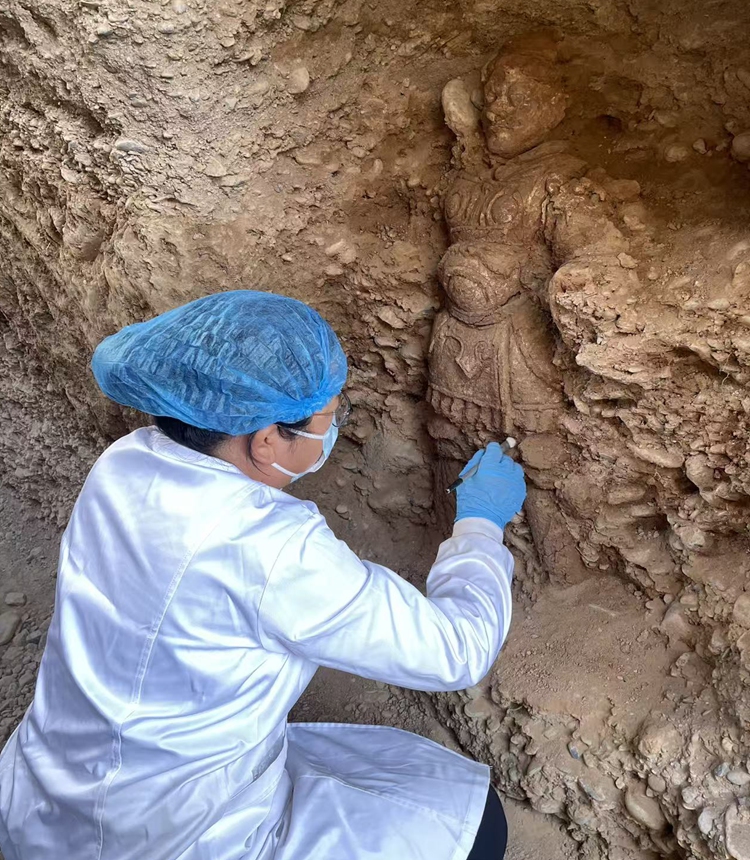
An archaeologist carries out restoration work at the Youyi Road tomb cluster. Photo: Courtesy of Xinjiang Institute of Cultural Relics and Archaeology
Among the recently announced 2025 key archaeological discoveries in Northwest China's Xinjiang Uygur Autonomous Region, the Youyi Road tomb cluster in the region's city of Kuqa has yielded a stunning find. At this tomb cluster, a Tang Dynasty (618-907) epitaph has been unearthed, revealing the story of integration between the Central Plains and Xinjiang during ancient times.
This epitaph was discovered by none other than Alifujiang Niyazi, a Xinjiang-born archaeologist with nearly 30 years of experience. Over the years, he has worked his way through countless excavation sites across the region, rising from a novice who couldn't understand site orientations to a project leader.
Having visited numerous sites both large and small, Niyazi is a "tomb keeper" who can recount the history of each site with great familiarity.
From unearthed ancient epitaphs, murals, pottery and more, each relic is not merely an artifact for Niyazi, but a piece of a larger puzzle that forms "the story of how our unified multi-ethnic country came to be."
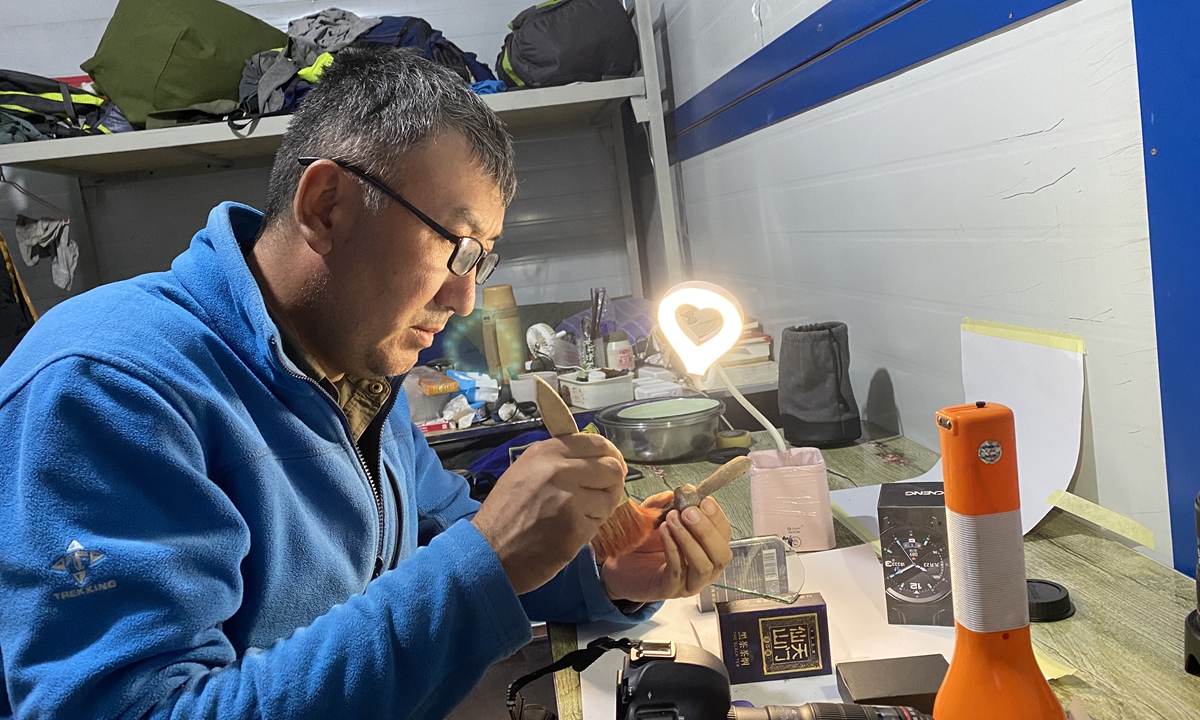
Archaeologist Alifujiang Niyazi
Epitaph's secret
First discovered in 2007, the Youyi Road tomb cluster has yielded a total of approximately 2,800 artifacts over the years, but the newly unearthed epitaph remains the most unique among them.
It was unearthed from a brick-chambered tomb with a sloping passageway. This tomb features an exquisite design with four niches, in which warrior figurines were placed to guard the tomb. They were intricately carved, with solemn and dignified expressions.
"Inside, we discovered 'Kaiyuan Tongbao' coins, [a major currency in circulation during the Tang Dynasty]. These tomb details quickly told us that this burial site was a high-ranking tomb," Niyazi told the Global Times.
As the excavation deepened, Niyazi discovered the epitaph inside the tomb chamber. The epitaph cover and the epitaph stone were separated from each other. Brushing off the dust, Niyazi saw that 16 characters were carved on the square epitaph cover.
They unveiled a mystery: This tomb belonged to "Yin Gong" or "Official Yin." This official was a former deputy protector-general of the Anxi Protectorate, a military-administrative region established by the Tang central authority to administer the ancient Xinjiang region.
Although some of the characters on the epitaph were damaged, Niyazi's team was still able to learn that this high-level official was born in Tianshui, Northwest China's Gansu Province, and was later assigned to work in Xinjiang.
He was a versatile professional who had held posts in several places in Shaanxi Province, managing areas such as transportation and more.
As an archaeologist, this new discovery excited Niyazi, but beyond the excitement, he admitted that "what I felt more was deep feelings." This epitaph not only bears witness to "the Tang Dynasty's effective administration of the Xinjiang region," but also testifies that during "turbulent times, the Central Plains and Xinjiang always maintained the same beliefs."
On the epitaph, it was found that "Official Yin" passed away just following the An Lushan Rebellion in the Tang Dynasty. Yet the Anxi Protectorate, where the official served, continued to govern and preserve stability in ancient Xinjiang society.
"The vivid and truthful histories behind those relics are what makes my career meaningful and what makes me feel complete," said Niyazi.
From canvas to field
Niyazi's achievements extend beyond his discoveries at the Youyi Road tomb cluster. Over the years, his archaeological journey has extended to different parts of Xinjiang, including the Huangshanhe reservoir tomb site in the Changji Hui autonomous prefecture and the Narensu site in the Tacheng prefecture and also the Dandan Oilik site in the Hotan prefecture.
Had he not gone to the site in person, Niyazi would not have been amazed by the Narensu site. This site not only contains multiple types of burials, but each tomb has its own distinct characteristics.
In addition to discovering gold artifacts, bone and horn relics, and other items, the archaeological team, including Niyazi, also discovered belt ornaments and accessories featuring typical Tang and Song dynasty aesthetics.
Before becoming an archaeology expert, Niyazi's lifelong dream was to become an artist. Although he later stumbled into a different field, his love for art never faded. Instead, it transformed into a unique perspective that made him especially sensitive to beauty during his archaeological work.
At the Dandan Oilik site, his love for beauty was realized. This Tang Dynasty site contained many traces of ancient daily life, such as fields, orchards, and the architectural remains of a Buddhist temple.
It also showcases rich cultural connotations, since ancient texts written in Chinese and Sanskrit were unearthed. Meanwhile, exquisite Tang wooden panel paintings depicting vivid images, such as a rat-headed figure wearing a crown, were also unearthed.
"Paintings are a form of record that differs from written text. They not only contain historical stories but also showcase the artistic level and aesthetic concepts of their time," Niyazi told the Global Times.
"I was truly amazed by them, especially the technique of the brushwork, which is exquisite. The use of color is sophisticated, and the facial expressions of the figures are vivid and full, with a strong sense of volume."
With his artistically trained eyes and hands, Niyazi not only participates in fieldwork but also works in labs on artifact restoration. "What we can do is to preserve these relics as best as we can, so that the next generation can see the truth of history."
RELATED ARTICLES