ARTS / CULTURE & LEISURE
Chinese archaeologists discover oldest known Neolithic site on Inner Mongolian Plateau
By Published: Feb 26, 2026 10:55 PM

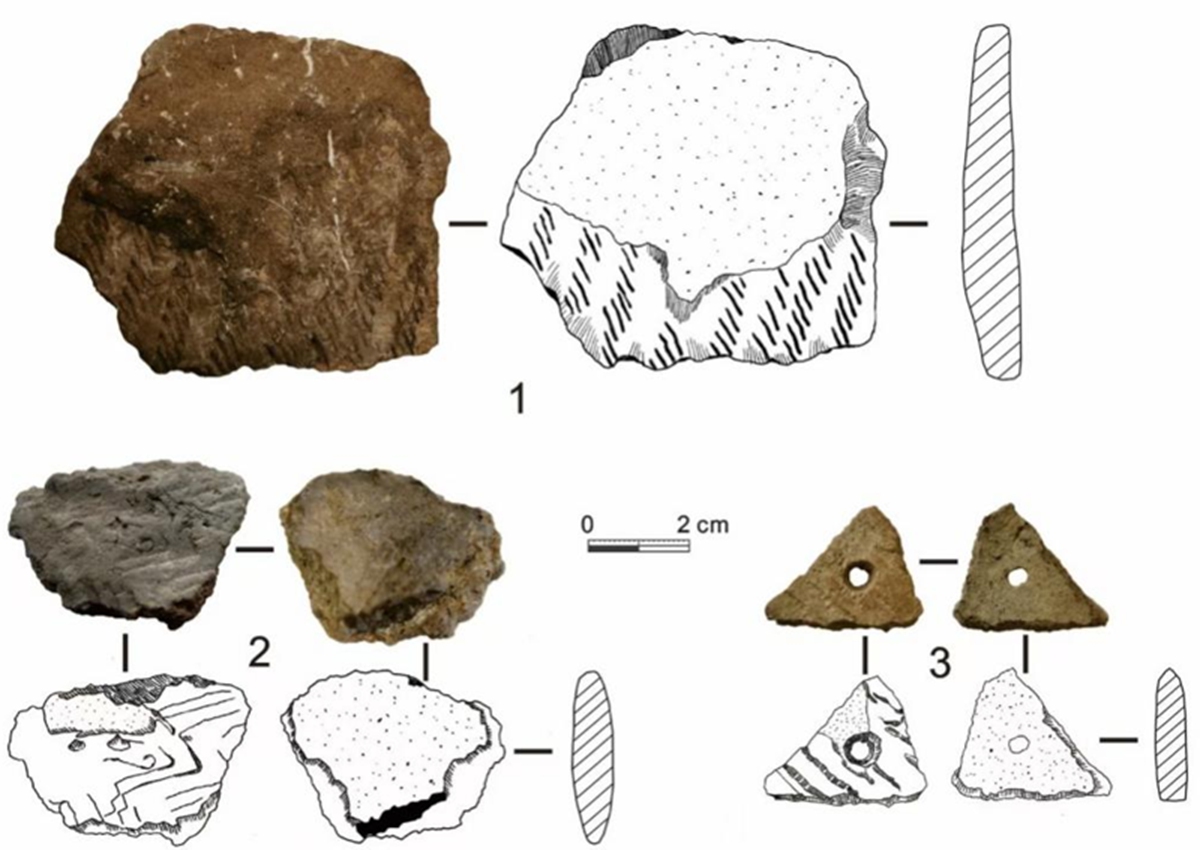
Pottery fragments discovered at the Dali Lake site Photo: Courtesy of Zhang Xujiao
A longstanding archaeological question - whether there was early human activity in the West Liaohe River Basin and even the wider Inner Mongolian Plateau - has finally received a definitive answer. Recently, a Chinese archaeological research team announced the discovery and confirmation of the oldest known Neolithic site on the Inner Mongolian Plateau at Dali Lake, the region's second-largest lake.The team from the China University of Geosciences (Beijing) unearthed a significant collection of early human cultural remains at this site, including large numbers of stone tools, pottery fragments, as well as a rich array of mammalian bones, teeth, and claws. This material provides crucial evidence for understanding early human production activities and technological applications in the West Liaohe River Basin and beyond, Zhang Xujiao, the team's lead researcher and a professor at the university, told the Global Times on Thursday.
Using advanced techniques such as accelerator mass spectrometry radiocarbon dating, researchers determined that human activity at the site began between 11,753 and 11,298 years ago, ending around 10,502 to 10,075 years ago. These dates are clearly earlier than those previously associated with the Xiaohexi Culture and Xinglongwa Culture - previously the earliest known Neolithic cultures in the West Liaohe River Basin. Zhang pointed out that the Dali Lake findings push back the timeline for Neolithic human activities in this region by nearly 3,000 years, filling a critical gap in the early cultural phase of the West Liaohe River Basin's Neolithic era.
Among the discoveries, pottery fragments dating back about 11,200 years were unearthed, offering new insight into the earliest pottery-making techniques and their diffusion across southern Inner Mongolia Autonomous Region. Most fragments were decorated with distinctive "impressed patterns," with some showing signs of perforations caused by repairs.
"The impressed patterns, which were created by pressing during the making of the pottery, added decorative elements. This indicates that at this time, pottery not only met the material needs of people's lives but also incorporated spiritual aesthetic demands," Liu Zheng, a member of the Chinese Society of Cultural Relics, told the Global Times on Thursday.
This discovery links, both temporally and geographically, pottery sites around Lake Baikal - dating to about 12,000 years ago - to the pottery artifacts of the Yumin Culture, another Neolithic culture discovered in southern Inner Mongolia that dates to around 8,400 to 7,800 years ago. The findings provide critical physical evidence for the southward diffusion of early Neolithic pottery technology and prehistoric human migration. They also expand the understanding of the innovation and spread of early pottery technology in East Asia.
Liu emphasized the importance of the Neolithic site, saying that it explains the transmission routes of the culture in the northern part of China in the early period of the Neolithic era, providing a basis for the origin of the Hongshan Culture, one of China's representative archaeological cultures, in the later period.
Further formal excavations around the Dali Lake site are planned to reconstruct a more comprehensive history of prehistoric human activity, including the spatio-temporal characteristics of this potential new cultural entity and its broader implications for understanding early human adaptation and cultural development in East Asia, according to Zhang.
RELATED ARTICLES