Merz wraps up China visit with Palace Museum tour, Mercedes-Benz test drive, robots shows
China and Germany should be strategic cooperative partners, not ‘systemic rivals’: expert
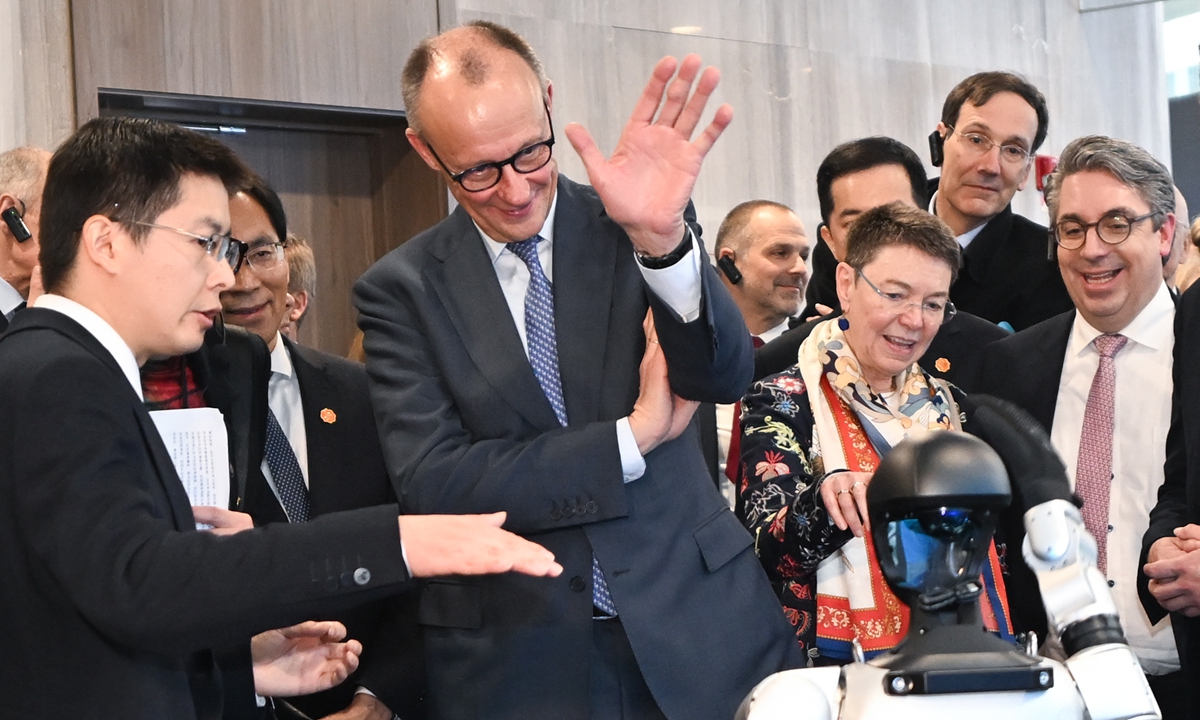
German Chancellor Friedrich Merz waves to a humanoid robot during his visit to the Chinese robot company Unitree Robotics in East China's Hangzhou on February 26, 2026. Photo: cnsphoto
China's state-of-the-art robots on Thursday put on a martial arts show, and the German chancellor watched from the front row. Touring Unitree Robotics in the Chinese tech hub of Hangzhou on Thursday, Chancellor Friedrich Merz watched with widening eyes as robotic fighters put on a "robot kung fu" showcase and a "robot combat match." But the most telling moment came after the applause faded: Merz picked up a single robotic component, examining the intricate Chinese hardware with careful scrutiny.
Thursday marked the second day, also the last day, of Merz's China visit. For a manufacturing powerhouse like Germany, it would have been unimaginable 30 years ago for its Chancellor, during a tightly scheduled high-level visit, to examine a Chinese company's part up close, said Chinese analysts.
The German Chancellor arrived Wednesday in Beijing, kicking off his first official visit to China since taking office. He is also the first foreign leader China has received in the Year of the Horse.
On Thursday, Merz first paid a visit to the Palace Museum, also known as the Forbidden City, in Beijing, as he walked among the ancient red walls and yellow glazed tiles.
German media Die Welt reported that, while touring the imperial palace, Merz quoted from Friedrich Schiller's poem Sayings of Confucius: "Threefold is the march of time, while the future slow advances, like a dart the present glances, silent stands the past sublime."
According to Der Spiegel, the poem, written around the 1790s, proved that German writers had already turned their eyes toward the East centuries ago.
Before leaving for China's tech hub Hangzhou, Merz took a test ride in a new Mercedes-Benz S-Class car in Beijing on Thursday, experiencing the L2 Urban and Highway Navigation System in person, the Global Times learned on site.
"This is amazing," Merz commented on the cooperation between German car manufacturers and Chinese technology, while trying out the urban- and highway-pilot-assist driving system jointly developed by Mercedes-Benz and the Chinese tech company Momenta, the Global Times learned.
A new window
On Thursday afternoon, after the plane touched down at Hangzhou Airport, Merz stepped off the aircraft and slid into a Hongqi limousine, the iconic Chinese flagship car brand, setting off to explore China's buzzing tech hub Hangzhou.
At the Unitree Robotics plant, Wang Xingxing, the company's founder, introduced the manufacturing process and various functions of the robots, as he walked Merz and his delegation through the factory, Global Times reporter observed on site.
Wang described Merz's visit as a window for building more cooperation with German companies and an opportunity to jointly promote the global development of the intelligent robotics industry, according to China News Service.
Merz also visited Siemens Energy in Hangzhou, touring the company's workshops and learning about its latest developments in the energy sector.
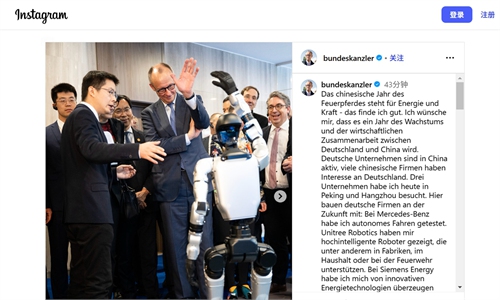
Posting photos of him waving and smiling toward a humanoid robot later on Thursday, Merz said on Instagram, "the Chinese Year of the Horse represents energy and power… I wish it will be a year of growth and economic cooperation between Germany and China. I visited three companies today in Beijing and Hangzhou. This is where German companies are building on the future."
He continued, "What makes this trip particularly important for me is that we have great interest in the further development of our economic relations - but for this to happen, our companies must be on a level playing field. We need transparency, reliability and adherence to common rules. We intend to deepen discussions on these issues in the coming months."
In Hangzhou, Merz met with representatives from 10 Chinese firms from sectors ranging from traditional manufacturing, artificial intelligence, humanoid robots, and new energy vehicles, according to Yuyuantantian. The Chinese media commented that the 10 enterprises not only encapsulate the trajectory of China's industrial exploration, but also represent the new direction of China-Germany cooperation.
'Systemic rival no longer fits the tone'
The German Chancellor's visit was captured and shared widely by many passersby on the streets, earning enthusiastic welcomes from netizens across Chinese social media. One netizen named Jason Xu commented: "Why Hangzhou? I'd say because Hangzhou is exactly the China that Germany wants to connect with."
"On the surface it's about touring companies, but deep down it's a strategic meeting between Germany's Industries 4.0 and China's digital powerhouse," the post read.
In a report titled Chancellor Merz Confronts a Confident China, German media ZDF astutely observed that back in the 1980s, German automakers brought their technologies to China and formed joint ventures. Today, however, those Chinese partners have taken a leading position in software and battery manufacturing, and major German enterprises now prefer to cooperate with Chinese companies on their own initiative.
"Systemic rival" no longer fits the tone - Table Briefings commented on Merz's China trip: "On his inaugural visit, Friedrich Merz is emphasizing partnership with China. The chancellor no longer speaks of a 'systemic rival.'"
Jiang Feng, a researcher at Shanghai International Studies University and president of the Shanghai Regional Studies Association, who attended several parallel meetings of the visit, noted that as Europe is currently grappling with severe security and competitiveness challenges alongside a waning global influence, it is understandable that Merz previously formed the perception of China as a "systemic rival" given his judgments of China shaped from a European perspective.
However, what he saw firsthand during this visit and the extensive exchanges with various sectors would have left him with a completely different impression. "Both sides have come to realize that China and Germany should not be so-called 'systemic rivals', but rather strategic cooperative partners," Jiang said.
Compared with earlier visits to China by leaders of France and the UK, the German leader is distinguished by a distinctly German brand of pragmatism, Jiang said. Discussions between the two sides faced problems head-on, focusing on concrete solutions and implementation paths rather than superficial exchanges.
Before his China visit, Merz noted that it is no coincidence that French President Macron, British Prime Minister Starmer, and himself are visiting China one after another within just a few weeks.
While Macron concluded his visit by touring the historic Dujiangyan Irrigation System and engaging with Chinese university students, and Starmer immersed himself in local culture during a stroll through Shanghai's iconic Yuyuan Garden, Merz—representing a nation where technological innovation and manufacturing excellence run deep in its DNA—filled his itinerary with intensive engagements in cutting-edge technology and industry.
Yet even amid this packed high-tech schedule, he made a deliberate point to visit the Palace Museum on Thursday morning, taking time to experience and appreciate Chinese cultural heritage firsthand.
In the Forbidden City of ancient time, Merz signed the guestbook, invoking the Chinese zodiac to chart a path forward. "I wish us a good pace, strength, and energy for the Year of the Horse," he wrote. "May it be a year of collaboration and growth for Germany and China."
RELATED ARTICLES