The US’ self-directed ‘China nuclear threat’ will only be a waste of effort: Global Times editorial
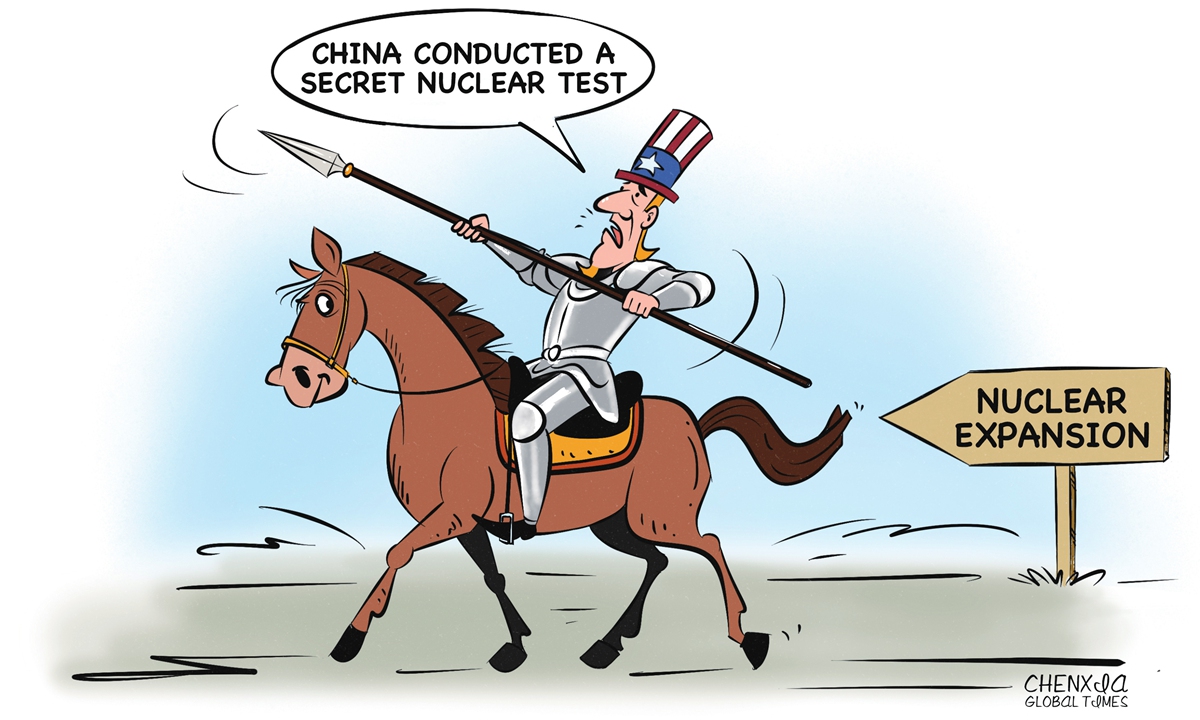
Illustration: Chen Xia/GT
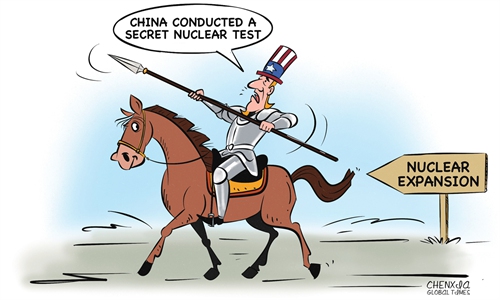
On Wednesday, US Secretary of State Marco Rubio again touched upon China in terms of nuclear weapons negotiations, claiming that any nuclear arms treaty must include China. In the same few days, CNN pub lished an "exclusive report," citing so-called intelligence sources, to hype up the so-called "Chinese nuclear test." These coordinated efforts are just a carefully orchestrated show by Washington. Earlier this month, Christopher Yeaw, assistant secretary for the Bureau of Arms Control and Nonproliferation at the US Department of State, disclosed a so-called "breaking news," claiming that China conducted nuclear testing in 2020, causing a stir in international public opinion. Since then, the "China nuclear threat" rhetoric, directed by Washington, has been launched.
With high-ranking officials making statements, the so-called "insiders" disclosing information to the media, and a number of mainstream media outlets echoing the sentiment, Washington's elaborate efforts are clearly driven by self-interest. The intention is obvious: Simultaneously with Yeaw's alleged "Chinese nuclear test" revelations, he also conveniently stated that the US will return to testing on an "equal basis." This timing coincides with the expiration of the New START Treaty between the US and Russia, a time when the US faces immense international pressure. Clearly, hyping up the "Chinese nuclear threat" is a two-pronged approach: It allows the US to deflect responsibility for deliberately delaying or even abandoning US-Russia nuclear negotiations, while simultaneously providing a fig leaf for its shady ambition to resume nuclear testing.
Washington's close monitoring of China's nuclear development is no secret. Take last year as an example. The Arms Control Treaty Compliance Report published in April focused solely on Russia's suspected supercritical tests, while the Report to Congress on Military and Security Developments Involving the People's Republic of China released in December detailed the so-called China's nuclear arsenal expansion and missile deployments, making no mention of so-called nuclear tests. It's worth noting that these reports, in order to prove the so-called "China threat," gathered various rumors from different sources. If there were truly "concrete information," would Washington have kept it hidden from 2020 until now? Why didn't it disclose it in official reports, but instead waited until the expiration of the New START Treaty between the US and Russia to release it? Moreover, global seismic networks, including the US Geological Survey under the Department of the Interior, did not record any abnormal seismic events at that time.
But this blame-shifting spectacle isn't merely friction between China and the US. The US possesses more than 5,000 nuclear warheads, a considerable number of which are deployed in a ready-to-launch posture. It also stations tactical nuclear weapons in six NATO countries capable of conducting nuclear strikes. Under such circumstances, how could China engage in so-called "equal negotiations"? As the country with a vast nuclear arsenal and the greatest impact on global strategic balance, the US should shoulder special and primary responsibility for nuclear disarmament and demonstrate genuine sincerity. The reality, however, is that Washington not only shows no intention of reducing its arsenal, but is accelerating nuclear expansion. Should Washington fail to restrain its nuclear ambitions, the consequences for the world would be disastrous.
Facts indicate that the US itself has become the greatest hidden danger to global nuclear security. It has withdrawn from multiple international arms control agreements, while continuing to modernize its nuclear arsenal, develop new nuclear weapons, expand the scope of nuclear strike capabilities, and even lower the threshold for nuclear use. By introducing nuclear deterrence into regional conflicts, it has seriously undermined the stability of the global nuclear security architecture. More ironically, while frequently accusing other countries of "developing nuclear capabilities," the US simultaneously engages in nuclear deterrence cooperation with its allies, transfers nuclear technology, and deploys nuclear equipment abroad. The double standard is evident.
It is the strong expectation of the international community that the US assumes its due responsibility as a major power in safeguarding global nuclear security. What Washington should do first is stop shifting blame. It should immediately resume strategic stability dialogue with Russia and discuss follow-up arrangements to the New Strategic Arms Reduction Treaty. In addition, AUKUS, which has raised concerns about nuclear proliferation, should be halted, and Washington should exercise restraint over its "close ally" Tokyo's increasingly swelling nuclear ambitions. The waste contamination left behind by dozens of US nuclear tests in the South Pacific also urgently requires remediation. In the nuclear issue, Washington has many pressing responsibilities to fulfill, rather than "finding faults" with China.
Nuclear arms control is a shared security issue for all humanity. Safeguarding it requires major powers to take proactive responsibility. During the Conference on Disarmament in Geneva, China said it is willing to maintain communication with all parties and exchange views on the work of the Conference and on the Review Conference of the Parties to the Treaty on the Non-Proliferation of Nuclear Weapons. China has long participated in and supported a range of arms control, disarmament, and non-proliferation mechanisms - actions and contributions that are visible to the international community. Washington's elaborate scheme, full of hidden motives, lacks both persuasiveness and credibility, and will ultimately be a waste of effort. Hopefully, it could do something genuinely meaningful that contributes to world peace and security.
RELATED ARTICLES