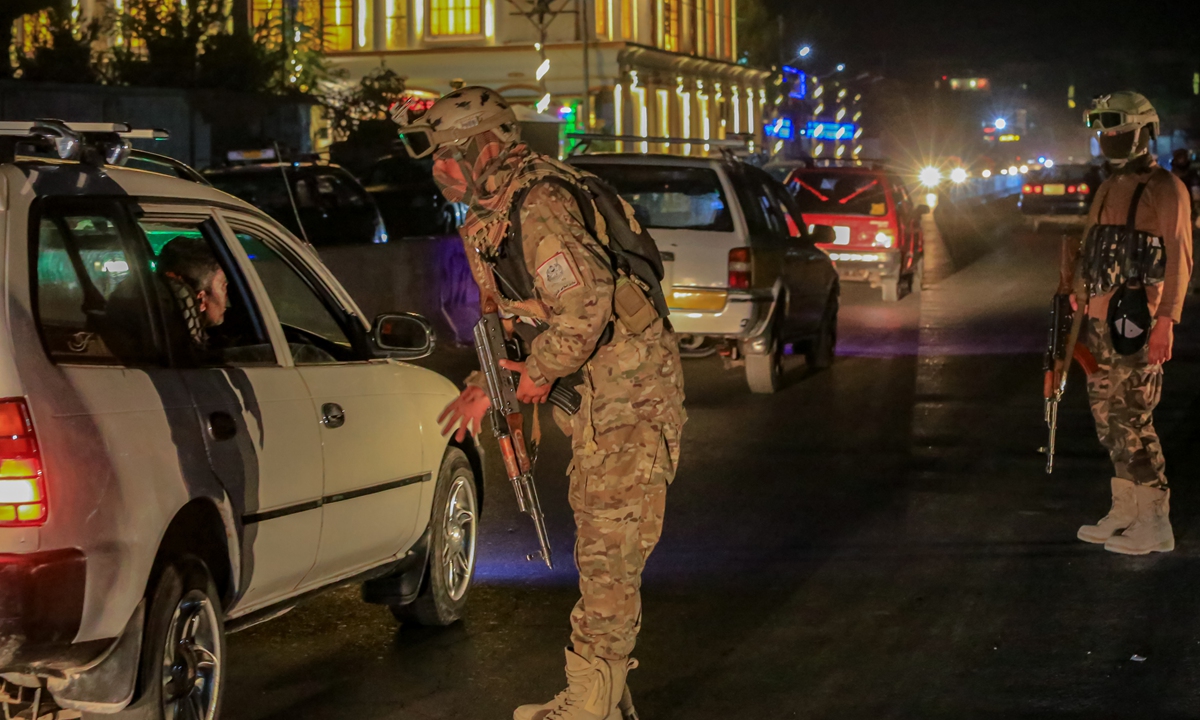
Taliban security forces check a vehicle at a checkpoint in Kabul, Afghanistan, 26 February 2026. Clashes erupted along the border as Taliban authorities said Afghan forces attacked Pakistani military posts following recent Pakistani air strikes in Nangarhar and Paktia. Both sides reported heavy fighting and casualties, escalating tensions between Afghanistan and Pakistan amid worsening diplomatic relations. Photo: VCG
At 3 pm on Friday, in the Blue Hall of China's Foreign Ministry in Beijing, Foreign Ministry spokesperson Mao Ning faced a packed press briefing where one question dominated: the latest surge in the conflict between China's neighboring countries, Pakistan and Afghanistan.
China is closely following the developments. "As their neighbor and friend, China is deeply concerned over the escalation of the Pakistan-Afghanistan conflict and is saddened by the casualties," Mao Ning said, urging both sides to achieve ceasefire as soon as possible.
Just hours earlier, clashes along the long and volatile border between the two neighbors had surged to the top of global headlines. From Al Jazeera and the BBC to the Xinhua News Agency, international media once again turned its attention to renewed violence along the frontier. The latest bloodshed marked the most serious flare-up since the two sides signed a fragile ceasefire in October 2025.
Open war
Pakistani Defence Minister Khawaja Asif said on Friday that Islamabad would now be waging "open war" as his country's "patience has run out" with the Taliban authorities in Afghanistan, following attacks by Afghan forces against Pakistani military positions along their shared border areas.
The new round of hostilities has caused casualties on both sides, although the figures remain contested.
According to Al Jazeera, Ahmed Sharif Chaudhry, the director general of Pakistan military's media wing, says 274 Taliban fighters have been killed and more than 400 injured by Pakistani attacks. He added that 115 tanks, armored personnel carriers and artillery pieces were also destroyed.
At least 12 Pakistani soldiers have been killed in the latest cross-border fighting with Afghanistan, a Pakistani army spokesperson confirmed in a news conference, according to Al Jazeera.
On the Afghan side, Taliban government spokesman Zabiullah Mujahid told the BBC that Afghan forces had destroyed 19 Pakistani border posts and detained a number of Pakistani soldiers. He also claimed that more than 50 Pakistani troops had been killed, according to the BBC. Both sides have reported civilian casualties.
The deadly confrontation began Thursday night, when Afghanistan launched a cross-border attack on Pakistan, saying it was in retaliation for deadly Pakistani airstrikes on Afghan border areas on Sunday. Pakistan then carried out airstrikes in Kabul and two other Afghan provinces early Friday, according to the Associated Press.
Residents along the border described an atmosphere of mounting fear. "My friends in Afghanistan told me that they have frequently heard Pakistani fighter jets flying overhead since last night. Pakistani residents living in the Pakistan-Afghanistan border region heard intense gunfire and artillery fire early this morning, and saw Afghanistan military drones this afternoon," Hu Yuzhen, a Chinese national in Islamabad, told the Global Times on Friday.
In terms of intensity, this may be the most severe exchange of fire since the Taliban returned to power in 2021. More strikingly, it marks the first time Pakistani officials have formally used the term "open war", suggesting the confrontation has escalated to a level just short of a formal declaration of war, Zhu Yongbiao, director of the Center for Afghanistan Studies at Lanzhou University, told the Global Times on Friday.
"This round of conflict is essentially the accumulation of old and new grievances between Pakistan and the Afghan Taliban," Zhu said. "It is the result of a deteriorating situation and mounting contradictions in recent years, which have finally erupted in an explosive escalation."
The escalation follows months of intermittent clashes. "Pakistanis in Islamabad are already used to the military conflict between Pakistan and Afghanistan," Hu said. "The Pakistanis around me don't believe that this is a real war, because the conflict between Pakistan and the Afghan Taliban is long-standing, and their military conflict has lasted for more than six months."
However, the protracted fighting has inflicted mounting casualties and deepened hostility between two countries that once maintained close ties, Hu said.
In Kabul, however, the narrative differs. Obaidullah Baheer, a Kabul-based political analyst and adjunct lecturer at the American University of Afghanistan, said that "Pakistan claimed that it was doing that in response to TTP (Tehreek-e-Taliban Pakistan) attacks based on the bogus claim that the Taliban are supporting the TTP, an insurgent group operating within Pakistan," arguing there is "no evidence" showing that the Taliban is sheltering or backing the group. Baheer also alleged that there are circles within the Pakistani military that want conflict, adding that "nothing seems to back them off," according to Al Jazeera.
Zhu noted that the roots of the conflict are complex. Beyond security concerns, there is the unresolved dispute over the Durand Line, which Afghan authorities do not recognize as the legitimate border. Pakistan argues that its domestic counterterrorism situation has deteriorated markedly since 2021 and accuses the Afghan Taliban of failing to effectively restrain the TTP, alleging that some attacks against Pakistan were planned or launched from Afghan territory. The Afghan Taliban firmly denies these claims, insisting the issue is Pakistan's internal affair and should not be shifted onto Afghanistan.
Mutual accusations have further eroded trust. Pakistan long viewed itself as a supporter of the Afghan Taliban, yet after the Taliban regained power, Kabul did not reciprocate in ways Islamabad had expected. Meanwhile, perceived Afghan diplomatic overtures toward India have deepened Pakistan's suspicions, Zhu said.
Historical grievances and contemporary geopolitical frictions are now "adding fuel to the fire" between the two neighbors, he added.
Global call for peace
As tensions rise, calls for restraint have grown louder worldwide. China, the United Nations and Russia are among those urging both sides to resolve disputes peacefully.
Mao Ning said Friday that the intensity of ongoing clashes between Pakistan and Afghanistan has gone beyond previous levels. Any protraction or escalation will inflict harm and losses on both sides. China supports combating all forms of terrorism and calls on the two sides to remain calm, exercise restraint, properly resolve differences and disputes through dialogue and negotiation, end the fighting as soon as possible, and avoid more suffering.
Mao added that China has been mediating between the two sides via its own channels, and stands ready to continue playing a constructive role for de-escalation and the improvement of relations between the two countries.
"Our Ministry and embassies in Pakistan and Afghanistan are engaging relevant sides in the two countries. China asks Pakistan and Afghanistan to ensure the safety and security of Chinese personnel, projects and institutions in the two countries," Mao said.
Russia has urged Afghanistan and Pakistan to halt cross-border attacks and resolve their differences through diplomatic means, the RIA news agency reports, citing the foreign ministry, according to Al Jazeera.
UN Secretary-General Antonio Guterres is closely monitoring reports of escalating cross-border clashes between Afghanistan and Pakistan, expressing deep concern over the recent surge in violence. In a statement delivered by his spokesperson, Stephane Dujarric, Guterres urged both nations to adhere strictly to their obligations under international law, with a specific emphasis on international humanitarian law, and underscored the urgent need to prioritize civilian protection, Al Jazeera reported.
RELATED ARTICLES