Beware of the nuclear ghost haunting East Asia: How far is Japan from nuclear armament?
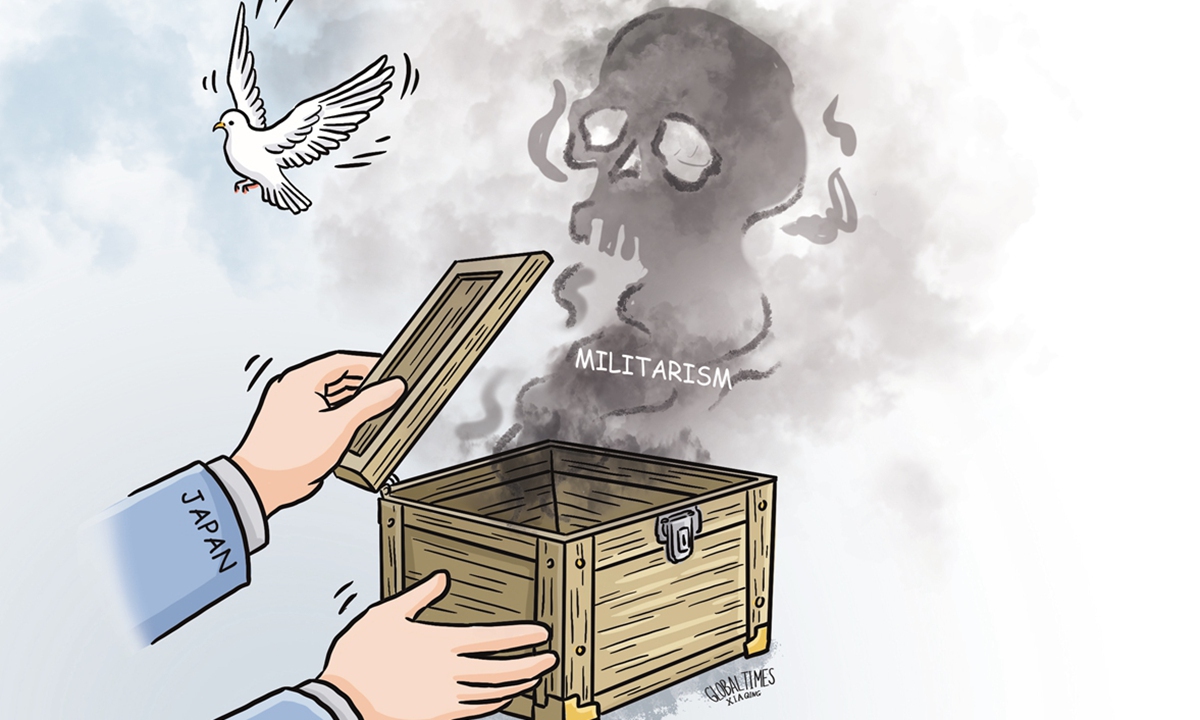
Illustration: Xia Qing/GT
Recent attempts by right-wing forces in Japan to revise the Japanese government's long-standing Three Non-Nuclear Principles have triggered alarm and warrant close scrutiny. A joint report by China Arms Control and Disarmament Association and China Institute of Nuclear Industry Strategy, titled "Nuclear Ambitions of Japan's Right-Wing Forces: A Serious Threat to World Peace," argues that Japan's nuclear capability is already well beyond the starting line. The country has already sat atop substantial stocks of sensitive nuclear materials and a relatively complete technological system. This raises a sobering question: How close is Japan to reaching a nuclear breakout capacity?
Fissile material: How large is the stock?
Start with the numbers. On plutonium, Japan holds the world's fifth largest civil stockpile of separated plutonium. At the end of 2024, it possessed approximately 44.4 metric tons of unirradiated separated plutonium, with about 8.6 metric tons stored domestically and 35.8 metric tons held at reprocessing facilities in the UK and France. That total is roughly four times Japan's plutonium holdings in 1993. Except for these separated stocks, Japan's spent fuel is estimated to contain about 191 metric tons of plutonium that remains unseparated in highly radioactive spent-fuel form. International experience shows that reactor-grade plutonium can also be used to produce nuclear weapons, meaning that it is technically feasible to use such material as the fissile core of a nuclear explosive device.
On uranium, the volume of Japan's civil stockpile of highly enriched uranium (HEU) is also significant for a non-nuclear-weapon state. Public data compiled by the James Martin Center for Nonproliferation Studies indicate that Japan's civilian HEU holdings are roughly 1.8 metric tons, one of the largest among non-nuclear-weapon states. Although some have been shipped out or down-blended, recent developments show that Japan retains an operational capability. In October 2025, Japan Nuclear Fuel Limited received uranium hexafluoride feedstock at the Uranium Enrichment Plant in Rokkasho Village for the first time since 2014, a step indicating its capability to resume routine enrichment operations. In nonproliferation assessments, such an enrichment capability that is usable in practice, scalable and reconfigurable is in itself a common risk threshold.
So how many nuclear weapons could Japan's stockpile yield? According to the International Atomic Energy Agency (IAEA), about 8 kilograms of plutonium or 25 kilograms of uranium-235 in highly enriched form constitute a significant quantity of nuclear material, roughly the amount needed for one crude nuclear explosive device. By this standard, Japan's domestic plutonium inventory of 8.6 metric tons alone would be sufficient for roughly 1,075 nuclear devices, while its total separated plutonium stockpile of 44.4 metric tons would be sufficient for about 5,550. Its civilian HEU holdings could in theory be converted into dozens of nuclear devices. Even after accounting for processing losses or technical inefficiencies, the latent arsenal embedded in Japan's sensitive nuclear materials still far exceeds what would be required for a medium-sized nuclear weapons stockpile.
Conversion time: How fast could it happen?
Japan possesses multiple forms of nuclear materials, the weaponization of which is all within the time window in terms of both the degree of difficulty and the time required. According to IAEA estimates, the time needed for conversion varies by material type. Plutonium metal or HEU metal could be fabricated into nuclear explosive components in roughly seven to 10 days. Converting plutonium or uranium oxides and other chemical compounds into metal would take about one to three weeks. Recovering plutonium from spent reactor fuel would take approximately one to three months, accounting for cooling, fuel shearing, dissolution and chemical separation. Further enriching existing stocks of low enriched uranium to weapons grade could take several months to about a year.
In an extreme contingency, should Japan set aside longstanding political constraints and pursue nuclear weapons, it could produce a basic nuclear explosive device within six to 12 months, drawing on its existing scientific and industrial base. To reduce the risk of a diplomatic and political backlash and sanctions, Tokyo could validate a design through high-end simulations and existing test data rather than an overt nuclear test, while keeping any assembled warheads undeclared to preserve deliberate ambiguity.
In the medium term, several assessments suggest that Japan could translate latent capacity into an initial nuclear arsenal within roughly three to five years. In 2023, former US secretary of state Henry Kissinger warned that Japan could become a nuclear power within five years. Within that window, Japan could possibly miniaturize warheads and integrate them with delivery platforms, fielding an arsenal measured in dozens of warheads. It could also establish a basic command-and-control architecture with a professional force. France, by comparison, spent about seven years after its first nuclear test developing operational capabilities for both air-delivered and sea-based systems. Japan's industrial and technological base is far more advanced. Therefore, once political constraints are lifted, the pace of progress should not be underestimated.
Delivery readiness: How mature is the capability?
Developing nuclear weapons requires a sequence of demanding steps: fissile material conversion and metallization, warhead design, precision machining, high-explosive lens fabrication and assembly, integration of the firing and detonation system, and miniaturization for delivery. Based on available evidence, Japan appears to face no major technical gaps across this chain.
Delivery systems and integration present a similar picture. Japan has a strong technological base in space launch and long-range rocket engineering. Although its postwar constitutional and policy constraints have limited certain missile deployments, decades of work on solid-fuel, multistage launch vehicles have built expertise in stage separation, guidance and precision flight control, with clear overlap with long-range missile technologies. The three-stage M-V launch vehicle and the newer Epsilon program have steadily added experience in control, guidance and reliability engineering. The successful high-speed reentry and recovery of the Hayabusa return capsule further demonstrated advanced thermal protection and reentry trajectory control, capabilities needed for designing a reentry vehicle for a warhead.
Japan's capabilities in precision manufacturing and electronics further strengthen its readiness in the military nuclear arena. Producing a compact, deliverable nuclear warhead requires exceptionally tight machining tolerances, high-purity specialty materials, and dependable detonation and fuzing electronics. Japan's long-standing strengths in precision engineering, robotics and conventional chemical explosive engineering suggest that its industrial base is able to meet exacting requirements for components such as high-explosive lenses and complex firing circuits.
In terms of human resources and know-how, Japan has a deep bench. Roughly 13 universities in Japan have nuclear engineering or related majors, producing a steady stream of nuclear engineers, material scientists and physicists. During the Cold War, Japan's nuclear research institutions quietly retained teams that engaged in theoretical research on nuclear explosions. In short, the required scientific knowledge is there. If the political leadership in Tokyo were to give the green light, Japan could swiftly mobilize the necessary experts and technicians to kick-start a weapons program.
In summary, be it for the quantity of available nuclear materials, the estimated timelines for converting materials into weapons or the existing technical expertise and infrastructure, Japan faces no obvious technical barriers in any aspect of nuclear weapons development. The real constraints on Japan's nuclear option are not capability, but political ambition and international verification. If Japan were to break the nuclear taboo, its industrial and technological reserves would enable an extraordinarily rapid leap from zero nuclear weapons to a functioning nuclear arsenal. The continued attempts by Japan's right-wing political forces to revise the country's Three Non‑Nuclear Principles are part of a deliberate, step-by-step campaign to challenge and erode the postwar international order and the global nuclear non-proliferation regime. This is a dangerous trend, and the world should remain highly alert and resolutely oppose it.
Preserving hard-won peace and stability is a shared responsibility for the region and the wider international community. If Japan's latent nuclear capability were ever translated into an actual arsenal, it would reshape regional security dynamics and weaken the global nonproliferation regime. This risk should not be dismissed. It is essential to stay vigilant and take coordinated actions to ensure that the nuclear ghost will never haunt East Asia.
The author is an assistant professor at China Foreign Affairs University and can be reached at y.stellaris@outlook.com.
