China condemns killing of Iran’s Supreme Leader
US strike on Iran could draw US into escalation it may struggle to control: expert
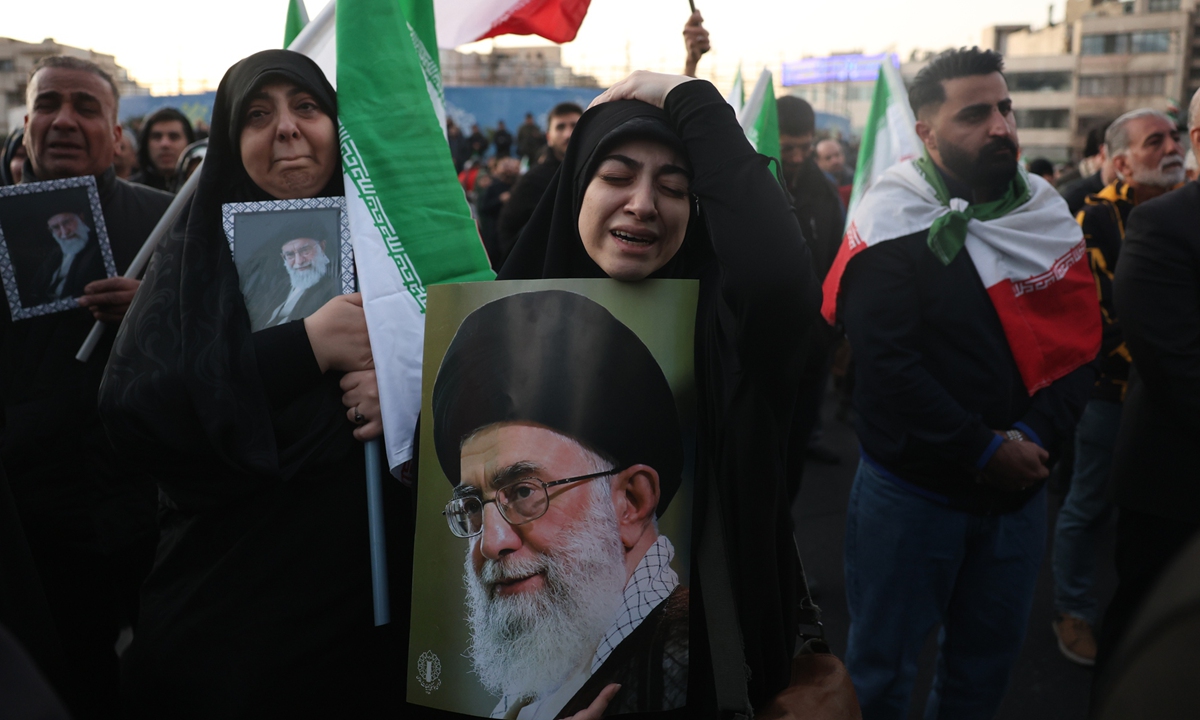
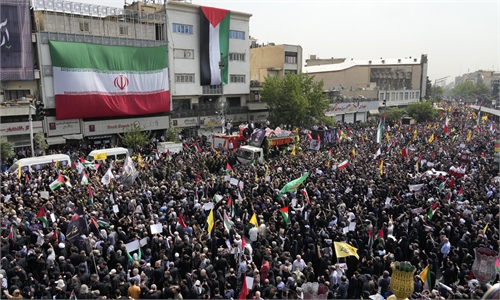
Mourners hold pictures of Iranian Supreme Leader Ayatollah Ali Khamenei at Enqelab Square in Tehran on March 1, 2026 after local media confirmed his death. Photo: VCG
China on Sunday strongly condemned the killing of Iran's Supreme Leader Ayatollah Ali Khamenei, calling the move "a grave violation of Iran's sovereignty and security."The US-Israeli strikes against Iran have drawn widespread attention and condemnation from international observers and media outlets, with Al Jazeera describing them as "the most aggressive escalation yet of US reliance on military force to pressure foreign governments."
Chinese experts warned that the operation represents a high-stakes gamble that could draw Washington into a prolonged and widening crisis it may struggle to control. They also warned that the US' killing of another country's leader, if becoming a pattern of behavior, would further complicate the global security landscape and provoke even more extreme acts of retaliation.
A spokesperson with the Chinese Foreign Ministry said on Sunday in a statement that the attack and killing of Iran's supreme leader is a grave violation of Iran's sovereignty and security. It tramples on the purposes and principles of the UN Charter and basic norms in international relations.
"China firmly opposes and strongly condemns it. We urge for an immediate stop to the military operations, no further escalation of the tense situation and joint effort to maintain peace and stability in the Middle East and the world at large," read the statement.
Iran confirmed early Sunday that its Supreme Leader Ali Khamenei was killed in US-Israeli airstrikes the previous day, Xinhua said, citing Iran's Nour News affiliated with the country's Supreme National Security Council.
Fox News, citing Israeli officials, also claimed that Saturday's strikes killed more than 40 senior Iranian security and government figures, noting that five to 10 top Iranian leaders were killed, along with Khamenei, who were meeting at a compound in Tehran.
Iran's ex-President Mahmoud Ahmadinejad was also killed in the attacks, Xinhua updated on Sunday evening, citing reports.
The Iranian government also declared 40 days of mourning and 7 days of public holidays over the martyrdom of the Supreme Leader, Press TV reported.
After Khamenei's death was confirmed, Chinese Foreign Minister Wang Yi had a phone call with Russian Foreign Minister Sergei Lavrov on Sunday. "It is unacceptable for the US and Israel to launch strikes on Iran during the Iran-US negotiations. It is also unacceptable for them to openly kill the leader of a sovereign state and encourage government transfer," Wang told Lavrov.
The fighting has now spread across the entire Persian Gulf region, and the situation in the Middle East risks being pushed into a dangerous abyss. China is highly concerned about these developments, said Wang.
Wang outlined China's position on the situation: an immediate cessation of military operations, a prompt return to dialogue and negotiations, and a joint opposition to unilateral actions, per Xinhua.
Lavrov said Russia, aligned with China, is willing to strengthen coordination and communication with Beijing and use platforms such as the UN and the Shanghai Cooperation Organization to send a clear signal, calling for an immediate stop to the fighting and a return to diplomatic negotiations.
Iranian President Masoud Pezeshkian, the Head of the Judiciary, and one of the jurists of the Guardian Council will be responsible for the transitional period following the martyrdom of that Supreme Leader Ayatollah Ali Khamenei, according to Iran's Fars News.
Pezeshkian condemned the killing as "a great crime," according to a statement from his office.
The Islamic Revolutionary Guard Corps (IRGC), in a statement published on its official outlet, Sepah News, offered its condolences and vowed that the Iranian nation would exact "a hard, decisive, and regret-inducing" punishment on the "murderers." It denounced the US and Israeli attack as a "criminal and terrorist" act that violated international norms.
The most devastating offensive operation in the history of Iran's armed forces is set to begin shortly, targeting the occupied territories and US bases, Iran's Press TV reported following the news of the Iranian Supreme leader's death.
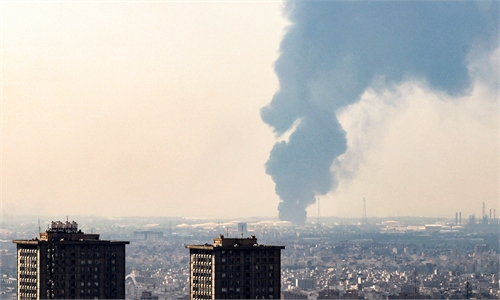
Iran said it has launched "extensive missile and drone" attacks on Israel and US military bases in the region. It said 27 US bases, as well as the Israeli Tel Nof airbase, the Israeli army's command headquarters at HaKirya in Tel Aviv, and a large defense industrial complex in the same city, were attacked.
After Iran's warning, US President Donald Trump responded on his Truth Social platform that "Iran just stated that they are going to hit very hard today, harder than they have ever been hit before."
"They better not do that, however, because if they do, we will hit them with a force that has never been seen before!"
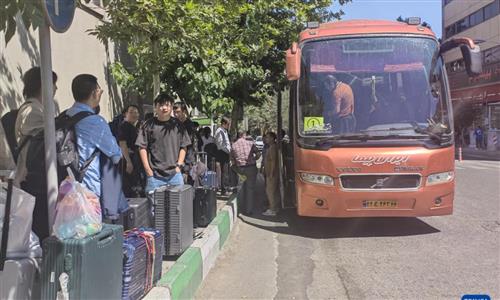
The Chinese Foreign Ministry and Chinese embassy and consulate in Iran on Sunday have reminded Chinese citizens in the country to evacuate to safe areas as soon as possible through appropriate means after US and Israel launched military operations against Iran.
There has been Chinese nationals injured in the attacks, and some temporary travelers are stranded locally, according to the Chinese Foreign Ministry on Sunday evening. The Chinese Ministry of Foreign Affairs reminded that Chinese citizens to closely monitor developments in the situation and temporarily avoid traveling to countries and regions around Iran that have been affected by military actions.
A Chinese national surnamed Xiong, who works in the photovoltaic industry in Tehran, told the Global Times that he has contacted the Chinese Embassy in Iran to take the bus to Azerbaijan, a journey expected to take about half a day. "I still don't know whether it is easy to pass the border of Azerbaijan and where we take the flight to go back to China," Xiong told the Global Times.
Bao Lijun, president of the Azerbaijani Overseas Chinese Association, told the Global Times on Sunday afternoon around 4 pm that the first batch of more than 10 Chinese nationals in Iran have arrived at the Astara border crossing. Next, according to the arrangements, they will be safely transported to Baku, the capital of Azerbaijan.
The Chinese Embassy in Israel on Sunday also issued a notice regarding the registration for relocation and evacuation of Chinese nationals in Israel after the US and Israel launched strikes against Iran. Multiple embassies in the Middle East, including those in Turkey, Azerbaijan, and Iraq, have issued notices for Chinese nationals who seek to evacuate from Iran to these countries.
The war started by the US and Israel on Iran has quickly escalated, prompting anxiety and concern in the whole region. In retaliation, several countries that host US military bases in the region including the United Arab Emirates, Qatar and Bahrain say they have been attacked, NBC reported.
Obvious motive
Global Times reporters noticed on Sunday afternoon that the Iranian national flag was flown at half-mast at the Iranian Embassy in China. Just 200 meters near the embassy, a 73-year-old man surnamed Luo told the Global Times that the strike on Iran is just the US trying to control the Middle East. "For its own national interests, it [US] supports Israel. If Iran is brought down, then Israel would have no real rival in the region. That is what serves America's interests in the Middle East," Luo said.
Also, according video footage circulated on Chinese social platform Weibo, the Iranian national flag at the Iranian Consulate in Shanghai was also flown at half-mast on Sunday morning and so was the flag of Secretariat of the Shanghai Cooperation Organization (SCO) on Sunday, according to SCO official Weibo account.
UN Secretary-General António Guterres condemned the US-Israeli airstrikes on Iran on Saturday and called for an immediate return to negotiations "to pull the region, and our world, back from the brink," according to Associated Press.
The Kremlin on Sunday published on its website a condolence message written by Russian President Vladimir Putin to the Iranian President. Putin expressed "deepest condolences" to Masoud Pezeshkian, condemning the "cynical violation of all norms of human morality and international law" in the killing of Ali Khamenei and members of his family.
A spokesperson with the DPRK Foreign Ministry issued a press statement on Sunday, condemning the military strikes against Iran by the US and Israel, according to the Korean Central News Agency (KCNA). Israel's military attack on Iran, launched under the US active support and patronage, and the military action of the US which joined in it are an illegal act of aggression and the most despicable form of violation of sovereignty in their nature from A to Z, read the statement, KCNA reported.
French President Emmanuel Macron wrote on X on Saturday that "the outbreak of war between the US, Israel, and Iran carries grave consequences for international peace and security … The ongoing escalation is dangerous for all. It must stop."
The Trump administration and Israel conducted their strikes as part of their efforts to push Iranians to overthrow their country's system. Trump also spoke about the need to destroy Iran's nuclear, ballistic missile and other military capabilities, which Israel, too, sees as major threats. Indeed, officials said Trump decided to use military action after deciding that Iran's regime would not commit to his satisfaction to forgo nuclear weapons, according to US media Politico.
If Iran's retaliation inflicts heavy casualties on the US and triggers further escalation, this would also pose a significant test for Washington - particularly for the Trump administration, Liu Zhongmin, a professor at the Middle East Studies Institute of Shanghai International Studies University, told the Global Times.
Strategically, Trump may seek to deliver maximum pressure and damage against Iran while avoiding entanglement in a prolonged conflict or ground war, attempting instead to manage the confrontation through what could be described as "controlled escalation." However, whether the US can truly keep the pace and scope of escalation under control remains highly uncertain, Liu noted.
The US move represents a blatant display of hegemonism, targeting the leaders of countries that defy its dictates without any legitimate justification and in clear violation of international law, Tian Wenlin, a professor at the School of International Studies at Renmin University of China, told the Global Times.
Wang Yi during his phone conversation with Lavrov, urged that the international community should send a clear and unequivocal message against the world regressing to the law of the jungle.
Should this "law of the jungle" harden into precedent, the basic machinery of the international order would begin to erode, Tian said, noting that the current situation only further underscores the importance of China proposed Global Security Initiative, which emphasized on abiding by the purposes and principles of the UN Charter and to peacefully resolving differences and disputes between countries through dialogue and consultation.
RELATED ARTICLES