The power of planning: Chinese NEVs rewrite the global automotive landscape
Chinese NEVs rewrite the global automotive landscape
By Yang Shasha, Ma Mengyang, in Beijing and Qing Mu in Germany Published: Mar 02, 2026 12:48 AM

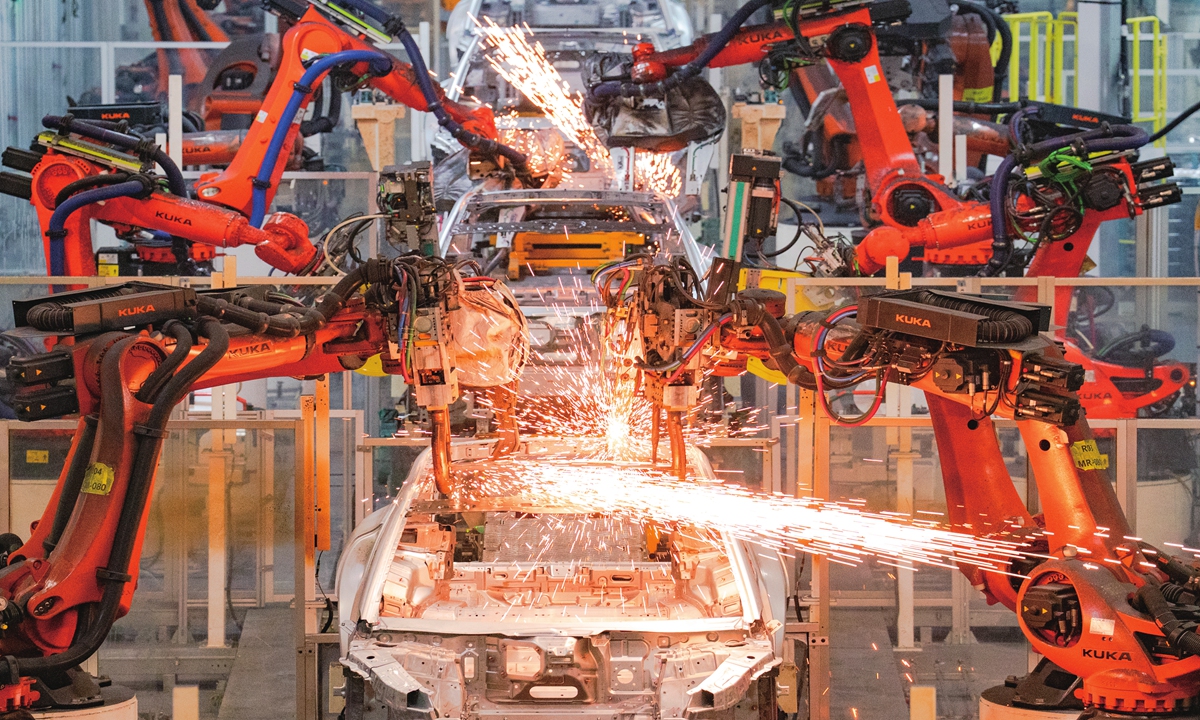
Robots perform welding operations at the BAIC New Energy Super Factory in Beijing on December 12, 2025. Photo: VCG
Editor's Note:Chinese new-energy vehicles (NEVs), which were described by some Western media a decade ago as low quality and short in range, are now being hailed by US news website Semafor as "Chinese EVs can save Detroit."
What accounts for such a dramatic transformation in China's electric vehicles (EV) industry? Chinese and foreign automakers and scholars, recently interviewed by the Global Times, emphasized that the industry's structural upgrade reflects the impact of scientific planning and consistent implementation, the increasing maturity of the industrial chains, and new achievements in high-level opening-up - all of which continue to drive fresh momentum for China's high-quality economic development. The Global Times launches a series of special reports on China's evolution into an automobile powerhouse. This is the first installment.
Strategic planning drives industrial leap
What we have called a "miracle" is often born from a deep understanding of historical opportunities and forward-looking strategic planning. The formulation and implementation of Five-Year Plans have long been an important means through which the Communist Party of China governs the country. The rapid development of China's NEV industry is a compelling example of how strategic planning can guide a specific sector, driving its historic transition from a "follower" to a "global frontrunner."
It is precisely this long-term commitment to "follow a good blueprint through to the end" that has provided stable policy support and a sound market environment for the development of NEVs, enabling them to overtake competitors on the curve in the shift toward electrification. The systematic framework established through planning has refined the "three verticals and three horizontals" technological road map, while also shaping the upstream, midstream, and downstream industrial ecosystem, thereby forging a full-industry-chain advantage.
This industrial miracle has long transcended the sector itself. It demonstrates to the world the remarkable strength that can be unleashed when an effective market and a proactive government work in concert within a long-term national development strategy. While some Western countries still view industrial competition through the outdated lens of subsidy rollbacks and trade barriers, China continues, through steadfast long-term planning, to cultivate fertile ground for industrial growth.
'It's a miracle'
In May 2014, during an inspection of SAIC Motor, Xi Jinping, general secretary of the Communist Party of China Central Committee and Chinese president, emphasized that developing NEVs is essential for China to evolve from an automobile power to an automobile powerhouse.
Following these directives, the Chinese government implemented a series of policies and measures. In July that year, the State Council, China's cabinet, issued guidelines on accelerating the promotion and adoption of the NEVs.
A Chinese industry expert who had participated in the formulation of national policies related to NEVs told the Global Times that these guidelines "systematically established a policy framework for the first time, proposing specific requirements and plans from multiple aspects."
The market had gained "stable expectations," helping drive a qualitative leap in the industry's development. In 2015, China's NEV sales exceeded 330,000 units, a record high. Later, China issued policies allowing more types of capital to enter the sector, including lifting shareholding caps for foreign joint ventures. It was against this backdrop that Tesla was able to begin the construction of its Shanghai Gigafactory.
Before China's rise, the global NEV market was dominated by Tesla. A Tesla representative, in an interview with the Global Times, recalled that it took the Shanghai Gigafactory, Tesla's first factory outside the US, less than a year from breaking ground to delivering its first vehicles.
Now, the plant boasts an annual production capacity exceeding 900,000 vehicles, with one rolling off the line approximately every 30 seconds. It serves not only the domestic market but also functions as Tesla's global export hub, supporting its expansion in the Asia-Pacific region. The success of the Shanghai Gigafactory is a milestone in Tesla's globalization strategy.
"It's a miracle. We deeply admire this and feel proud of this," the representative said.
Tesla's "Shanghai miracle" is just one facet of the broader story of China's EV development. The expert recalled China's exploration of NEVs had already begun when he first entered the workforce in the late 1990s.
During the 13th Five-Year Plan period (2016-20), China issued policy documents such as the "Medium- and Long-Term Development Plan for the Automotive Industry." During the 14th Five-Year Plan period (2021-25), China successively issued over 70 industrial policies and measures and introduced more than 100 national and industry standards.
Backed by the series of policy plans, China's NEV sales grew at an average annual rate of more than 50 percent from 2021 to 2024, surpassing 12 million units in 2024. In 2025, BYD overtook Tesla in global sales of battery-electric vehicle, seen as a key marker of the shifting global NEV landscape. That same year, BYD's NEVs alone had entered 119 countries and regions.
China's NEV development has not been entirely smooth; it represents an industrial leap enabled by top-level planning, as well as down-to-earth development that follows the sector's underlying dynamics.
Take EV batteries. During the early stage, the industry faced severe challenges such as low battery energy density and range anxiety.
Liu Jing, a professor of accounting and finance and director of the Investment Research Center at Cheung Kong Graduate School of Business, told the Global Times that early on, Japanese battery makers once held a dominant position thanks to their advances in lithium battery technology. In 2009, China's power battery energy density was less than two-thirds of Japan's level.
When CATL was founded in 2011, Chinese companies had little presence in the global power battery market. Today, the common sentiment in the global battery industry is that "it's easier to shake a mountain than to shake China's advantage."
The Chinese government planned the entire industrial chain in parallel, from upstream lithium mining and refining, through the midstream "three-electric" systems (battery, motor, and electronic control), to downstream charging facilities. The industry expert who had participated in the formulation of national policies related to NEVs said that this combination of policy guidance and market synergy has encouraged many companies to commit to electrification strategies, continuously elevating battery products across technology, quality, performance, and cost.
China's power batteries currently command around 70 percent of the global market share, and anode materials exceed 90 percent.
Throughout this journey, China's commitment to its NEV development path has remained unwavering, despite the challenges it has faced.
Xin Guobin, vice minister of industry and information technology, said that during the 14th Five-Year Plan period (2021-25), companies in the NEV sector increased investment, overcame several technical challenges, and significantly improved product quality and performance. The average driving range of battery-electric passenger cars is approaching 500 kilometers, while costs of power battery cells have fallen by 30 percent, lifespan has increased by 40 percent, and charging speed has improved by more than threefold.
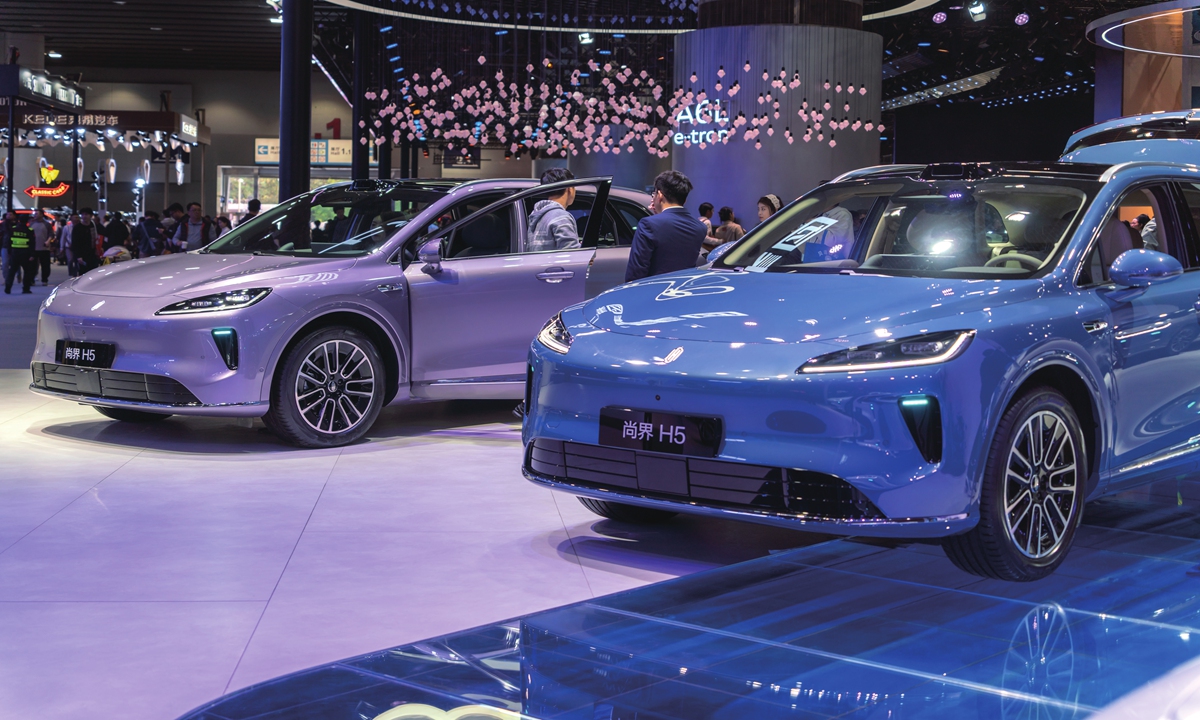
Shangjie, a brand jointly developed by SAIC Motor and Huawei, are showcased at the Guangzhou International Auto Show in South China's Guangdong Province, on November 28, 2025. Photo: VCG
'Our perspective is usually limited to four years, but China's is not'Ferdinand Dudenhoeffer, a prominent German automotive expert and director of the Center for Automotive Research in Bochum, western Germany, began closely monitoring the electric-vehicle market around 2007.
Initially, his research focused on Tesla, which launched the Roadster in Germany in 2009. At that time, in the German market of 3.8 million new cars, only 66 were EVs - a mere drop in the ocean.
Dudenhoeffer told the Global Times that German manufacturers initially dismissed the numbers due to a "not invented here" mind-set. German engineers generally believed EVs had no future.
According to the Chinese industry expert who had participated in the formulation of national policies related to NEVs, as China developed NEVs, it invited several foreign automakers, including German companies, to take part in R&D, but received little response. Dudenhoeffer pinpointed the reason: "Germans lacked confidence in China."
In 2005, three Chinese automakers participated in the International Motor Show (IAA) in Frankfurt, marking the first time Chinese car companies showcased at this important industry event in Europe. German media described Chinese products as "of low quality and safety ratings."
The situation gradually changed after 2015. China began producing highly innovative EVs, with brands like BYD, NIO, and XPeng making concentrated appearances. Concurrently, China's battery industry developed rapidly, with companies like CATL and BYD emerging. In 2019, the first batch of Chinese-made EVs arrived in Germany, making Chinese EVs the focus of the German and European automotive industries. It took Chinese automakers just over one decade to rank among the world's technological leaders.
"China takes a long-term view, precisely what Europe lacks," Dudenhoeffer said, adding that once a policy becomes a national strategy in China, implementation is remarkably strong.
For instance, at the UN General Assembly in 2020, China announced its goals to peak carbon emissions by 2030 and achieve carbon neutrality by 2060.
"While we Europeans hesitate and delay, China is fulfilling its commitments and tackling the problem very systematically, which is completely different from countries like the US." Dudenhoeffer pointed out, "Our perspective is usually limited to four years, but China's is not. Where we are, an election can change all decisions; such an approach cannot make you a world champion."
Dudenhoeffer concluded that China views the future strategically and has immense interest in technological innovation. Consequently, China is on a path to success in many fields.
In February, a New York Times article on China's NEV development reached a similar conclusion. The article quoted Keith Bradsher, who has been reporting on China for 24 years, as saying "China's high-speed rail and ultramodern subways and growing numbers of self-driving electric cars often make me feel like I'm living in the future."
'If there is an Olympic Games in the automotive world, it is here'
"China possesses a complete supply chain and world-class 'intelligent manufacturing' capabilities, providing Tesla with unique, hard-to-replicate competitive advantages," the Tesla representative said when discussing the rapid development of new-energy vehicles.
"If Tesla had remained in the West, lacking the fertile ground China provided to amplify its technology and reduce costs, it might have gone bankrupt," Liu Jing from Cheung Kong Graduate School of Business stated.
China not only offered Tesla one of the world's most efficient production bases and largest markets, but also demonstrated a unique "amplification" capability: When a technological pathway is validated, China, through its comprehensive industrial ecosystem and efficient institutional mechanisms, can rapidly scale up the entire industry and accelerate its development.
"The West has missed the opportunity to use Tesla's 'spark' to ignite a complete NEV industrial ecosystem on its own soil," Liu said.
In Liu's view, China's ability to achieve "curve overtaking" in the NEV sector is not due to any single advantage but stems from the systemic synergy formed by technological breakthroughs, industrial chain integration, policy support, and a unique market environment.
Some industry experts compare EVs to a hybrid of a car and a mobile phone - "a mobile phone on four wheels."
This description vividly illustrates the intelligent attributes of NEVs - China's robust internet industry foundation enables capabilities such as voice interaction, intelligent cabins, and in-car entertainment to be seamlessly integrated into automobiles, endowing them with intelligent features that transcend traditional modes of transportation. While the core engine and transmission systems of conventional vehicles no longer exist in electric cars, and the West still retains the advantages in traditional mechanical fields such as body chassis and suspension systems, China has leveraged breakthroughs in the two critical areas of batteries and intelligent technology to reconstruct the entire value system of vehicles.
Technology can be learned, but the fundamental driving force for surpassing others comes from people.
Liu said that the innovative spirit and work ethic demonstrated by Chinese entrepreneurs and workers in the new era are difficult to replicate in many Western developed countries. More importantly, China provides a uniquely fertile institutional environment for industrial innovation.
Another factor is the intense yet healthy competition within the market. After the Chinese central government set the direction for NEV development, local governments across the country offered land, capital, and tax incentives to attract companies. Firms gained access to growth conditions that would be hard to imagine.
Finally, a unified and vast domestic market provides a testing ground and launchpad for innovation. The unified national market promoted by the central government effectively breaks down local protectionism, enabling promising technologies to spread rapidly nationwide - an advantage unmatched by any other country.
"It can be said that China has forged a development path that both aligns with global trends and offers first-mover advantages," the expert who had participated in the formulation of national policies related to NEVs said. China has truly "followed a good blueprint through to the end," continuously promoting industrial upgrading through stable policy expectations and long-term strategic road map. It is this scientific planning and strategic resolve that have earned China first-mover advantage and initiative in the global new-energy vehicle competition.
"If there is an Olympic Games in the automotive world, it is here," claimed an article entitled "China's electric carmakers put on a huge show of force" posted in the Times Magazine in April 2024.
"If further evidence were needed that the axis of the automotive world has moved on from Detroit, Stuttgart or even the West Midlands, the Beijing Motor Show has provided compelling verification," the report reads.
RELATED ARTICLES