Robotics firms secure fresh funding as commercialization of embodied AI accelerates
Wave of billion-yuan deals signals faster industrial application of humanoid technologies
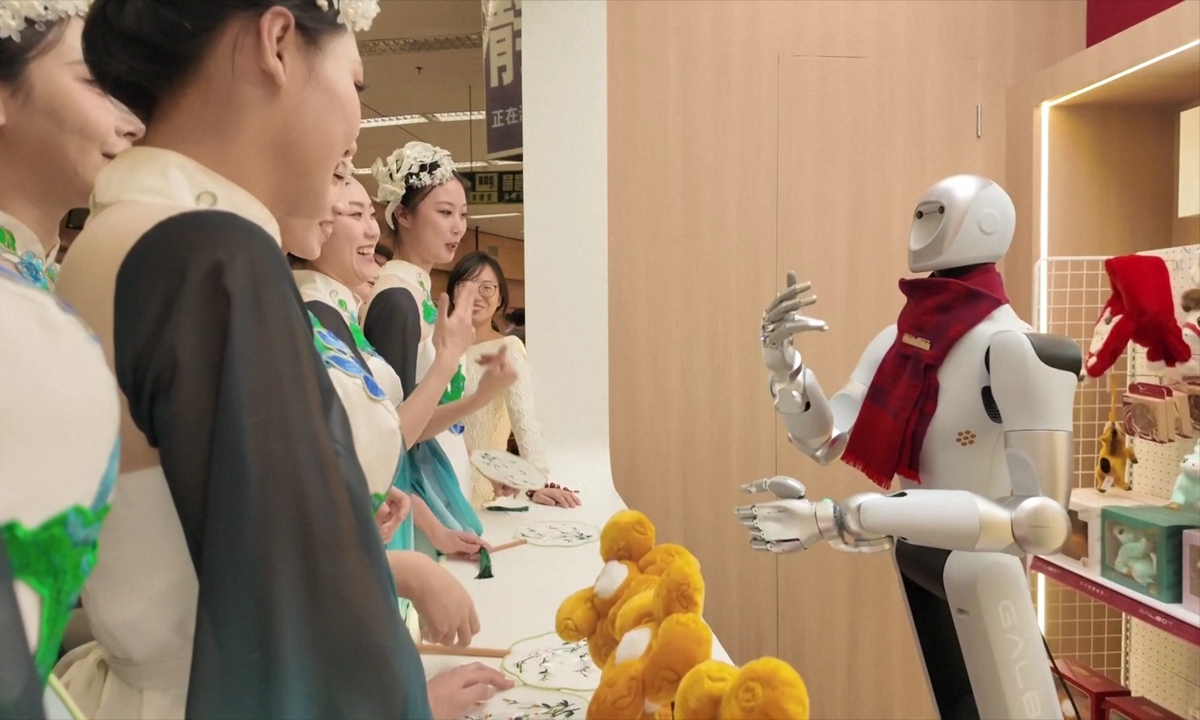
A Galbot robot interacts with dancers during a performance at the 2026 Spring Festival Gala on February 16, 2026. Photo: VCG
A wave of major financing deals in embodied artificial intelligence (AI) since the Spring Festival is adding fresh momentum to China's robotics sector, with analysts saying that the cluster of billion-yuan investments reflects growing confidence that the industry is moving from technical validation toward broader commercial and industrial application amid the country's push to foster new quality productive forces.
Galbot, a Chinese startup developing embodied intelligent robots, on Monday completed a new 2.5 billion yuan ($350 million) financing round, with investors including the national AI industry investment fund, China Petroleum & Chemical Corp and CITIC Investment Holdings, according to Galbot's official WeChat account. The fresh capital will help expand the firm's applications in sectors such as energy, manufacturing and real estate, the company said.
This marks the first time the national AI industry investment fund has invested in an embodied intelligence company, according to industry insiders. The fund, launched last year with a total scale of 60 billion yuan, was established to support the development of China's AI industry.
Also on Monday, robotics company Songyan Power announced that it had completed nearly 1 billion yuan in cumulative Series B financing, bringing its number of funding rounds to nine, according to a statement the company sent to the Global Times.
The company said that the new round, backed by industry capital, state-owned funds and venture investors, will expand its presence in household consumer markets and speed up the commercialization of its humanoid robot technologies, calling it a sign that the sector is shifting from technical validation to more mature commercial development.
Another general-purpose embodied intelligence robotics firm, UniX AI, announced on Monday that it had secured nearly 300 million yuan in a new equity financing round. The company said on its official WeChat account that the funds will be used to deepen its full-stack self-developed system, speed up product iteration and expand its global distribution network, with a focus on scaling up real-world commercial deployment.
"This round of financing suggests that embodied intelligence is accelerating from laboratory research toward industrial-scale application," Wang Peng, an associate research fellow at the Beijing Academy of Social Sciences, told the Global Times on Monday. It shows that China is integrating breakthroughs in "AI plus the physical world" into the core track of the next stage of industrial upgrading, Wang said.
The latest capital moves followed strong public attention generated after the start-ups' robotics products showcased advanced capabilities at the Spring Festival Gala on February 16, widely regarded as the world's most-watched annual television event. Analysts said that the resulting "Gala effect" boosted public awareness and confidence in robotics, accelerating the shift from technical demonstrations to broader real-world deployment.
Financing momentum had already been building prior to this week. On February 23, Shenzhen-based AI² Robotics completed a Series B round exceeding 1 billion yuan. A day later, Hangzhou-based Spirit AI announced nearly 2 billion yuan raised across two consecutive rounds, attracting leading institutions including Yunfeng Capital, Chaos Investment and Sequoia China.
Also on February 24, Inspire Robots, a leading domestic developer of dexterous robotic hands, announced the completion of its C1 and C2 rounds, totaling several hundred million yuan, according to a statement released on the company's official WeChat account.
As a representative industry of the future, embodied intelligence is built on China's solid foundation in hardware manufacturing and a comprehensive industrial supply chain, Liu Gang, chief economist at the Chinese Institute of New Generation Artificial Intelligence Development Strategies, told the Global Times on Monday.
The new funding will help companies enhance core capabilities such as robots' cognitive decision-making systems and operational performance in complex environments, paving the way for broader applications in manufacturing, biopharmaceutical production and various services sectors, Liu said.
China's humanoid robotics industry has developed rapidly in recent years. Data from the Ministry of Industry and Information Technology showed that in 2025, China had more than 140 humanoid robot manufacturers that had launched more than 330 related products. Industry observers widely view 2025 as the first year of mass production for humanoid robots, with the sector poised for faster expansion.
This year is a critical turning point for the robotics industry, which is moving from simply handling many tasks with limited proficiency to truly accomplishing tasks with high performance and achieving practical application, the Xinhua News Agency reported on February 17, citing Luo Jianlan, chief scientist at Chinese robotics start-up AgiBot.
During the 15th Five-Year Plan (2026-30) period, Liu said that industrial applications of embodied intelligence and robotics are expected to accelerate, supported by China's complete supply chain system and extensive, large-scale application scenarios.
RELATED ARTICLES