China's central bank cuts forex risk reserve ratio to zero, in an attempt to curb one-way, excessive yuan appreciation

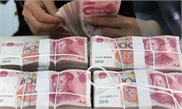
A bank staffer counts foreign currencies in Beijing. File photo: VCG
The People's Bank of China (PBC), the central bank, reduced the foreign exchange risk reserve ratio for forward foreign exchange sales from 20 percent to 0, effective from Monday.
This marks the first use of this counter-cyclical tool by the central bank in nearly three and a half years. Market analysts said the measure is designed to lower enterprises' costs for forward foreign exchange purchases, stabilize foreign exchange market expectations, in a move to curb too rapid appreciation of the yuan seen recently.
Analysts also pointed out that the policy shift underscores the PBC's balanced approach: supporting real economy while preventing excessive currency swings in a challenging external environment.
In a Friday announcement, the central bank noted that the move aims to promote the development of the foreign exchange market and better support enterprises in managing exchange rate risks.
The PBC will continue guiding financial institutions to optimize hedging services for businesses while maintaining yuan exchange rate at a reasonable and balanced range on a basically stable basis.
"When the ratio stood at 20 percent, banks had to freeze $20 (with no interest) for every $100 forward foreign exchange sale, a cost ultimately passed on to enterprises as higher forward purchase prices. With the ratio now decreed at zero, banks no longer need to set aside funds, which lower forward foreign exchange purchase costs for companies," Wen Bin, chief economist at China Minsheng Bank, told the Global Times.
The policy adjustment reduces banks' costs in handling forward foreign exchange sales, encouraging more enterprises to use forwards for hedging and effectively cutting their exchange rate risk management expenses, Wang Qing, chief macroeconomic analyst at Golden Credit Rating International, said in a research note sent to the Global Times on Monday.
The foreign exchange risk reserve ratio, introduced after the August 2015 exchange rate reform, is a macro-prudential tool applied to banks' forward foreign exchange sales by the central bank. Most recently, to stabilize market expectations, it was restored to 20 percent in September 2022.
"It sends a clear policy signal against recent yuan appreciation, helping stabilize market expectations," said Wang.
Since early 2026, Chinese yuan has gained value against the US dollar, with both onshore and offshore rates rising by 2 percent year-to-date. During the week post-Chinese New Year, yuan's appreciation has accelerated, with offshore rate breached 6.82665 against the dollar on February 26.
Following PBC's Friday announcement, the offshore yuan fell by more than 100 basis points against the US dollar, coming back to around 6.85 level.
"If rapid strengthening of yuan persists, other stabilization tools could be deployed, possibly with greater emphasis on daily central parity rate adjustments," said Wang.
Wen added that the central bank's latest move aims to balance supply and demand in the foreign exchange market. "This is a gentle 'cooling' signal to the market's one-sided bet on further yuan strengthening. It clearly shows that the central bank's goal remains to keep the yuan exchange rate basically stable," said Wen.
Yang Delong, chief economist at Shenzhen-based First Seafront Fund, attributed yuan's recent gain to a weakening US Dollar Index amid the Federal Reserve's ongoing rate-cut cycle, gradually stabilizing China-US trade ties, rebounding internal demand, and China's stabilizing capital market.
"Breakthroughs in areas like humanoid robotics, semiconductors, and AI large models have boosted global confidence in Chinese assets, driving cross-border capital inflows," Yang told the Global Times on Monday.
RELATED ARTICLES