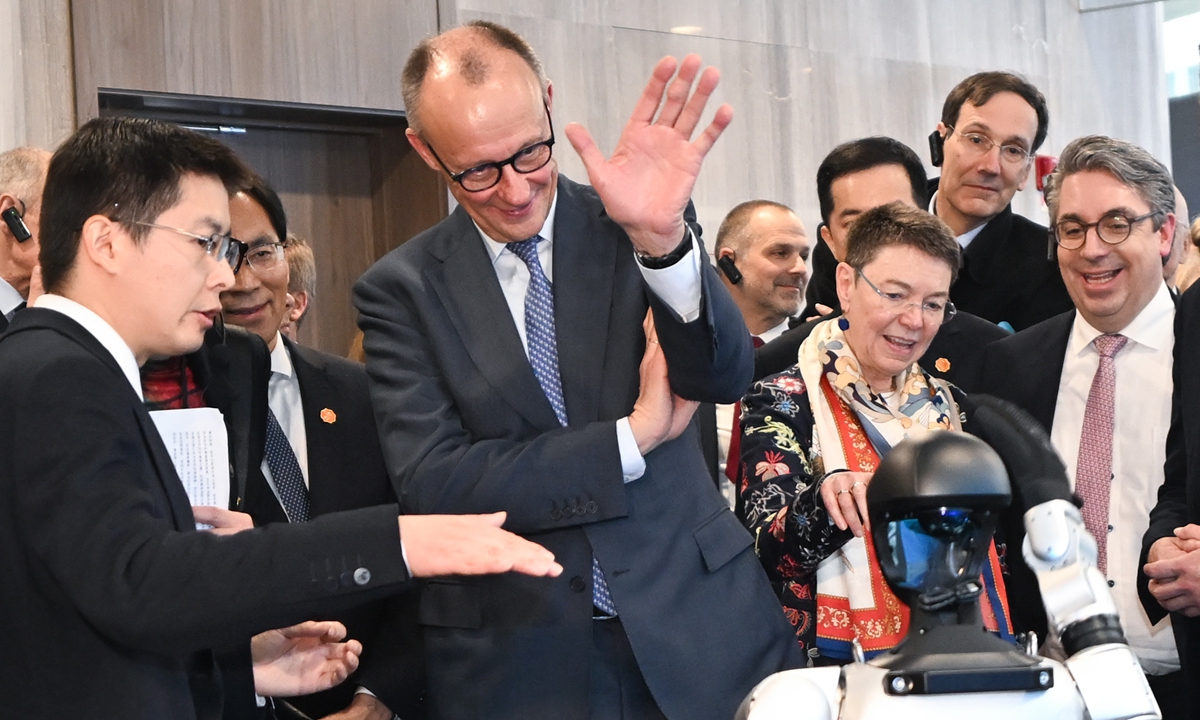
German Chancellor Friedrich Merz waves to a humanoid robot during his visit to the Chinese robot company Unitree Robotics in East China's Hangzhou on February 26, 2026. Photo: cnsphoto
German Chancellor Friedrich Merz was the latest in a row of representatives of major Western countries to pay an official visit to China this year. All those recent visits from Western leaders were firmly motivated by new geoeconomic and geopolitical conditions. The challenges are coming from both global changes toward multipolarity and Washington's erratic tactics. There certainly was no automatism in a turn of those major Western countries toward Beijing, but somehow it was "in the air." And Beijing had always kept the door open, including signals of increasing visa-free entries.Besides, Germany's relationship with China needed an update, as sometimes there was a clear lack of diplomacy from Germany's side in recent years. There were narratives of "superior values" and of a hostile rivalry. This was in face of Germany's particularly weak economic standing recently, with virtually zero growth, losing positions in international competitiveness rankings and in the World Bank's GDP rankings based on purchasing power parity. Specifically, Germany is experiencing problems of weak domestic investment and large outgoing investment.
While many in the EU and the EU Commission are stuck in the world of "decoupling" and limiting relations with China, Merz has managed a pragmatic turnaround. He was accompanied by 30 CEOs - the largest German business delegation to China in recent years. And their stances of engagement in China have been rather clear. Merz apparently listened to them and changed his own attitude as compared to what he had said in Munich a couple of weeks ago. The setting appeared to change toward an equal footing, open-mindedness, pragmatism and willingness to reestablish confident dialogue to discuss all issues of future win-win cooperation.
So far, the German media have moved into a new phase of pragmatism with Merz, and there is little critique of him. It is hoped this "credit" will hold for a while, until the next constructive steps have been taken and synergies deepened. It appeared to many that Merz bridged back to the Angela Merkel era, which is meant to be a compliment. Many even enjoy the new relaxation, pragmatism and willingness to choose trust and commitment.
Despite such a reaction in Germany toward Merz's China visit, we should not forget about the structural problems of China-Germany relations that need to be addressed in the future. There are still misleading narratives dominating the media and politics in Germany, the EU and the West in general. These include misconceptions of "overcapacities," "state subsidies," "price dumping" and "unfair competition" allegedly on the side of China. For some time now, we have scrutinized and rectified all those narratives in a number of publications.
Germany appears to be divided: While many in the elites still are caught in a mental mode of hostility and war, its corporate economy, from big corporations to medium-sized enterprises, is investing abroad, and particularly so in China. That has often been the case against explicit advice and threats from Berlin and Brussels.
But they say that there is no alternative to doing so, if they do not want to lose their own corporate international competitiveness. China is not only their largest single market, but also their production and R&D "gym," their technological future. They need the joint ventures with Chinese partner firms, the abundant potential of complete value chains and regional clusters. They also need the advice, supplies, and services of the many young cutting-edge Chinese start-ups and unicorns, as well as the high skills available, and the modern, efficient and cheap infrastructures.
And it is no longer only about "Made in China for China," but "Made in China for the World." Products of German firms and joint ventures made in China do compete with products made in Germany in third markets, and in the last instance, even in their home market. Parts of the increasing Chinese exports to Germany, therefore, are exports of German companies/joint ventures in China to Germany. And, not least, German firms earn well in China so that after investment from their surplus, some billions can be transferred back home and support the German public budget with corporate taxes.
If Germany were to regain its old economic strength and get on a level playing field, it might open up toward the larger "gym" of the world and strive to take part in the China-proposed Belt and Road Initiative (BRI). This may sound unrealistic today. The eastern parts of the EU have been in the BRI already for some years; some have left, but most are still in. We may be some years away from that, but it could be a prime template for future win-win cooperation between Germany/EU and China.
The author is a retired professor of economics at the University of Bremen, Germany. opinion@globaltimes.com.cn
RELATED ARTICLES