OPINION / GLOBAL MINDS
US-Israel strikes on Iran signal a ‘worrying shift in the paradigm of modern warfare’
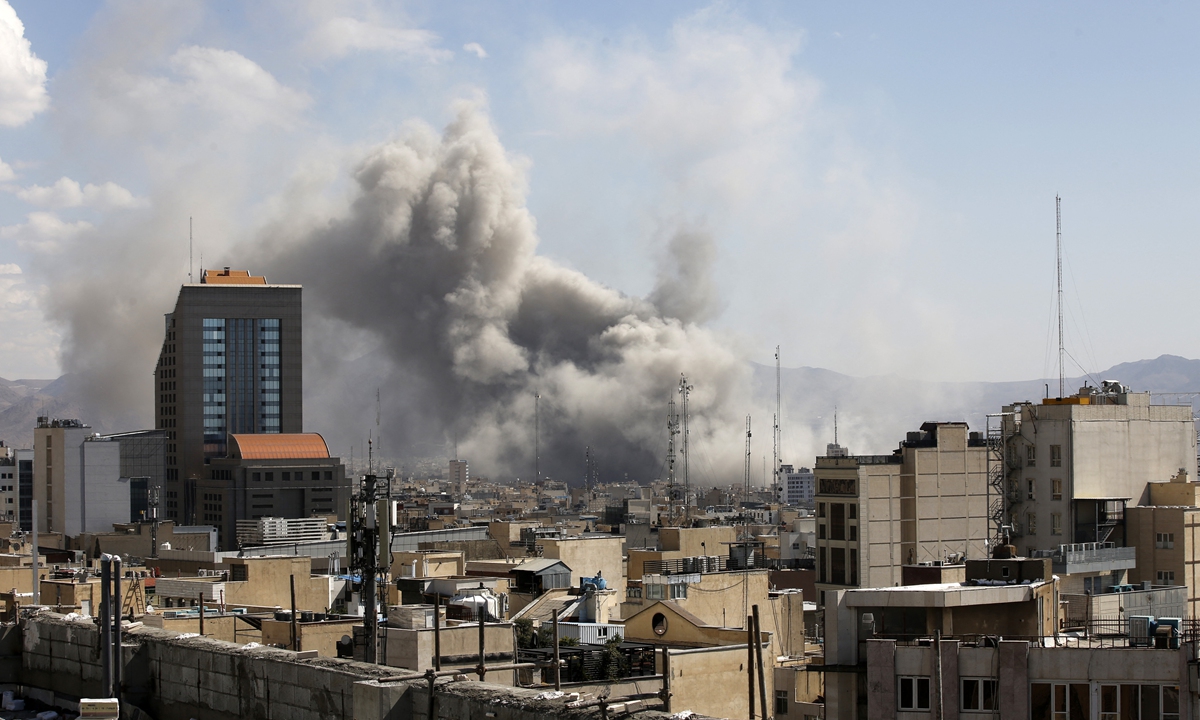
Airstrikes by the US and Israel on Iran continue, with thick smoke rising over the capital Tehran on March 1, 2026. Photo: IC
Editor's Note:
"In the minds of US and Israeli politicians, disliking a regime appears to have become sufficient justification for launching an illegal war against it - a profound and worrying shift in the paradigm of modern warfare," Alfred de Zayas (De Zayas), professor of international law at the Geneva School of Diplomacy and former UN independent expert, author of the books Building a Just World Order, Countering Mainstream Narratives, The Human Rights Industry (Clarity Press, 2021, 2022, 2023), told Global Times (GT) reporter Li Aixin after the US and Israel launched surprise attacks on Iran. What do the strikes mean? How will the war develop? De Zayas shared his views.
GT: In what ways might US-Israel military operations against Iran set a dangerous precedent under international law?
De Zayas: In the minds of US and Israeli politicians, disliking a regime appears to have become sufficient justification for launching an illegal war against it - a profound and worrying shift in the paradigm of modern warfare.
The authority and credibility of all law - whether domestic or international - depends on enforceability. If law can be violated with impunity, if there is no implementation of court judgments, and if governments fail to use diplomatic protection and other means to give meaning to the norms, we have a civilizational collapse. We revert to the times of Thucydides and the Peloponnesian War, when the Athenian general told the people of Melos, "The strong do what they can and the weak suffer what they must." (Melian Dialogue in Chapter "Sixteenth Year of the War," History of the Peloponnesian War)
I believe the UN Charter should be our only rules-based international order, akin to a world constitution. What is necessary is enforcement. "Business as usual" is not an option. It is for the international community to stand up and adopt countermeasures against violations of the charter.
GT: You wrote that: "We are witnessing a revolt against the UN Charter, against customary international law… It means retrogression in terms of civilization." Could you elaborate on this?
De Zayas: The military actions against Iran are only one example of a long series of gross violations of international law by the "collective West."
The NATO bombardment of Yugoslavia in 1999 was contrary to Article 2(4) of the UN Charter, and involved the use of depleted uranium bombs. The use of uranium bombs continued during the 2003 assault on the people of Iraq, which the then secretary general of the UN Kofi Annan correctly referred to as an "illegal war." And in 2015, the US fired thousands of depleted uranium rounds in Syria.
The breach of international law does not invalidate international law. It only manifests the fact that the UN system is not equipped with appropriate enforcement mechanisms.
GT: How do you see this conflict between US, Israel and Iran evolving in both the short term and the long term?
De Zayas: There are many "what if" questions. I do not have the answers. I think the illegal US-Israel attacks entail a breach of international peace and security within the meaning of Article 39 of the UN Charter. This could escalate into a world war, this time involving most of the planet. A nuclear confrontation would mean an apocalypse for all of us.
The US never seriously intended to withdraw from the Middle East. It sees itself as the world hegemon and that necessarily includes the Middle East. The US is desperate to save its empire, to cling to the fantasy of a "unipolar" world.
GT: In your recent post on X, you wrote, the US "is NOT 'defending American people' by striking Iran." Could you elaborate on this assessment?
De Zayas: The US is putting the American people at a much higher risk of terrorism and placing the world on the brink of World War III. As an American living abroad, I am concerned about terrorism. I am also a Swiss citizen, but that does not mean I could not be targeted as an American.
Experience shows that terrorism has grown alongside the unjust "war on terror." Violence breeds more violence. I am not alone in expressing these views that coincide with those of Professor John Mearsheimer from the University of Chicago, Professor Jeffrey Sachs from the Columbia University, and Professor Glenn Diesen from the University of South-Eastern Norway. Unfortunately, we are not being governed by rational and democratic leaders. The people want peace, but the ruling military-industrial-financial-digital-media complex wants perpetual war for perpetual profits.
In this context, it is disgraceful that the US concocted a so-called "Board of Peace." This is not only cynical and Machiavellian - it is Orwellian. It corresponds to the "Ministry of Peace" from Orwell's dystopian novel 1984, and runs according to Orwellian principles: "War is peace. Freedom is slavery. Ignorance is strength."
GT: You also wrote: "Sooner or later the rule of law will evolve into the rule of justice. That is the course of civilization." In light of these recent events and the apparent setbacks to international law, do you remain optimistic about this trajectory?
De Zayas: Yes, while I recognize the setbacks and join many others in condemning the crimes being committed in our name, we cannot give up on the rule of law. If we do, civilization is lost. Indeed, in chaotic times like ours, it behooves us to practice proactive optimism, which is far more than infantile hope or pious faith.
Conscious, vigorous optimism is visionary and builds on our awareness of our human identity and dignity. It expresses our faith in humanity, our resolve to be morally and intellectually honest, and our goodwill.
It is axiomatic that to be constructive and effective, we need access to all information, access to the facts and to a multiplicity of interpretations. Democracy cannot function without reliable information. Therefore, we demand transparency and accountability from our authorities, reject scams, public relations schemes, propaganda and skewed media narratives.
For example, China's Global Governance Initiative makes all the sense in the world, but it must become better known. However, we have a major problem with the manipulation of public opinion by Western mainstream media, which not only lies to us on a daily basis, but also suppresses inconvenient information.
What should the international community do?
In the light of the misuse of the veto right in the Security Council, it is within the mandate of the General Assembly to take greater responsibility for international peace and security. It could and should adopt a "Uniting for Peace" resolution as it has done in the past when the Security Council has been blocked. And rhetoric is not going to change the US' and Israel's approach to international law - only economic consequences.
RELATED ARTICLES