Analyst: US plans weeks-long assault on Iran, but can its ammunition stockpile sustain it?
By Liang Rui and Published: Mar 02, 2026 01:57 PM

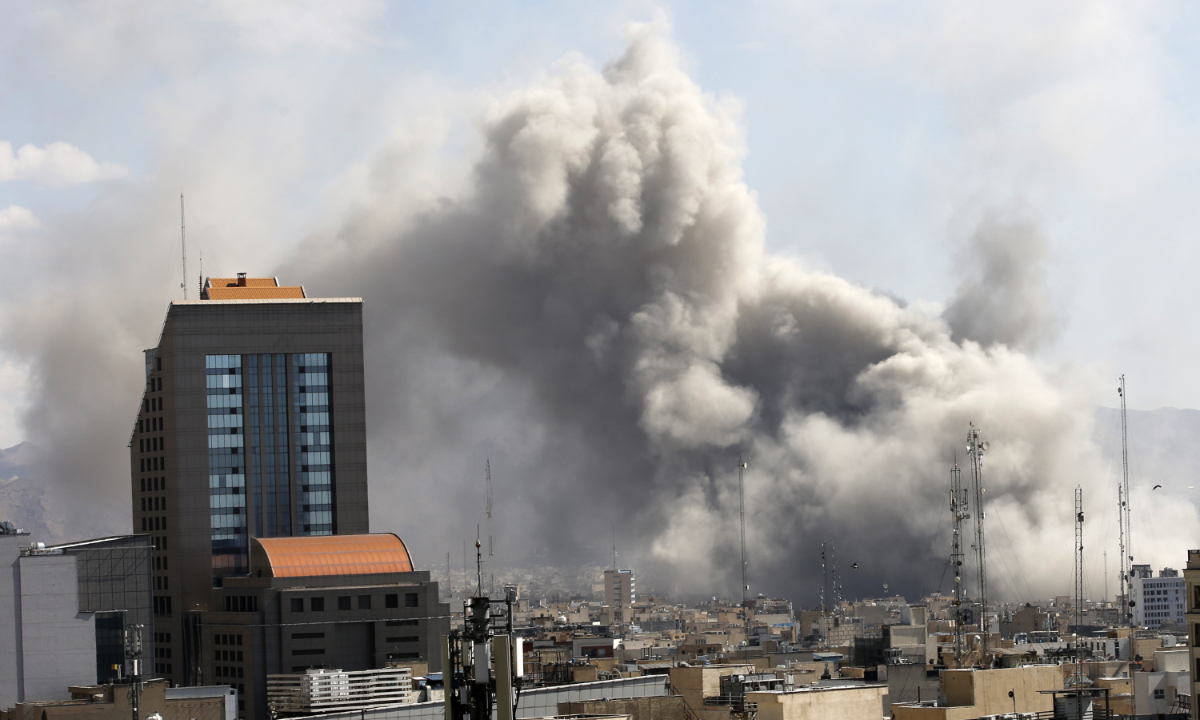
Plumes of smoke rise over the residential areas of the Iranian capital following airstrikes amid ongoing US-Israeli attacks as multiple explosions are heard across the city in Tehran, Iran, on March 01, 2026. Photo: VCG
As Washington signaled that its conflict with Iran could last up to four weeks on Sunday local time, media scrutiny over US ammunition stockpiles has risen. A Chinese military affairs expert told the Global Times that although the US made relatively large-scale preparations for its strikes on Iran, limited ammunition reserves and declining defense industrial capacity may constrain its ability to sustain a prolonged high-intensity war.
The US President Donald Trump said on Sunday that the US military intends to sustain its assault on Iran for "four to five weeks" if necessary, insisting that it "won't be difficult" for Israel and the US to maintain the intensity of the battle even as he warned of the possibility of more American casualties, the New York Times reported.
However, the report said that Trump made no mention of the Pentagon's concerns that the conflict could further deplete reserves that military strategists have said are critical to retain.
Before the US-Israeli attacks began, media reports had already raised concerns about the state of US ammunition stockpiles.
Dan Caine, the chairman of the Joint Chiefs of Staff, has said that the US has amassed forces in the Middle East to carry out a small or medium strike, but that there would be a potentially high risk of American casualties and that such an operation would have a negative effect on US weapon stockpiles, according to the New York Times on February 23.
On Sunday, The Wall Street Journal said that now that is being put to the test, as the US races to destroy Iran's missile and drone force before it runs out of interceptors to fend off Tehran's retaliation - current and former officials and analysts say.
"One of the challenges is you can deplete these really quickly," said Kelly Grieco, a senior fellow at the Stimson Center think tank who used to teach at the Air Command and Staff College, to The Wall Street Journal regarding the ongoing US, Israeli, and Iranian strikes. "We're using them faster than we can replace them."
Israel has concerns about its munitions supply as well. It is still low on Arrow 3 air-defense interceptors, as a US official told The Wall Street Journal.
Previously, some foreign media outlets had already questioned US ammunition stockpiles, including during the period when Washington was providing military aid to Ukraine in the Russia-Ukraine conflict, when similar concerns were raised.
The Pentagon has halted shipments of some air defense missiles and other precision munitions to Ukraine due to worries that US weapons stockpiles have fallen too low, the Politico reported in July 2025.
The decision was driven by the Pentagon's policy chief, Elbridge Colby, and was made after a review of Pentagon munitions stockpiles, leading to concerns that the total number of artillery rounds, air defense missiles and precision munitions was sinking, according to three people familiar with the issue, reported the Politico.
Zhang Junshe, a military affairs expert, told the Global Times on Monday that if the US maintains its current level of high-intensity bombardment, it may not be able to sustain it for too long, after which the intensity would likely decline.
In addition, amid deindustrialization, US defense industrial capacity has declined, limiting its ability to rapidly replenish munitions. At the same time, Washington must retain strategic reserves for other potential contingencies and cannot commit all of its stockpiles to operations against Iran, Zhang said.
Under current conditions, the US does not appear prepared for a prolonged high-intensity conflict. If the confrontation drags on, it could place significant pressure on US forces and potentially have negative implications for their broader long-term combat readiness, Zhang added.
RELATED ARTICLES