GT Voice: Merz’s visits reveal how German firms assess opportunities in China and the US
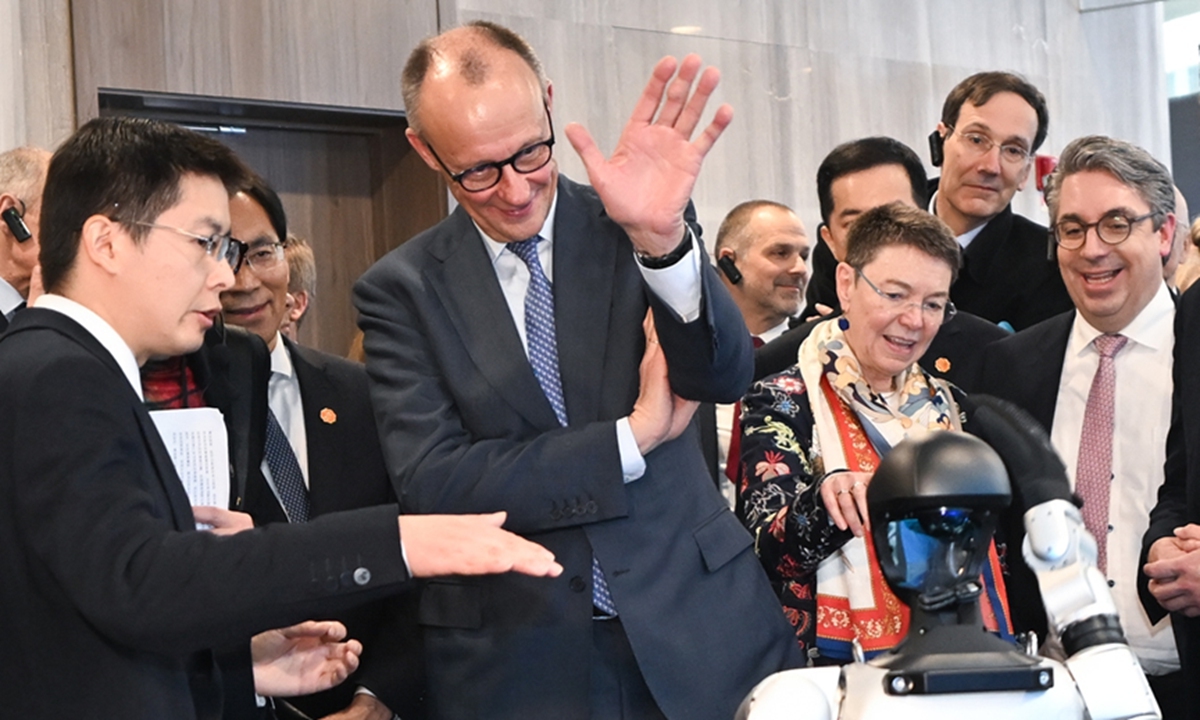
German Chancellor Friedrich Merz waves to a humanoid robot during his visit to the Chinese robot company Unitree Robotics in East China's Hangzhou on February 26, 2026. Photo: cnsphoto
German Chancellor Friedrich Merz waves to a humanoid robot during his visit to the Chinese robot company Unitree Robotics in East China's Hangzhou on February 26, 2026. Photo: cnsphotoGerman Chancellor Friedrich Merz's visit to the US has understandably drawn attention in the German media. The headline of a recent Deutsche Welle article, "Merz to Visit Washington to Discuss Tariffs Without a Business Delegation," highlights a key difference in Merz's US visit. The article notes that, unlike his recent trip to China, Merz will not be accompanied by a business delegation. Although a German government official was quoted as saying the itinerary remained subject to change until the last moment, the reported absence of such a delegation stands out.
Just days earlier, Merz led a high-profile economic delegation to China, accompanied by senior executives from some of Germany's most prominent companies. The visit underscored Germany's interest in strengthening economic ties with China, with both sides seeking to expand cooperation in key industries. The involvement of such senior business leaders highlighted the significance of the trip for Germany's business community, signaling a clear intention to strengthen collaboration with the Chinese economy.
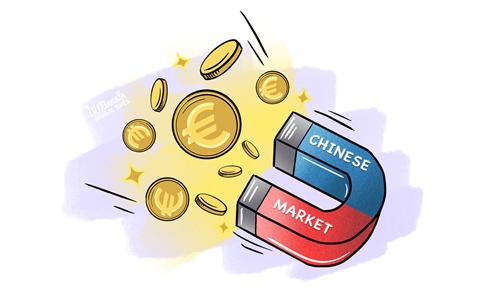
This contrast between Merz's trips to China and the US reflects the different economic dynamics Germany faces with each country. Turning first to China, German businesses have demonstrated strong interest in expanding their investments there. According to a report from the German Economic Institute (IW) cited by Deutsche Welle in January, German investments in China reached their highest level in four years in 2025. Xinhua News Agency further reported that German direct investment in China amounted to approximately 7 billion euros ($8.26 billion) in 2025, a notable increase from around 4.5 billion euros the previous year.
Turning to the US, Germany's economic engagement appears to be cooling, partly due to policy uncertainty. Deutsche Welle, citing another IW report, stated that from February to November 2025, German direct investment in the US totaled approximately 10.2 billion euros, representing a 45 percent decline. Meanwhile, according to media reports, German exports to the US dropped by nearly 9 percent year-on-year from February to October 2025. The automotive and parts sector reportedly saw a decline of almost 19 percent, while exports of machinery fell by approximately 10 percent.
The differing economic trajectories of Germany's engagement with China and the US reflect broader shifts in global supply chains and evolving market conditions. Investment patterns clearly show how businesses are adjusting their strategies to capitalize on emerging opportunities. The increasing focus of the German business community on China aligns with the country's ongoing efforts to expand high-level market access. With its well-established supply chains and rapid technological advancements, China presents an increasingly attractive environment for foreign investment.
Germany's high-end manufacturing sector stands to benefit from these trends. Many German companies are deepening their investments in China, attracted by the unique advantages the market offers. The enthusiasm of German businesses reflects the tangible opportunities available in the Chinese market.
Amid current global developments, rising trade protectionism and growing policy uncertainty have made market opportunities increasingly scarce, a reality clearly reflected in cross-border capital flows. Evolving US economic policies, coupled with the resurgence of protectionist measures, are contributing to volatility, prompting capital to gravitate toward more open and predictable markets.
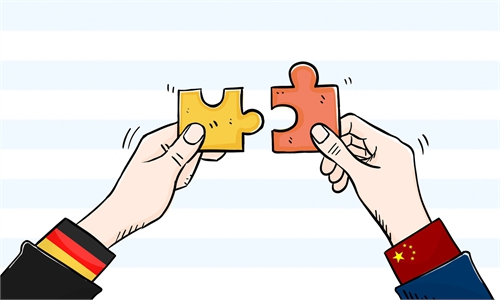
Merz's visits to China and the US provide a window into how Germany's business community is evaluating market opportunities. China's large and dynamic market, coupled with its commitment to high-level opening-up, positions the country as a key hub within the global supply chain. In this context, decoupling from the Chinese economy is entirely unrealistic. On the contrary, a stable and predictable economic relationship between China and Germany serves Germany's core economic interests. These realities underline the need for a more rational and pragmatic understanding of China within Germany's domestic public discourse.
RELATED ARTICLES