Multiple US military aircraft crash near Kuwait; Chinese expert analyzes possible causes
By Liang Rui and Published: Mar 02, 2026 11:05 PM


A video screenshot from social media user-generated content shows a US F-15E fighter jet crashing in Kuwait on March 2, 2026 local time. Photo: VCG
Kuwait's Defense Ministry reported several US military aircraft crashes on Monday, with the Iranian and the US sides also making their respective explanations and statements regarding the incident. While details remain to be released to the public, a Chinese military affairs expert outlined several possible causes for the incident, and noted that while Iran's military power is weaker than that of the US, Tehran has still been able to mount a certain degree of retaliation, and has distributed its forces beyond air defense operations.
Several US warplanes crashed on Monday morning, and all crew members survived, the Kuwaiti Ministry of Defense said in a statement posted on the social media platform X.
The ministry's military spokesperson added that the incident occurred earlier in the day without specifying the location or the number of aircraft involved, the Xinhua News Agency reported.
The spokesperson affirmed that the relevant authorities are continuing their investigation to determine the cause of the crash, Xinhua said.
The American military confirms that three US F-15 fighter jets were mistakenly shot down by Kuwait this morning, in an incident of so-called "friendly fire," reported the Times of Isreal.
Iran's IRNA shared video of an F-15E Strike Eagle spiraling in flames and crashing in western Kuwait on Monday, attributing it to their retaliation against US-Israeli strikes, reported India media outlet Republic World.
According to initial sources, a US Air Force F-15 fighter plane crashed in northern Kuwait near the Iraqi border, but the pilot ejected safely, Iraqi News reported on Monday.
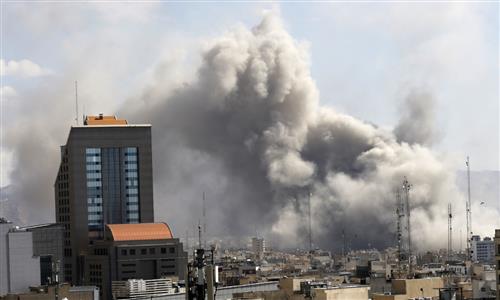
Videos circulating on social media seemed to show smoke billowing from the accident scene, Iraqi News said.
Authorities have yet to disclose any information about the crash's cause, the report added.
"The US F-15 fighter jet pilot who was down over Kuwait moments ago in a friendly fire incident is alive," Visegrád 24, a news website aggregating and curating news, politics and current affairs, said in an X post on Monday. Some media outlets mentioned the claim that it was a case of friendly fire.
Wang Yanan, editor-in-chief of Beijing-based Aerospace Knowledge magazine, told the Global Times on Monday that the video shows the aircraft's engine rear section catching fire before it fell to the ground.
Wang noted that several possibilities exist - including Iran media's claim that the aircraft was shot down by Iran's air defense system, and it is friendly fire involving the air defense systems during attempts to intercept Iranian drones or missiles.
At the time, the battlefield environment was highly chaotic, with large numbers of Iranian drones and ballistic missiles incoming. Friendly air defense system would have been on high alert. US fighter jets were likely participating in interception missions or conducting airspace security operations, making the possibility of misidentification and accidental engagement under complex combat conditions possible, Wang said.
In addition, the expert said that frequent mid-air explosions during interception operations may have produced debris that was ingested into the engine, potentially causing engine failure or shutdown and ultimately leading to the crash.
Although initial airstrikes by the US and Israel against Iran suggest that Iran's overall air defense system remains relatively weak — particularly in terms of command and control capabilities — the expert noted that under high-intensity conflict conditions, Iran would still be capable of organizing a certain level of retaliation. Even the US military, Wang said, would be expected to sustain casualties in a high-intensity conflict.
Wang said that Iranian air defense forces seem organized in a "mosaic" structure, with forces dispersed across various regions and operating in a manner similar to guerrilla warfare to counter airstrikes.
This means that even if the capital or certain facilities are struck, its military command system and key equipment could continue functioning, as command authority has already been decentralized to the local level, Wang said.
RELATED ARTICLES