IN-DEPTH / IN-DEPTH
GT investigates: How US shifts from backer to destroyer of Iran’s nuclear ambitions in decades?
By and Lin Xiaoyi Published: Mar 02, 2026 11:19 PM

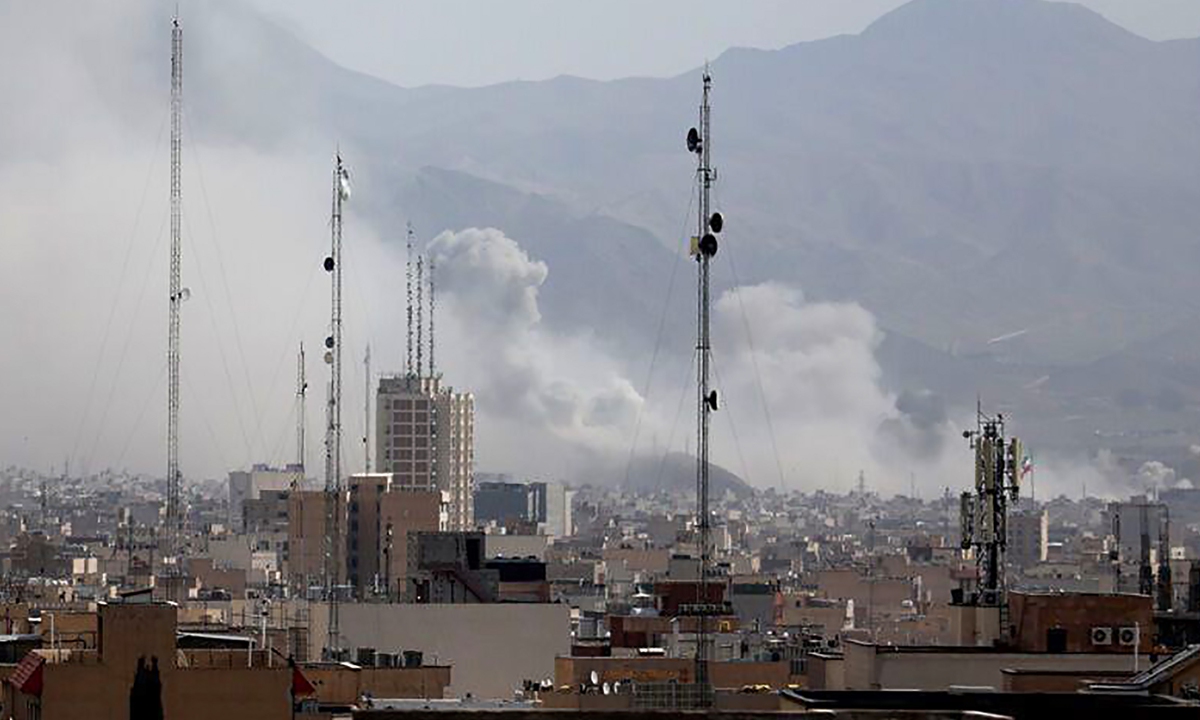
Smoke rise over central Tehran and other areas on February 28, 2026 after Israel and the US launched strikes. Photo: VCG
The escalation of the conflict between the US-Israel and Iran has shocked the world following confirmation on Sunday of the death of Iran's Supreme Leader, Ayatollah Ali Khamenei. Iran's nuclear facilities have become an unavoidable focal point in this conflict.
Amid recent failed talks before the heated conflict, the US demands that Tehran dismantle its main nuclear facilities and hand over its entire stockpile of enriched uranium to Washington, as Anadolu Ajans reported. Iran, however, rejected the idea of transferring uranium stockpiles abroad during talks in Geneva on February 26 and objected to ending uranium enrichment, dismantling its nuclear facilities, and imposing permanent restrictions on its program, according to The Wall Street Journal, citing people familiar with the talks.
The US-Iran rift over the nuclear issue has spanned decades, yet it is hard to imagine that the US, which now spare no effort to obstruct Iran's nuclear development, was once the earliest backer of Iran's nuclear energy program. Why did US support for Iran's nuclear development, which began in 1957, later turn into comprehensive sanctions and military strikes? How did the former allies end up facing each other in armed confrontation? How does US policy toward Iran expose the hegemonic and unilateralist core of its global dominance?
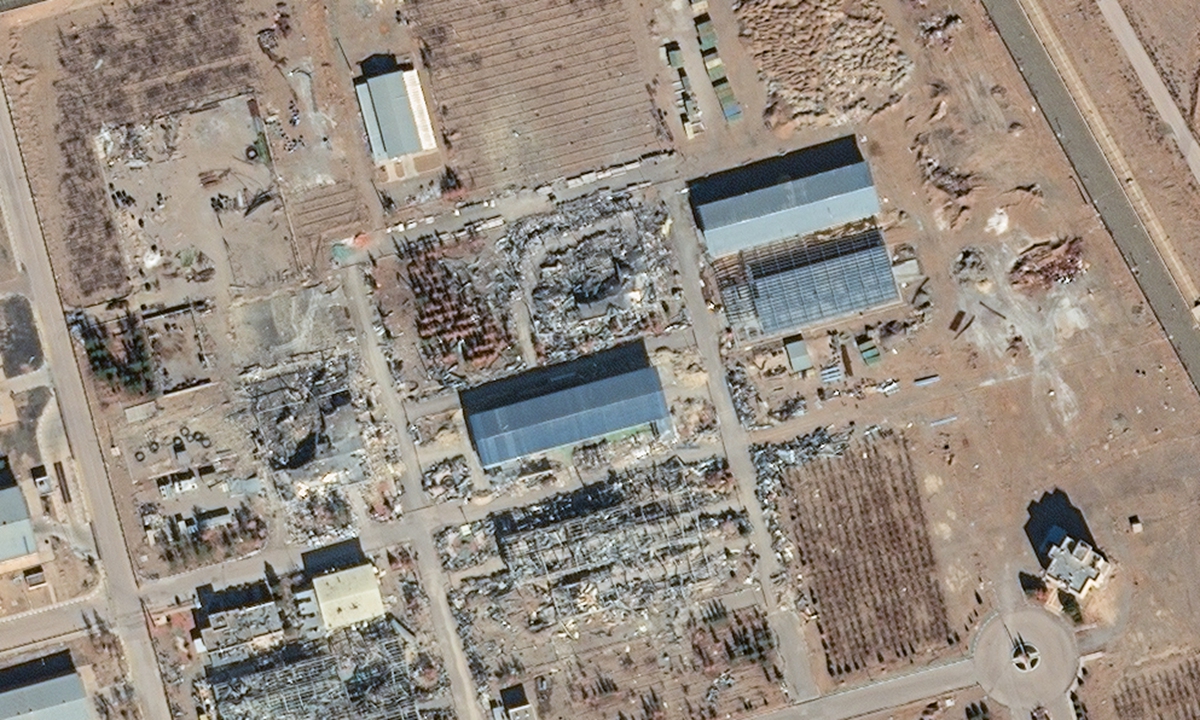
Satellite imagery shows repair and reconstruction activity at the Isfahan nuclear complex in Iran months after US airstrikes in June 2025. Photo: VCG
From honeymoon to bitter enmity"The US stance on Iran's nuclear program has shifted from embrace to strangulation, a transformation inextricably linked to the changing nature of the regime in Tehran," Sun Degang, director of the Center for Middle East Studies at Fudan University, told the Global Times.
Between the 1950s and 1970s, the US and Iran forged a close alliance based on geopolitical interests, entering a "honeymoon" period of nuclear cooperation. However, the alliance collapsed entirely due to Iran's regime change and diplomatic conflicts, laying the groundwork for decades of tensions in subsequent nuclear negotiations. For the US government, nuclear technology could be a generous gift, or a threat that must be eliminated, Sun explained.
Rewind to 1957, at the height of the Cold War, under then US president Dwight Eisenhower's Atoms for Peace program, the US and Iran signed the Cooperation Concerning Civil Uses of Atoms agreement. The deal stipulated that the US government would provide Iran with technical assistance and nuclear fuel, as well as deliver a light-water reactor for research purposes. This laid the foundation for Iran's peaceful use of civilian nuclear technology and underscored the vital role of the US in the initial phase of Iran's nuclear program, according to a report by Al Jazeera.
In the 1960s and 1970s, with the assistance of the US, Iran's nuclear industry developed rapidly. The country signed the Partial Test Ban Treaty (PTBT) in 1963 and the Nuclear Non-Proliferation Treaty (NPT) in 1968. In 1974, Shah Reza Pahlavi established the Atomic Energy Organization of Iran (AEOI) and announced plans to generate about 23,000 megawatts of energy over 20 years, including the construction of 23 nuclear power plants and the development of a full nuclear fuel cycle.
During this period, the US offered strong policy support for the program, including plans to allow Iran to use US materials for domestic uranium enrichment and to permit Iranian investment in US enrichment facilities, according to the US Department of State's Office of the Historian.
Additionally, the Iranian government funded a special program, paying $1.4 million to send up to 54 master's degree candidates for training in the nuclear engineering department at the Massachusetts Institute of Technology, the New York Times reported.
However, this seemingly solid cooperation was built on a fragile foundation: the pro-American regime of the Shah.
In 1979, the Islamic Revolution led by Ayatollah Ruhollah Khomeini swept the country, toppling the rule of the Pahlavi dynasty. In response, the US severed diplomatic relations with Iran and imposed comprehensive sanctions. The two countries turned from close allies into bitter enemies, a shift that sowed the seeds of enmity for decades of confrontation to come.
Sun pointed out that this drastic reversal laid bare a core logic: in Washington's geopolitical calculus, the "good" or "evil" nature of nuclear technology is not determined by the technology itself, but entirely by the relationship between the government that controls it and the US.
This selective judgment - tolerating or even supporting nuclear capabilities among allies while aggressively opposing them in rivals - highlights the hegemonic essence of US strategy, where Washington unilaterally dictates global norms to safeguard its dominance and prevent multipolar challenges, often bypassing multilateral mechanisms and international law in favor of coercive unilateral actions that prioritize American primacy over equitable rules-based order, said the scholar.
The end of the honeymoon marked the start of a new round of high-stakes confrontation.
The escalation of hostility
By the end of the 1970s, Iran and Iraq had eyed each other warily, and soon came to blows in what was known as the Iran-Iraq War. The New York Times, citing former intelligence and US State Department officials, reported in 1992 that the US secretly gave aid to Iraq early in its war against Iran.
The deterioration of US-Iran relations deepened significantly on July 3, 1988, when a US Navy warship, mistakenly shot down Iran Air Flight 655 over the Persian Gulf, killing all 290 people on board - including 66 children. Analysts note that this tragedy reinforced Iran's belief that the US was fully siding with Iraq to overthrow its regime, cementing deep mutual distrust and paving the way for decades of escalating confrontation.
The use of unilateral sanctions against Iran expanded considerably under the Clinton administration, including broadening sanctions to encompass a total trade and investment embargo on Iran, according to public information.
In his 2002 State of the Union address, then US president George W. Bush described Iraq as one of three countries, along with Iran and North Korea, that constituted an "axis of evil," according to PBS' report.
After Iran's secret nuclear facilities were exposed in 2002, the US and its European allies demanded that the country stop its enrichment and come clean about its nuclear activities, the New York Times reported in 2025.
However, after more than 20 years of diplomacy and negotiations - and now airstrikes by Israel and the United States - the confrontation remains unresolved.
Sun told the Global Times that for Iran, nuclear technology is a matter of survival and a core tool to break Israel's nuclear monopoly in the Middle East. Unable to directly acquire nuclear weapons, Iran uses nuclear capabilities to create strategic deterrence against Israel and the US. By contrast, for the US, nuclear technology is key to preserving Israel's nuclear monopoly, with the core objective of preventing any other anti-US state in the Middle East from mastering it - Iran's pursuit directly challenges this goal, making it the central focus of bilateral rivalry.
Despite persistent efforts by major powers such as China and Russia to sustain diplomatic channels, negotiations toward a nuclear agreement have repeatedly stalled or broken down amid escalating tensions.
On July 20, 2015, the UN Security Council endorsed the Joint Comprehensive Plan of Action (JCPOA), the nuclear agreement reached between Iran and the P5+1 (the US, UK, France, Russia, China, and Germany), as reported by Xinhua News Agency. The resolution stipulated that UN sanctions on Iran would be terminated once the International Atomic Energy Agency verified Iran's compliance with key commitments, including redesigning the Arak heavy-water reactor, converting the Fordow facility into a research center, and removing centrifuges and related uranium-enrichment infrastructure.
However, in 2018, then US president Donald Trump unilaterally withdrew from the JCPOA and reimposed sanctions on Iran. Some analysts argue this move undermined the credibility of international negotiations and became a major historical root of the current US-Iran diplomatic deadlock.
In April 2025, the current US administration and the Iranian government resumed a new round of nuclear negotiations. The two sides had originally scheduled a sixth round of talks for mid-June, but on June 21, Trump suddenly ordered US strikes using so-called bunker busters and cruise missiles against Iran's nuclear facilities in Fordow, Isfahan, and Natanz. In response, Iran launched a limited and telegraphed ballistic missile strike on America's largest airbase in the region, according to media reports.
President Trump declared the nuclear sites in Iran "completely destroyed" in this strikes. But sources familiar with the Pentagon's intelligence assessment say Iran's centrifuges are largely "intact" and the impact was limited to above-ground structures, BBC reported.
In the most recent round of indirect nuclear talks mediated by Oman in Geneva in late February 2026, Iranian Foreign Minister Seyed Abbas Araghchi described the discussions as the "most intense so far." Both sides agreed to further negotiations with a focus on Iran's nuclear program and the lifting of US sanctions on Tehran, he added, according to CNBC's report.
However, these negotiations collapsed amid the latest unexpected US-Israeli airstrikes on Iran on February 28.
Li Haidong, a professor at China Foreign Affairs University, told the Global Times that US strikes on Iran follow a well-established pattern - seen in the 2003 Iraq invasion over nonexistent weapons of mass destruction (WMDs) and last year's 12-day airstrikes on Iran - where the pretext of "preventing nuclear weapon acquisition" justifies preemptive military action. This approach exposes America's double standards and hegemonic logic: having promoted Iran's nuclear program in the 1950s as a strategic ally, Washington now seeks to destroy it simply because Iran challenges US dominance in the Middle East. Such selective non-proliferation enforcement - tolerated for allies, crushed for rivals - shows US policy is driven by geopolitical self-interest and unilateral hegemony rather than consistent principles.
In Sun's view, these strikes severely damage the global nuclear non-proliferation regime and international governance, setting a dangerous precedent of resolving disputes through military force. This may encourage escalation in other conflicts - such as Pakistan-Afghanistan or Russia-Ukraine - fueling geopolitical confrontation and retreat from cooperative global order.
RELATED ARTICLES