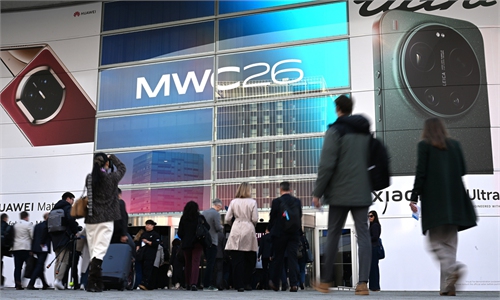
How ‘Intelligent Manufacturing in China’ takes center stage at MWC Barcelona again: Global Times editorial
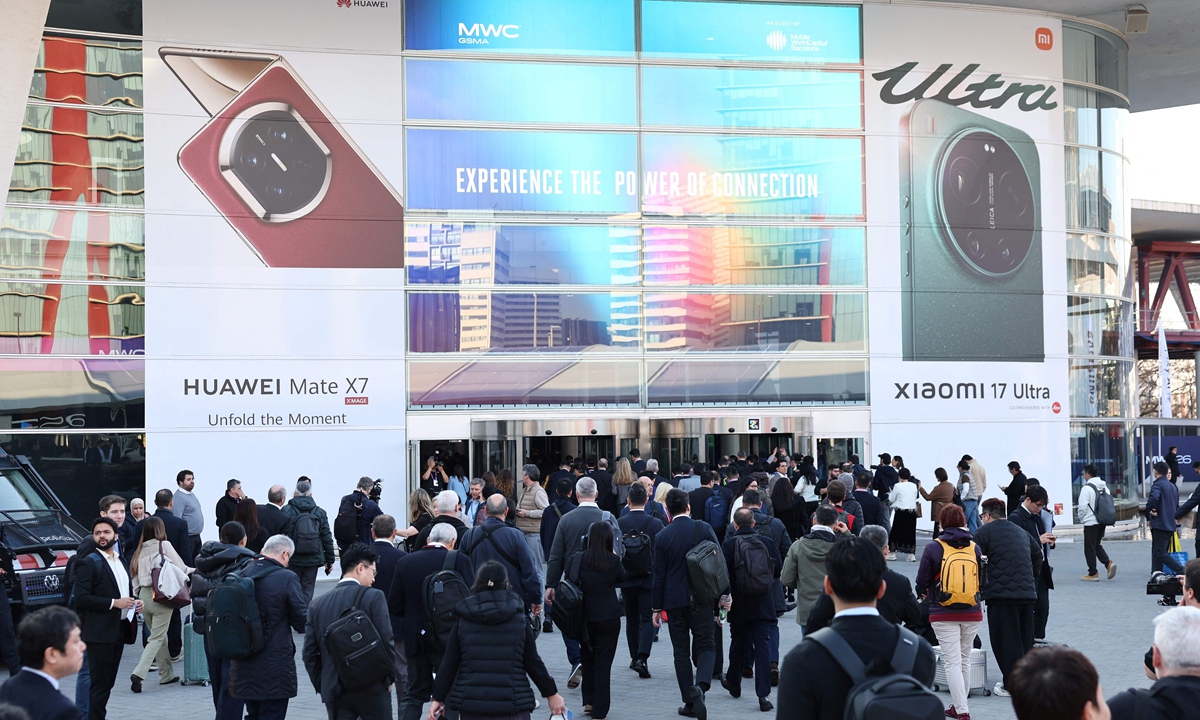
Visitors to the Mobile World Congress (MWC) go to the entrance on March 2, 2026. The global mobile communications industry showcases its latest products and services at the MCW in Barcelona, Spain. Photo: VCG
From Monday to Thursday, the Mobile World Congress (MWC, or MWC Barcelona), hailed as the world's leading connectivity event, is taking place in Barcelona, Spain. "Intelligent Manufacturing in China" has once again taken center stage with sheer strength.
Huawei released the Agentic Core solution and the full U6GHz product suite. Honor made a stunning appearance with its "Robot Phone," a device blending high IQ and emotional intelligence (EQ). ZTE unveiled the world's first 6G prototype with 2048 antenna elements in the U6G band. Xiaomi showcased its eye-catching Vision Gran Turismo concept hypercar, created in collaboration with a renowned racing game. A series of blockbuster achievements were unveiled in a concentrated display, fully demonstrating the vibrant vitality of "Intelligent Manufacturing in China."
This tech storm from "Intelligent Manufacturing in China" sweeping Barcelona is no accident. From the 2024 Paris Motor Show and the 2025 Munich Motor Show to the early 2026 Consumer Electronics Show in Las Vegas, Chinese companies have been shining brightly. In cutting-edge fields such as 6G research, new energy vehicles, humanoid robots, and AI-integrated applications, "Intelligent Manufacturing in China" is demonstrating multi-domain coordinated breakthroughs and comprehensive advances. Data bears witness to this growth. The number of Chinese exhibitors at this year's MWC Barcelona surged from 288 last year to 350, ranking third globally - behind only host Spain and the US - sending a strong signal that the center of gravity for global technological innovation is quietly shifting eastward.
China's high-level technological self-reliance and self-improvement have accelerated dramatically. During the 2025 two sessions - China's annual sessions of its top legislature and political advisory body - "embodied intelligence" was mentioned for the first time in the Government Work Report, becoming one of the future industries prioritized for national cultivation. In just one year, China's robotics industry has rapidly transitioned from laboratory research to large-scale application, showcasing astonishing efficiency in real-world deployment. At this MWC Barcelona, embodied intelligence scenarios that deeply integrate AI with wearable devices have become almost a standard feature among China's leading exhibitors. 2026 marks the commencement of China's 15th Five-Year Plan (2026-30), and every one of China's five-year plans features clear goals and well-defined pathways, anchoring industrial development directions while bridging scientific research, innovation, and industrial transformation.
The MWC Barcelona once again highlighted the core competitiveness of "Intelligent Manufacturing in China." In the past, "Made in China" provided the global market with high cost-performance products, significantly reducing living costs for people in many countries. Today, "Intelligent Manufacturing in China" delivers high-value-added tech products at affordable prices, embodying a capability for "technological inclusivity." This makes advanced technology no longer confined to a niche high-end market, but instead integrates into everyday life in a far more accessible way.
China has chosen to share, in real time, a vibrant and cutting-edge piece of its "innovation puzzle" with the world. This is also a proactive effort to provide high-quality goods and a vivid demonstration of its commitment to the vision of a community with a shared future for humanity, highlighting the responsibility and sense of mission that China bears as a major technological power.
Against a backdrop of complex geopolitics and mounting risks of "decoupling" and supply chain disruption, Chinese manufacturers have emerged as one of the mainstays of MWC Barcelona. This reality powerfully affirms that market logic will ultimately prevail over political blockades. Despite being placed on the Pentagon's blacklist, the vast majority of drones used in the US agricultural sector and by local governments still originate from China. The 5G-A private networks and AI-driven digital transformation platforms provided by Chinese companies to the European market also far surpass those of local operators in cost effectiveness. Attempts by certain major powers to suppress China have failed to fundamentally impede the country's technological progress. Instead, such pressure has become a driving force that compels Chinese companies to accelerate their diversification strategies and deepen their globalization efforts, driving China's steady transition from a "manufacturing giant" to an "innovation powerhouse" and continuously elevating the position of its foreign trade within global value chains.
"Intelligent Manufacturing in China" has become a pillar of MWC Barcelona due to its genuine appeal to global clients. Powered by hardcore technological innovation, "Intelligent Manufacturing in China" has captured worldwide attention and overturned the false narrative that its competitiveness stems from subsidies and unfair competition. From simple product exports to brand building, standards setting, and ecosystem development, the evolution of China's global expansion trajectory bears witness to the growth of its technology enterprises. Today, Chinese companies are breaking through multiple barriers, proactively seeking deep collaboration and joint innovation with local partners, working together to narrow the global digital divide and presenting a new model of globalization characterized by inclusiveness, mutual benefit, and shared growth, injecting fresh momentum into coordinated global industrial development.
The tide of technological advancement has never been led by a single country, and healthy technological competition ultimately propels the collective progress of human civilization. At this year's MWC Barcelona, alongside the formidable "Chinese team," companies from other countries such as Ericsson and Samsung also unveiled major new technological products, jointly outlining a blueprint for the future of global tech development. The accessible pricing strategies of Chinese enterprises have added a sense of approachability and everyday vitality to this showcase of the world's latest technological achievements. China's technological innovations not only benefit its own people but will increasingly serve the world, contributing Chinese strength to global technological progress and industrial upgrading.
RELATED ARTICLES