China's AI, electronics shine at MWC 2026
Nation's technological self-reliance push accelerates multi-scenario applications: expert
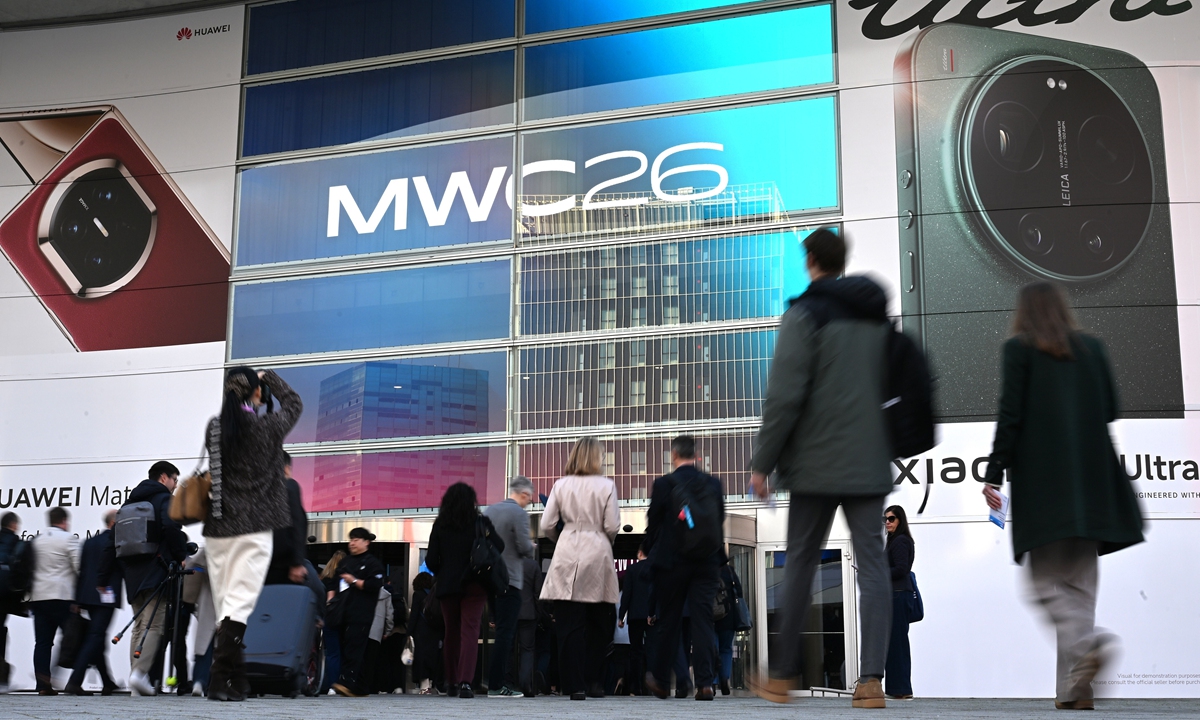
Visitors to the Mobile World Congress (MWC) go to the entrance on March 2, 2026. The global mobile communications industry showcases its latest products and services at the MCW in Barcelona, Spain. Photo: VCG
As the Mobile World Congress (MWC) 2026 opened in Barcelona on Monday, the Fira Gran Via buzzed with a shared vision of an AI-driven future. A palpable "China momentum" drew significant attentions at the halls, alongside Google's generative AI demos and Samsung's cohesive Galaxy S26 ecosystem. From AI-installed terminals to advanced humanoid robots, these high-tech products from China showcase that China's progress toward high-level technological self-reliance has reached a new milestone.
"Foreign audiences are deeply impressed by our cutting-edge products and China's technological advancement," Olivia Pan, brand director of iFLYTEK Co, told the Global Times on Sunday, noting that this is her third time to attend the MWC.
Industry observers noted that the presence of Chinese enterprises this year transcends mere market expansion. It represents a strategic shift from being "participants" in the global supply chain to becoming "trendsetters" in core technologies. Amid a complex international landscape, the resilience and innovation displayed by Chinese firms underscore a robust domestic ecosystem capable of breaking bottlenecks and delivering world-class solutions that are reshaping the global digital map.
Danni Liu, vice chair of the Spain Science and Technology Business Association APSBI, who was invited to the MWC 2026 as a special guest, told the Global Times on Monday that the visibility of Chinese companies at the exhibition is exceptionally high. "Foreign attendees are showing significant interest in brands like Huawei, Honor, and Xiaomi," Danni Liu said. "Beyond hardware, the latest breakthroughs in mobile terminals, AI, and 6G from Chinese firms have become a focal point of the event."
Latest tech advantages
In the realm of digital infrastructure, China Mobile, building on the commercialization of 5G-A in the past year, showcased benchmark applications including 5G-A intelligent interactive robots and AI-powered smart campuses. The telecom giant also demonstrated 6G agent-based communication capabilities tailored for commercial service scenarios.
Computing power remains the bedrock of the AI era. China Mobile unveiled its massive AI computing hubs, each powered by over 10,000 GPUs, alongside ultra-high-speed networking hardware and new global computing power infrastructure. These breakthroughs are designed to supercharge the world's digital backbone, according to a statement sent from the company.
In the consumer electronics sector, Lenovo displayed several AI-driven concepts: the robotic-arm-styled AI Workmate, designed for meeting summarization and PPT content curation; and the clock-shaped AI Work Companion, which focuses on multi-device task synchronization, automated daily planning, and focus management.
Lenovo's latest financial report showed a 72 percent increase in AI-related revenue and that AI business accounted for 32 percent of total operations. The report is a testament that AI has transitioned from a conceptual narrative to substantial business implementation, the company told the Global Times.
Xiaomi also launched a series of its premium products at 2026 MWC, officially introducing its flagship Xiaomi 17 and Xiaomi 17 Ultra mobile phones to the global market, alongside the Leitzphone - a strategic collaboration with Leica priced at 1,999 euros ($2,339.78). In addition to smartphones, Xiaomi's tablets, wearables, and electric scooters pricing from 799 euros received an enthusiastic response, according to the company.
MagicLab, one of four robotics firms staged the 2026 Spring Festival Gala, showcased its latest humanoid and quadruped models at 2026 MWC. Since launching its global strategy in 2025, the company has expanded into 27 countries and regions. Overseas revenue now consistently exceeds 30 percent, with monthly peaks surpassing 60 percent - signaling a transition from market exploration to aggressive global expansion, the company's statement showed.
Based on her observation, Danni Liu noted that the coverage of Chinese enterprises this time - spanning both enterprise and personal life scenarios - is incredibly broad. "This is a dimension and a dynamic that many foreign competitors currently lack," Danni Liu said.
Following nearly two decades of digital transformation, China has emerged as a global leader in intelligent equipment and electromechanical products, Liu Gang, chief economist of the Chinese Institute of New Generation Artificial Intelligence Development Strategies, told the Global Times on Monday, adding that by participating in MWC, China is not only promoting cutting-edge hardware but also exporting its advanced manufacturing models to elevate industrial standards worldwide.
Taking the global lead
Even before the opening of this year's MWC, international media had begun focusing on Chinese offerings. A report by Digitimes noted that "Chinese suppliers at MWC 2026 are showcasing premium smartphones, AI-driven hardware, and vertically integrated ecosystems," adding that the trend signals a strategic shift toward higher-end global competition and deeper control over key technologies.
Bloomberg on Monday highlighted Lenovo's innovative prototypes, including modular laptops and folding-screen gaming devices. A Sunday report from Bloomberg also drew attention to "Robot Phone" by Chinese mobile phone maker Honor, which features a camera mounted on a robotic arm that pops out from the body. CNBC noted that Honor aims to use such innovations to stand out against larger rivals like Samsung and Apple.
On X, the Xiaomi Vision Gran Turismo (VGT) concept supercar generated significant buzz. User "@knvanand" commented that the design "mixes sheer audacity and innovation." Developed in collaboration with Polyphony Digital, the creator of the Gran Turismo game series, Xiaomi is the first Chinese brand invited to the VGT project, signaling international recognition of Chinese design prowess, said the company.
Danni Liu further emphasized that most Chinese companies possess strong products that bridge the gap between technical application and real-world consumer landing, resulting in formidable competitiveness on the international stage.
Hu Qimu, a deputy secretary-general of the Forum 50 for Digital-Real Economies Integration, said Chinese technology is shifting from "application participation" to "independent R&D." Leveraging its massive market, China has become a "first-launch validation site" and an "application showroom" for new global concepts, completing the transition from follower to leader, he noted.
The data supports this trajectory. In 2025, China's total social R&D investment reached 3.9262 trillion yuan, with R&D intensity rising to 2.8 percent, placing China among the world's leading nations in tech investment. Furthermore, China's AI-related patent applications accounted for 60 percent of the global total, making it the world's largest source of AI patents.
Meanwhile, Hu emphasize that the emergence of independent, innovative products across international tech-themed exhibitions reflects the fruits of China's push for technological self-reliance. China's vast and tiered economy provides a comprehensive testing environment, which, combined with a complete industrial system and massive data pools, paves the way for efficient technology implementation and international application.
RELATED ARTICLES