China-foreign cultural exchanges show a contrast of 'complex politics and economics, warming culture': Zhang Yiwu, Peking University professor
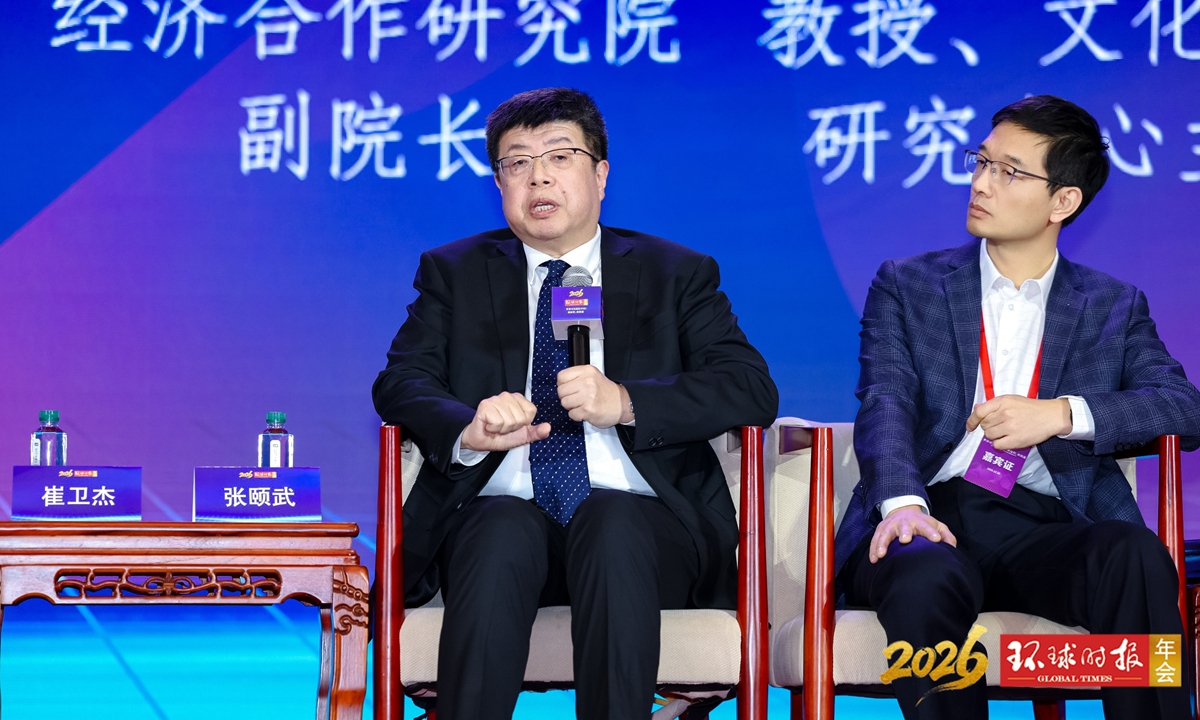
Zhang Yiwu, a professor in the Department of Chinese Language and Literature at Peking University and director of its cultural and arts committee. Photo: Global Times
On Saturday, the Global Times Annual Conference 2026, themed "Trust in China: New Journey, New Opportunities," was held in Beijing. During a discussion themed "an empowering country: what global dividends will the 15th Five-Year Plan release?" Zhang Yiwu, a professor in the Department of Chinese Language and Literature at Peking University and director of its cultural and arts committee, said that current cultural exchanges between China and other countries are marked by a striking contrast: complex politics and economics on the one hand, and warming cultural ties on the other.
Zhang noted that for a long time, Although China's political and economic relations with the Western world have appeared highly complex, in 2025, multiple surveys in Western countries showed a new rise in favorability toward China-particularly in awareness and recognition of Chinese culture-an unprecedented phenomenon. He said this forms a clear contrast: against a backdrop of intricate political and economic relations, perceptions of Chinese culture among ordinary Western citizens, especially middle-income groups and the middle class, are trending more positively.
A second contrast lies in agenda-setting. While China and the West face many conflicts and problems in political and economic spheres, Western countries have raised relatively fewer confrontational issues in the cultural domain, where exchanges have proceeded more smoothly, said Zhang.
As an example, Zhang said that with growing cultural confidence, China has shown greater openness to Western cultural products. A typical case is the US animated film Zootopia 2, which since its China release on November 26 has achieved box-office results even stronger than in North America-earning 3.7 billion yuan ($515 million) in revenue, attracting more than 91 million viewers, and nearing the 100-million mark, with receipts still climbing.
Zhang said such openness has not produced negative social effects; instead, cultural diversity has enriched audience choice.
According to Zhang, behind these contrasts are two positive trends worth noting. First, China is advancing openness with firm cultural confidence, bringing new development opportunities to the global cultural industry. China's acceptance of overseas cultural products-including Hollywood films-has increased, and newly released titles such as Avatar 3 are expected to receive significant support from the Chinese market.
Second, the image of a "Cool China" is taking shape globally. The "new trio" of culture included in the 15th Five-Year Plan proposal-online literature, online games, and online audiovisual content-is accelerating its global expansion. Online games such as Black Myth: Wukong are presenting Chinese culture overseas in a more accessible and engaging way.
Since the beginning of the year, a wave of foreign influencers "witnessing China" has enabled more ordinary Western people to see a real China, breaking past Western filters and distortions, said Zhang.
At the same time, vivid everyday life showcased on platforms such as Xiaohongshu, along with the global expansion of cultural IPs like Pop Mart, are jointly creating a lively, multidimensional image of contemporary China with spillover effects worldwide.
Zhang said that the rise of a "Cool China" will influence China's political, economic, and social spheres in many ways, adding that "over the next five years, we will see a very powerful cultural wave, along with vast prospects and opportunities."
RELATED ARTICLES