2025 Yearender: From past heroes to present youth – cross-Straits shared culture and memories shine amid DPP disruptions
By and Shen Sheng Published: Dec 19, 2025 11:08 PM


An aerial view taken from Xiamen, East China's Fujian Province, on June 5, 2025, shows the Xiamen-Kinmen Bridge along with the scenic landscape of Kinmen county, Taiwan island. Photo: VCG
Throughout 2025, a slew of political, cultural and social events and phenomena keep shaping the cross-Straits relations - from attention to a mainland television drama featuring heroes of the covert front, to viral memes adapted from a Taiwan politician; from commemorations marking the 80th anniversary of Taiwan's restoration to China to controversy sparked by Taiwan regional authorities' restrictions on Xiaohongshu. Alongside the developments, Global Times reporters have witnessed increasingly complex dynamics in cross-Straits interaction as well as enduring people-to-people connections, but the historical trend of reunification is clear.
The mainland television series Silent Honor was really a success on screen in 2025. The drama recounts the stories of Communist Party of China (CPC) underground agents Wu Shi and his fellows in Taiwan in the 1950s, drawing wide viewership on both sides of the Straits while prompting spontaneous acts of remembrance.
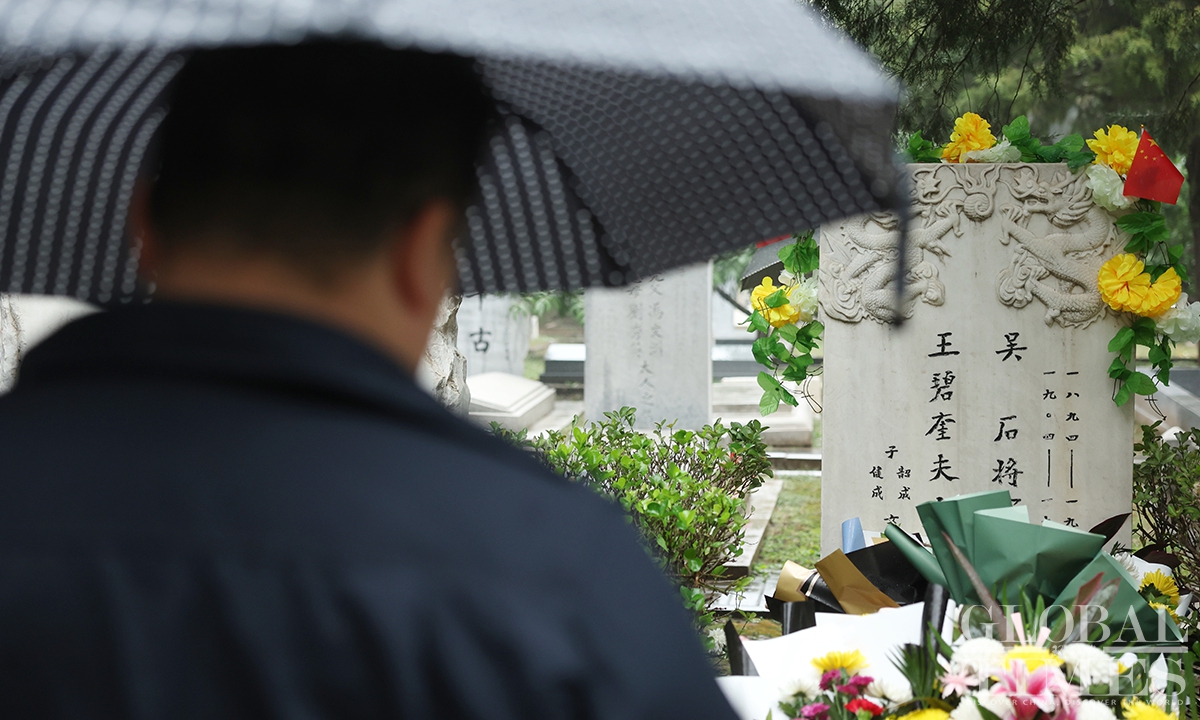
Photo: Cui Meng/GT
On October 16, at Futian Cemetery in Beijing, where Wu and his wife Wang Bikui are buried, the Global Times reporters observed a steady stream of visitors solemnly paying their respects despite the rain. A tribute payer surnamed Luo summed up his feelings toward the heroes in four phrases: "Nameless in glory, selfless in devotion, unseen in battle, and unmatched in honor."As his words fell, a tear traced his cheek and blended seamlessly with the rain - like water returning to the sea, like an island returning motherland.
Such sentiments were also echoed by a visitor from Taiwan. On October 23, Professor Yuan Juzheng from National Taiwan University who made an unplanned visit to Wu's grave.
Yuan was in Beijing to attend events marking the 80th anniversary of Taiwan's restoration. After he and his nephew discussed Wu over breakfast and realizing the cemetery was nearby, they decided to go immediately.
Yuan said the series resonated deeply with him, particularly its portrayal of Wu as a man who rejected Chiang Kai-shek's rule in Taiwan out of ideological conviction, despite holding a trusted position at the time. "That kind of unwavering resolve deserves respect," he said.
Just days before the visit in Beijing, Yuan went to Machangding Memorial Park in Taipei, the site where Wu was executed. Days later, on November 8, this year's memorial gathering was held under the theme "Remember history, honor the martyrs, unite across the Straits, revitalize China," drawing more than a thousand participants.
Chinese Kuomintang party chairperson Cheng Li-wen attended the memorial gathering, where she delivered an address and laid flowers, media on the island reported. In her speech, Cheng, citing an victim of that time, expressed deep wish for cross-Straits peace and an end to hostilities between the two sides, chinanews.com reported.
At a seminar in Taipei held in November, Cheng said that facts have proven that the 1992 Consensus can ease cross-Straits tensions and facilitate peaceful exchanges. She also noted the importance of the exchanges, saying that only through cross-Straits exchanges, can "we embrace a better future." By contrast, erroneous cross-Straits policies would place the island "in its most disadvantageous position," she added.
New trend emerges
October 25, 2025 marked the 80th anniversary of Taiwan's restoration to China and a range of commemorative activities were held on both sides of the Straits.
From memorial sites to university lecture halls, the Global Times reporters gained the feeling that history and the present are increasingly intersected in conversations on cross-Straits relations.
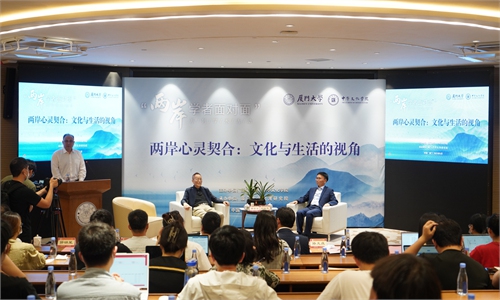
At an academic symposium on the new dynamics of cross-Straits relations held at Tsinghua University in Beijing on October 23, Hsiao Hsu-tsen, the executive director of the Ma Ying-jeou Culture and Education Foundation at the time, told the Global Times that the series of Silent Honor is highly significant as it served as a starting point for rethinking cross-Straits relations beyond long-standing political labels.
By portraying a sensitive historical period in a more open and candid manner, Hsiao said the series sparked discussion within Taiwan - particularly among younger audiences. Commemorations marking Taiwan's restoration should not be confined to remembrance alone, but serve as an opportunity to reflect on the future.
Another impressive moment that writes a cultural footnote was a music video created by a mainland netizen using earlier remarks by Taiwan politician Wang Shih-chien going viral. Discussion on the phenomena even entered the Tsinghua forum that the Global Times reporters attended.
At the forum, scholars and young participants from Taiwan cited the adapted song and online memes as examples of how cross-Straits interaction is increasingly taking place through unofficial, bottom-up channels rather than traditional exchanges.
Some participants told the Global Times that the rapid rise of digital and intelligent technologies is reshaping cross-Straits youth exchanges. They noted that new media has broken the "information bubble" created by separatist forces on the island, enabling more young people in Taiwan to gain exposure to firsthand, despite digital, information on the mainland.
Unstoppable public will
Yet these expanding informal exchanges unfolded alongside tightening political constraints on the island imposed by the Democratic Progressive Party (DPP) authorities.
On December 4, Taiwan's "interior affairs department" announced restrictions on access to Xiaohongshu for one year, citing alleged cybersecurity risks and its involvement in fraud cases, according to multiple Taiwan media reports. Xiaohongshu has more than 3 million users on the island, with its download rate and popularity rising rapidly and, in some periods, surpassing those of Instagram, according to udn.com.
Blocking Xiaohongshu was not an isolated case. Throughout the year, the DPP authorities also took steps to restrict cross-Straits exchanges, from threats and policy restrictions on mainland spouses to warning against participation in activities commemorating the 80th anniversary of Taiwan's restoration.
Hsiao told the Global Times that the DPP's denial of the history of Taiwan's restoration has drawn widespread criticism on the island, with many condemning it as a betrayal of historical fact. Refusing to commemorate such a significant event, while simultaneously discouraging Taiwan residents from taking part in related activities, he said, has proven difficult for Taiwan society to accept.
A young scholar from the island of Taiwan surnamed Luo told the Global Times that framed as an administrative decision, targeting a mobile app reflected what he described as growing anxiety among the DPP authorities in response to deepening cross-Straits exchanges and changing perceptions of the mainland among Taiwan's youth. He added that such measures could heighten curiosity among young people about what authorities were seeking to limit and why.
Zheng Jian, a professor at the Taiwan Research Institute of Xiamen University who attended multiple cross-Straits activities this year, said public demand in Taiwan for exchanges is at a high level. Instead of responding to this sentiment, the DPP has tightened restrictions. At the same time, online platforms have continued to lower barriers to understanding, enabling island residents to gain a clearer view of the mainland and encouraging them to engage deeper and further.
The DPP has openly framed "anti-China confrontation" as the core of its campaign strategy. However, "the desire of ordinary people is not confrontation, but exchanges, peace and tangible benefits," Zheng said. "These aspirations cannot be suppressed indefinitely."
Observing cross-Straits developments throughout 2025, the contrast has become increasingly clear: while political restrictions have tightened, social connectivity continues to deepen. Family ties, shared history and everyday interaction remain the most resilient links across the Straits - persisting even amid uncertainty and restraint.
Looking into 2026, there will still be uncertainty and restraint, but the major trend in cross-Straits is clear, just like Professor Yuan Juzheng put in a previous interview with the Global Times- "Taiwan's destiny is inextricably bound up with that of the motherland. If it does not remain part of the country, Taiwan will inevitably face misfortune and decline."
RELATED ARTICLES