A stably developing China brings confidence to the world: Global Times editorial
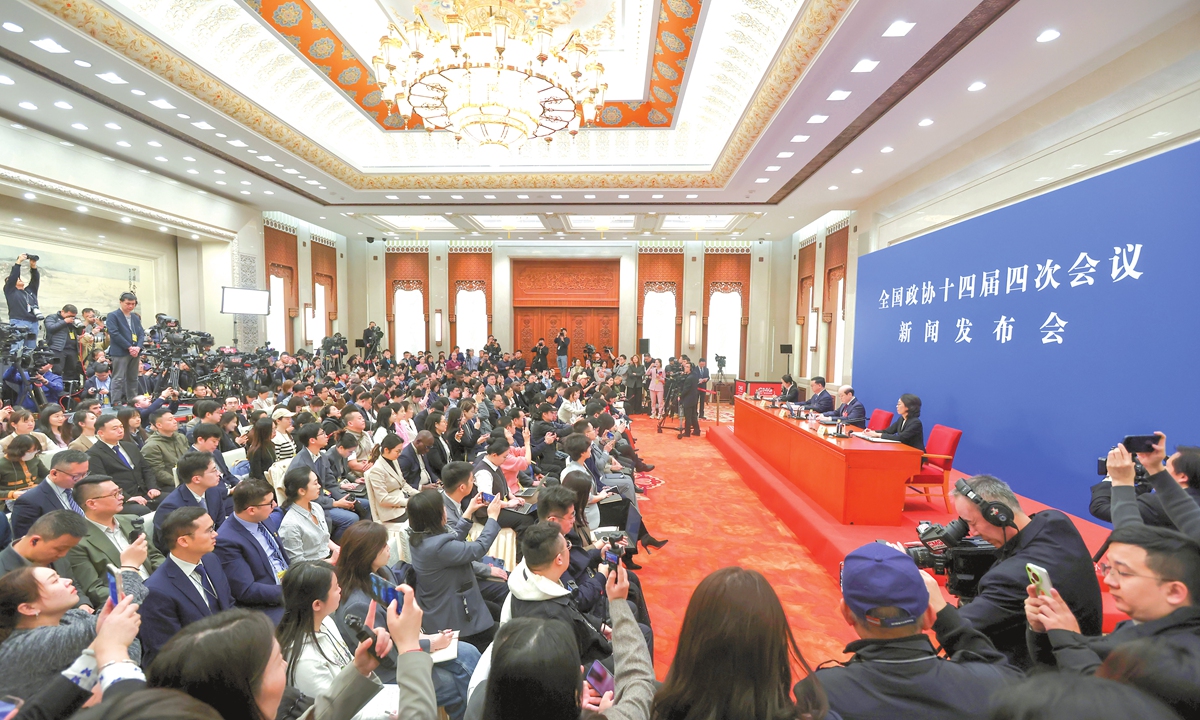
Liu Jieyi, spokesperson for the fourth session of the 14th Chinese People's Political Consultative Conference (CPPCC) National Committee, attends a press conference at the Great Hall of the People in Beijing, on March 3, 2026. The CPPCC National Committee, China's top political advisory body, held a press conference on Tuesday, one day before its annual session. Photo: cnsphoto
China has officially entered the two sessions season. As China's political weather vane and economic barometer, the two sessions - China's annual sessions of its top legislature and political advisory body - serve not only as a major domestic political agenda but have also long been a significant global political event with worldwide impact.
This year marks the commencement of China's 15th Five-Year Plan (2026-30), drawing extensive attention from mainstream international media to how China will outline a longer-term strategic blueprint. Consequently, this year's two sessions are seen as carrying exceptional significance. The South China Morning Post described it this way: "This gathering is no ordinary policy meeting"; "Beijing has an opportunity to position itself as a more stable and reliable anchor in an increasingly fragmented international order."
When we unfold the timeline of history, the unique historical positioning of this year's two sessions becomes clearer - 2026 is the inaugural year of the 15th Five-Year Plan period, which plays a pivotal bridging role in the process of essentially realizing socialist modernization. Amid global changes unseen in a century, Chinese modernization has created a new form of human civilization. It is especially important to recognize that in today's world, the rule-based foundation of the global order is becoming unstable, and the predictability of the international system has significantly decreased. Against this backdrop, the signals released by China's two sessions carry profound significance that extends far beyond domestic affairs.
Looking back at the 14th Five-Year Plan period (2021-25), its extraordinarily challenging and remarkable journey inspires deep reflection. Facing complex international circumstances and the arduous tasks of domestic reform, development and stability, China's economy has successively crossed multiple trillion-yuan thresholds in total output; its manufacturing value added has firmly held the top spot worldwide; breakthroughs in sci-tech self-reliance have accelerated dramatically; and grain production has consistently reached new highs year after year. This hard-won report card is a vivid testament to the solid strides made in advancing Chinese modernization, and a concentrated reflection of the advantages of the socialist system when tested by risks and challenges.
The draft outline of the 15th Five-Year Plan, soon to be submitted to the National People's Congress (NPC) for deliberation, will chart the strategic course for China's development over the next five years. Moving from the "laying the foundation for transformation" and "generating new growth drivers" of the 14th Five-Year Plan to the "comprehensive drive and overall upgrading" of the 15th Five-Year Plan, scientific and technological self-reliance and self-improvement is advancing toward original innovation, achieving breakthroughs "from 0 to 1." A growth model driven primarily by domestic demand and consumption is accelerating, and the policy orientation of "investing in people" is becoming prominent. These strategic arrangements reflect not only the foresight and continuity of macroeconomic policy, but also China's flexibility in adjusting to changing circumstances amid uncertainties.
The commencement of the 15th Five-Year Plan, along with economic growth, technological self-sufficiency, and green development, has all become high-frequency keywords in global observations of China's two sessions. Taking climate change, Bloomberg noted that the 15th Five-Year Plan policy settings are "critical to determining the world's success in tackling climate change." This demonstrates the achievements of China in advancing the modernization of its national governance system and governance capacity are recognized by the international community. When studying and discussing China's policymaking and long-term planning, the world feels reassured.
It is against this backdrop that an increasing number of leaders from various countries, including Western nations, have come to China to seek cooperation. This aligns with the heightened attention on the two sessions, reflecting a consistent underlying logic. The South China Morning Post describes this phenomenon as a "shifting global narrative," asserting that "China's economic resilience has stood out against US unpredictability." Whether it is expanding high-level opening-up, deepening cooperation in the digital economy, or promoting the joint construction of a green "Belt and Road," China has always adhered to a high-quality and sustainable development path, insisting on mutual benefit and win-win cooperation. Observations from the two sessions will further deepen the perception of China that is credible, appealing, and respectable.
From the successful conclusion of the 14th Five-Year Plan to the good start of the 15th Five-Year Plan, China has transformed its modernization blueprint into reality through continuous and stable medium- to long-term planning. A comparison has been made: Western modernization took over 300 years, yet only enabled fewer than 1 billion people to achieve modern living standards; in contrast, a primary feature of Chinese modernization is its "massive population scale," allowing over 1.4 billion people to move toward modernization in just a few decades - a groundbreaking achievement in the history of human civilization. The strategic determination of "following a good blueprint through to the end," the institutional advantage of pool all resources to complete major missions, and the people-centered development philosophy are the core elements that make Chinese modernization particularly compelling to the world.
During the two sessions, NPC deputies and CPPCC members will engage in deliberation and discussions surrounding the government work report and the draft outline of the 15th Five-Year Plan. This is a microcosm of the new journey of Chinese modernization, and it reflects the certainty of China's development and the stability of its system. For a world that is increasingly filled with instability and uncertainty, this itself represents confidence and strength.
RELATED ARTICLES