China to strengthen core tech breakthroughs during 15th Five-Year Plan
NPC spokesperson highlights push for original innovation, deeper tech-industry integration
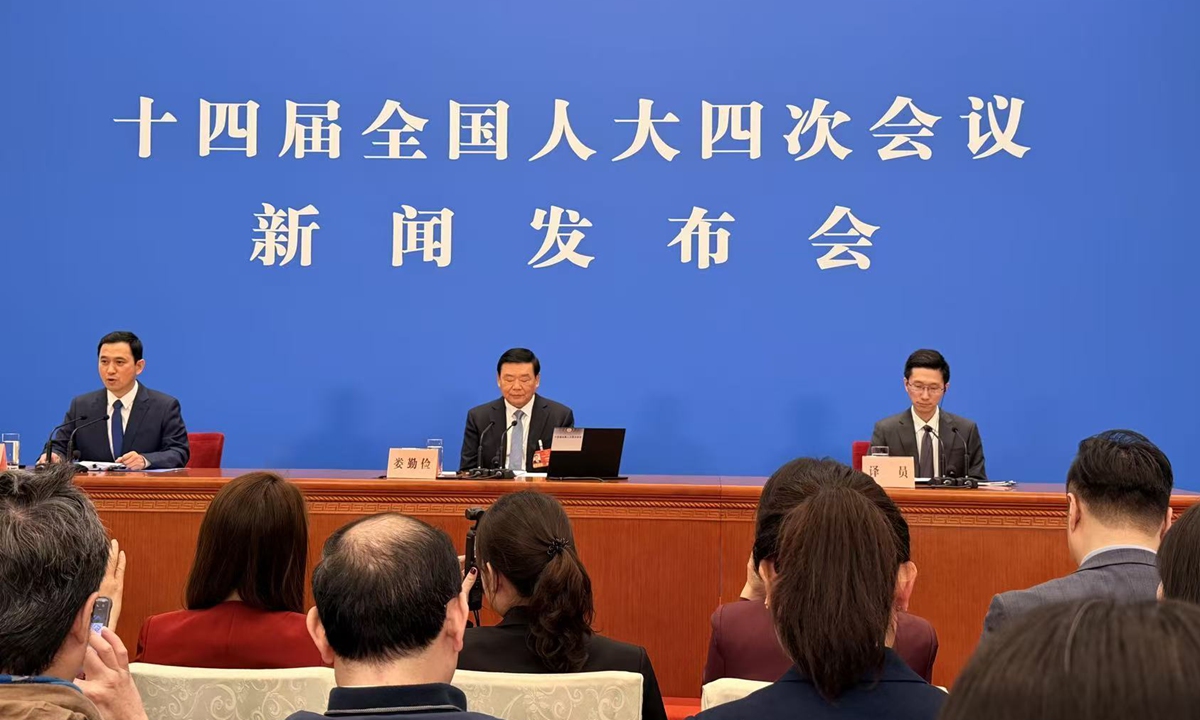
Lou Qinjian, spokesperson for the fourth session of the 14th National People's Congress, attends a press conference at the Great Hall of the People in Beijing on March 4, 2026. Photo: Chen Qingqing/GT
China will strengthen original innovation and intensify efforts to achieve breakthroughs in key core technologies during the 15th Five-Year Plan period (2026-30), a spokesperson for the fourth session of the 14th National People's Congress (NPC) said on Wednesday, adding that the country is also willing to work with all sides to promote an "open, fair, just and non-discriminatory" global environment for technological development.
Lou Qinjian, spokesperson for the fourth session of the 14th NPC, made the remarks at a press conference on Wednesday, one day ahead of the opening of the annual session of the NPC, China's national legislature, when asked about his view of China's sci-tech innovation system represented by artificial intelligence (AI), after China's humanoid robots made a strong impression during the Spring Festival Gala for the second consecutive year.
Lou said that the past year was undoubtedly a crucial one for China's domestically developed humanoid robot industry, which achieved major advances both in technological breakthroughs and in the real-world application of scenarios. As the technological capabilities and application scenarios of humanoid robots continue to expand, they offer a glimpse of a future filled with vast possibilities, he noted.
"In recent years, China has accelerated the development of the artificial intelligence industry, with the scale and capacity of computing infrastructure steadily improving, high-quality datasets emerging at a faster pace, and domestically developed algorithm models helping to lead an open-source innovation ecosystem," the spokesperson said.
"China will strengthen original innovation and intensify efforts to achieve breakthroughs in key core technologies during the 15th Five-Year Plan period, while accelerating the deep integration of technological and industrial innovation and striving for decisive progress in critical technologies across key sectors along the entire innovation chain," the NPC spokesperson said.
Lou added that scientific and technological innovation cannot be separated from an open, inclusive and mutually beneficial global ecosystem, pledging that "China is willing to work with all countries to promote the establishment of an open, fair, just and non-discriminatory global environment for technological development, so that the outcomes of scientific and technological innovation can benefit more countries and people."
As one of the major agenda items of the session, the NPC will examine the draft outline of the 15th Five-Year Plan (2026-30) for national economic and social development, according to the Xinhua News Agency. The draft's recommendations adopted last October set "substantial improvements in scientific and technological self-reliance and strength" as one of the major objectives of the next round of the five-year plan.
Despite a complex international environment and mounting technological restrictions, China made notable progress in key fields such as materials, chips and energy during the 14th Five-Year Plan period (2021-25), significantly strengthening its capabilities in core technologies, said Xiang Ligang, director-general of the Zhongguancun Modern Information Consumer Application Industry Technology Alliance.
"As the country enters the 15th Five-Year Plan period this year, as a major country with a relatively complete technological system and industrial base, China will definitely play an active role in this new round of technological revolution and has the capacity to move to the forefront in key fields such as artificial intelligence," Xiang told the Global Times on Wednesday.
Several national political advisers highlighted efforts to strengthen innovation and technological development during a group interview on Wednesday ahead of the opening meeting of the fourth session of the 14th National Committee of the Chinese People's Political Consultative Conference (CPPCC) in Beijing.
Pan Jianwei, executive vice president of the University of Science and Technology of China and a CPPCC National Committee member, said that "we will continue to strengthen original innovation and accelerate the commercialization of research outcomes during the 15th Five-Year Plan period, enabling quantum technology to better support high-quality economic and social development."
Zeng Yuqun, chairman of Contemporary Amperex Technology Co (CATL) and also a CPPCC National Committee member, pledged during the interview that the company will further increase research and development investment, particularly by applying more AI technologies, while bringing Chinese products to global markets and promoting China's technologies and standards worldwide.
Guo Lanfeng, a CPPCC National Committee member and president of the China Society of Economic Reform, said during Wednesday's group interview that China's science and technology spending ranked second in the world, with the country's average investment exceeding the average level of EU economies and a large number of breakthroughs achieved in scientific research and development.
"This reflects the country's growing innovation capacity," Guo noted.
Xiang stressed that China's commitment to independent innovation does not mean developing technology behind closed doors. "Instead, China remains open and inclusive, sharing the benefits of technological progress with the world - an approach that contrasts with the technology blockades imposed by some countries - and contributes to global peace and stability," he added.
RELATED ARTICLES