IN-DEPTH / IN-DEPTH
BeautifulChinaING: Decade of skyline photos traces China’s clean air campaign driven by sustainable policy, public effort
By Published: Mar 04, 2026 09:27 PM

Editor's Note:
"Building ecological civilization concerns the well-being of the people and the future of the nation."
Chinese President Xi Jinping, also general secretary of the Communist Party of China (CPC) Central Committee and chairman of the Central Military Commission, pointed out, "Respecting, adapting to, and protecting nature is essential for building China into a modern socialist country in all respects."
The building of a Beautiful China is a key component of Xi Jinping Thought on Ecological Civilization. Recommendations of the Central Committee of the CPC for Formulating the 15th Five-Year Plan for National Economic and Social Development focus on securing "major breakthroughs in strategic tasks of overall importance to Chinese modernization" and designate "major new strides in advancing the Beautiful China Initiative" as one of the major objectives for economic and social development during the 15th Five-Year Plan period (2026-30).
The Global Times's column on Xi Jinping Thought on Ecological Civilization is launching a series of reports titled "BeautifulChinaING." From the perspectives of the beauty of nature, the beauty of system and the beauty of lifestyle, the series uses both Chinese and international cases as entry points. Through field reporting and video storytelling, it explores how green development has become a defining feature of Chinese modernization while showcasing China's role as a responsible major country providing global public goods.
In this installment, we turn our focus to China's decade-long battle for blue skies. From industrial cities once shrouded in smog to neighborhoods where residents now record clear skies day after day, officials, scientists, businesses and ordinary citizens have joined forces to tackle air pollution. Their combined efforts have transformed the country's air quality and brought blue skies back to daily life.
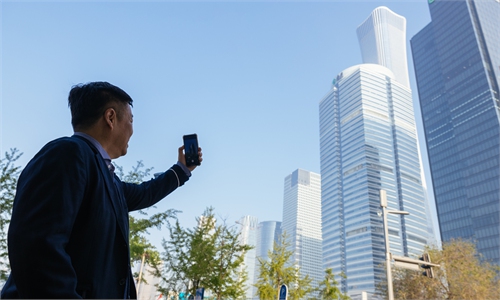
In the early morning, on a pedestrian overpass in Beijing's Chaoyang district, Zou Yi raises his phone and takes a photo of the skyline of the CBD.
This Tuesday marked the 4,782nd day since he began the routine.
Over the past 13 years, he has taken photos of the sky from the same spot almost every day, documenting not only the growth of the city but also the dramatic improvement in China's air quality and the gradual return of blue skies to daily life.
This transformation is also reflected in official data. The Global Times learned from the Ministry of Ecology and Environment that in 2025, China's ambient air quality continued to improve, reaching the best level since monitoring records began. The annual average concentration of fine particulate matter (PM2.5) in cities at the prefectural level and above nationwide fell to 28.0 micrograms per cubic meter. The proportion of days with good or excellent air quality reached 89.3 percent, while the share of days with heavy pollution dropped to 0.9 percent.
As Chinese President Xi Jinping puts it, "A sound eco-environment is the fairest public good and the most inclusive benefit to people's wellbeing," the Xinhua News Agency reported.
Over the past decade and more, China has responded to this expectation by steadily advancing actions to prevent and control air pollution, allowing blue skies to once again become a form of public wealth that ordinary people can see and feel.
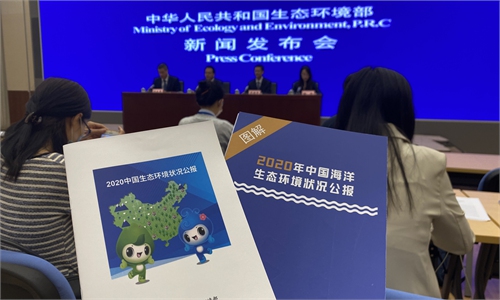
"There is no blue sky that comes out of thin air," Li Tianwei, head of the Atmospheric Environment Department of the Ministry of Ecology and Environment, said at a recent press conference on February 27, 2026.
Behind these seemingly ordinary blue skies lies more than a decade of systematic governance - and a story of how institutions, technology and public participation together helped change the color of the sky.
Recording blue skies
In Zou's lens, the changes in Beijing's sky did not happen overnight, but accumulated little by little.
Since 2013, Zou has taken photos of the sky from a fixed spot near the CBD in Beijing's Chaoyang district almost every day. Over more than a decade, what began as a personal hobby has turned into a long-running "sky archive," known as Beijing Air Now.
He stitches together photos from each day and lines up the mosaics year by year. The result reveals a gradual shift in the dominant color of Beijing's sky - from gray to increasingly blue and bright. Smog has slowly retreated, while blue skies and white clouds have returned to the city with growing frequency.
In recent years, this transformation has reached a new milestone. Data from the Beijing Municipal Ecology and Environment Bureau showed that the city's annual average concentration of PM2.5 fell to 27.0 micrograms per cubic meter, down 11.5 percent year-on-year, marking the first time since monitoring began that the figure dropped below 30 micrograms, according to the Beijing Municipal Publicity Department in January.
"It can be seen as a new breakthrough for Beijing - another miracle," Zou told the Global Times. He believes the achievement stems from the advancement of China's dual-carbon goals to peak carbon emissions by 2030 and achieve carbon neutrality by 2060, effective control of transportation-related pollution sources, and comprehensive scientific governance covering the entire chain from source to process to end-of-pipe treatment.
Moreover, 29 Chinese cities now have GDP exceeding 1 trillion yuan ($139 billion). In these cities, the average PM2.5 concentration stands at 27.8 micrograms per cubic meter, better than the national average, and all have seen significant improvement during the 14th Five-Year Plan period, showing that economic growth and the protection of blue skies can advance together, according to Li.
For environmentalist Ma Jun, also founder of the Blue Map app, these changes are reflected not only in official statistics but also in the public's daily experience.
He often describes the improvement in Beijing's air quality with a string of numbers: "89.5, 86, 81, 73, 58, 51, 42, 38, 33, 30, 32, 30.5, 27.5…" These are the annual average PM2.5 of the capital city in past years. To him and many environmental volunteers, these seemingly ordinary numbers trace the trajectory of China's air pollution control efforts.
Launched in 2014, the Blue Map app allows the public to check companies' emissions data in real time and submit "micro-reports" through social media. At the same time, more and more internet users have begun documenting the skies above their hometowns. So far, nearly 3 million "snapshots of blue skies" have been uploaded by netizens across various platforms.
"From the air-quality calendars shared by internet users, it is clear that blue skies are gradually shifting from a luxury to a new normal," Ma told the Global Times.
From coal dust to clear days
Behind this gradually bluer sky, each city has followed its own path and story of change. In Linfen, Shanxi Province in North China, a city once plagued by pollution due to its coal industry, the transformation has been particularly striking.
"When I was a child, many days the air was filled with black dust as we walked to school. The first thing we did after arriving was wash our faces and hands," recalled Lin Xiu, a Linfen resident in her 30s, who still remembers the air conditions of her childhood with lingering unease.
She later left her hometown to study and work elsewhere. But in recent years, every time she returns, she has clearly felt the changes. "There are more blue skies, more trees, and the whole city seems brighter," she told the Global Times.
Official data confirms this transformation. Over the past five years, Linfen has recorded the fastest improvement in air quality nationwide. In 2025, the city's PM2.5 concentration fell to 35.1 micrograms per cubic meter, down 46.5 percent from 2020, Xinhua reported.
Changes like those seen in Linfen are far from isolated cases. Instead, they represent a microcosm of China's systematic push to tackle air pollution.
Meanwhile, China has also carried out large-scale industrial upgrading and emission control in recent years. Key industries such as steel, power generation and cement have implemented ultra-low emission upgrades. The share of clean energy has continued to rise, while northern regions have promoted clean heating on a large scale. These measures have not only reduced pollution emissions but also driven industrial transformation and upgrading.
New chapter
China's progress in air pollution control has also drawn international attention.
Rejane Rocha, executive secretary of the China-Brazil Center for Climate Change and Innovative Energy Technologies, told the Global Times that the most tangible change she has observed during her visits to China over the past decade is the country's remarkable improvement in air quality, which she said reflects how quickly national plans can translate into real-world progress.
Although air quality has already seen significant improvement, China's battle to defend blue skies has now entered a critical phase.
Li noted at the press conference that China's air quality is currently in a transition from "significant improvement" to "fundamental improvement." As pollutant concentrations continue to fall, each further step toward improvement will become increasingly difficult.
Starting this March, revised ambient air quality standards officially came into effect, further tightening PM2.5-related indicators and setting higher targets for sustained improvements in air quality, according to the Guangming Daily.
At the same time, the environmental code, which is expected to be reviewed by the lawmakers during this year's two sessions, is also seen as an important step in improving China's ecological governance system.
For Yun Jianli, a volunteer who has long participated in environmental protection activities along the Hanjiang River in Central China's Hubei Province, such institutional progress offers a clearer foundation for public involvement in environmental protection.
"In the past, when dealing with some environmental issues, we often had to search across different laws to find a legal basis," Yun told the Global Times. "The code integrates these systems, providing clearer and more authoritative legal support for environmental actions."
In her view, provisions in the code concerning information disclosure and public participation will also encourage more people to take part in ecological protection, helping make environmental protection a truly shared social undertaking.
For Zou, these changes also mean a new mission of documentation.
After 13 years of photographing the sky, he had originally planned to conclude his project Beijing Air Now in 2026. But following suggestions from many friends and members of the public, he decided to continue.
"The decade from 2026 to 2035 will be a crucial period for building a Beautiful China," he said. "What began as a record of the changing smog conditions will gradually shift toward documenting a clearer goal, the skies of a Beautiful China in the era of the dual-carbon strategy."
If more than a decade ago people saw through his lens how a city struggled to shake off smog, in the coming decade he hopes to continue using the same approach to record the next chapter in the transformation of China's skies.
"Building ecological civilization concerns the well-being of the people and the future of the nation."
Chinese President Xi Jinping, also general secretary of the Communist Party of China (CPC) Central Committee and chairman of the Central Military Commission, pointed out, "Respecting, adapting to, and protecting nature is essential for building China into a modern socialist country in all respects."
The building of a Beautiful China is a key component of Xi Jinping Thought on Ecological Civilization. Recommendations of the Central Committee of the CPC for Formulating the 15th Five-Year Plan for National Economic and Social Development focus on securing "major breakthroughs in strategic tasks of overall importance to Chinese modernization" and designate "major new strides in advancing the Beautiful China Initiative" as one of the major objectives for economic and social development during the 15th Five-Year Plan period (2026-30).
The Global Times's column on Xi Jinping Thought on Ecological Civilization is launching a series of reports titled "BeautifulChinaING." From the perspectives of the beauty of nature, the beauty of system and the beauty of lifestyle, the series uses both Chinese and international cases as entry points. Through field reporting and video storytelling, it explores how green development has become a defining feature of Chinese modernization while showcasing China's role as a responsible major country providing global public goods.
In this installment, we turn our focus to China's decade-long battle for blue skies. From industrial cities once shrouded in smog to neighborhoods where residents now record clear skies day after day, officials, scientists, businesses and ordinary citizens have joined forces to tackle air pollution. Their combined efforts have transformed the country's air quality and brought blue skies back to daily life.
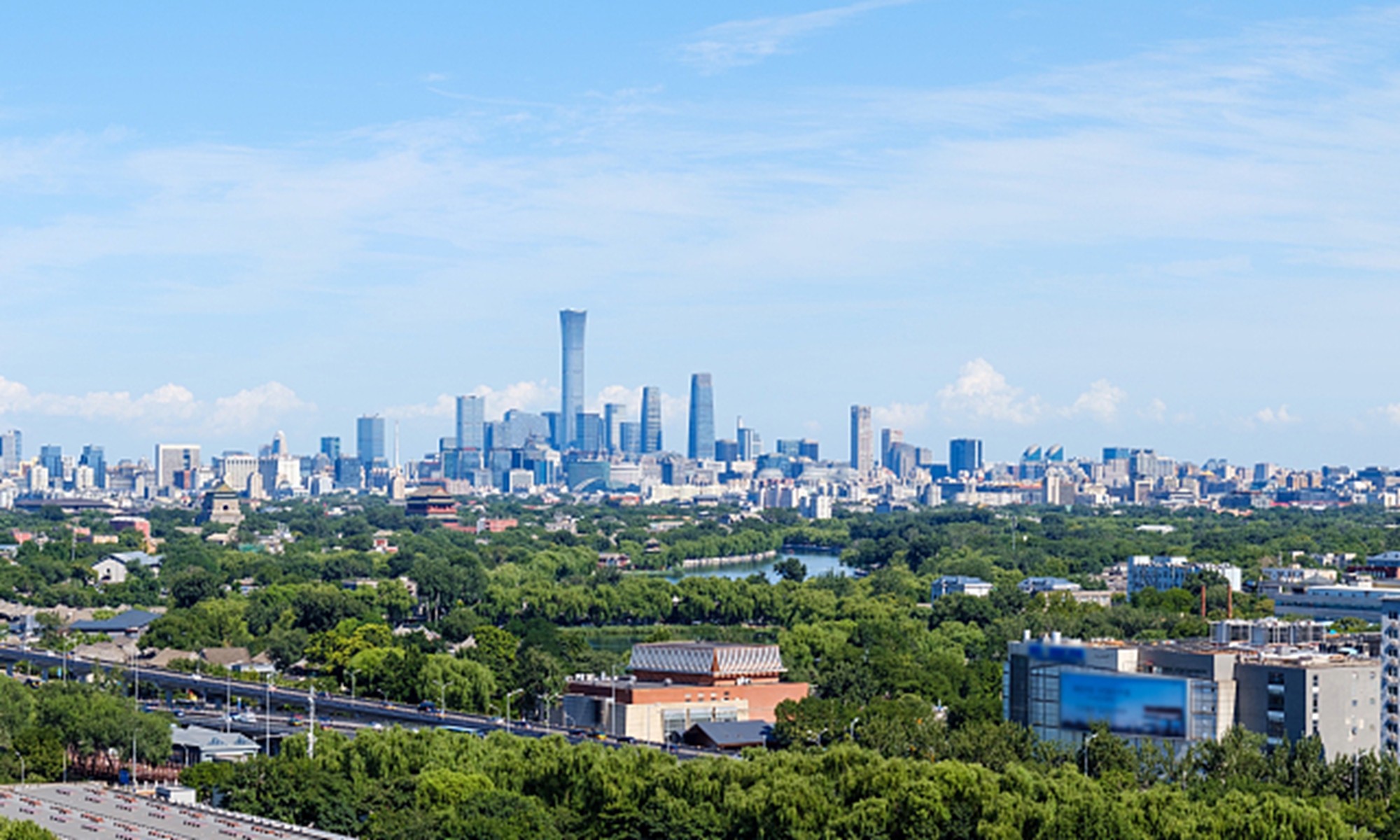
The skyline of Beijing Photo: VCG
In the early morning, on a pedestrian overpass in Beijing's Chaoyang district, Zou Yi raises his phone and takes a photo of the skyline of the CBD.
This Tuesday marked the 4,782nd day since he began the routine.
Over the past 13 years, he has taken photos of the sky from the same spot almost every day, documenting not only the growth of the city but also the dramatic improvement in China's air quality and the gradual return of blue skies to daily life.
This transformation is also reflected in official data. The Global Times learned from the Ministry of Ecology and Environment that in 2025, China's ambient air quality continued to improve, reaching the best level since monitoring records began. The annual average concentration of fine particulate matter (PM2.5) in cities at the prefectural level and above nationwide fell to 28.0 micrograms per cubic meter. The proportion of days with good or excellent air quality reached 89.3 percent, while the share of days with heavy pollution dropped to 0.9 percent.
As Chinese President Xi Jinping puts it, "A sound eco-environment is the fairest public good and the most inclusive benefit to people's wellbeing," the Xinhua News Agency reported.
Over the past decade and more, China has responded to this expectation by steadily advancing actions to prevent and control air pollution, allowing blue skies to once again become a form of public wealth that ordinary people can see and feel.
"There is no blue sky that comes out of thin air," Li Tianwei, head of the Atmospheric Environment Department of the Ministry of Ecology and Environment, said at a recent press conference on February 27, 2026.
Behind these seemingly ordinary blue skies lies more than a decade of systematic governance - and a story of how institutions, technology and public participation together helped change the color of the sky.
Recording blue skies
In Zou's lens, the changes in Beijing's sky did not happen overnight, but accumulated little by little.
Since 2013, Zou has taken photos of the sky from a fixed spot near the CBD in Beijing's Chaoyang district almost every day. Over more than a decade, what began as a personal hobby has turned into a long-running "sky archive," known as Beijing Air Now.
He stitches together photos from each day and lines up the mosaics year by year. The result reveals a gradual shift in the dominant color of Beijing's sky - from gray to increasingly blue and bright. Smog has slowly retreated, while blue skies and white clouds have returned to the city with growing frequency.
In recent years, this transformation has reached a new milestone. Data from the Beijing Municipal Ecology and Environment Bureau showed that the city's annual average concentration of PM2.5 fell to 27.0 micrograms per cubic meter, down 11.5 percent year-on-year, marking the first time since monitoring began that the figure dropped below 30 micrograms, according to the Beijing Municipal Publicity Department in January.
"It can be seen as a new breakthrough for Beijing - another miracle," Zou told the Global Times. He believes the achievement stems from the advancement of China's dual-carbon goals to peak carbon emissions by 2030 and achieve carbon neutrality by 2060, effective control of transportation-related pollution sources, and comprehensive scientific governance covering the entire chain from source to process to end-of-pipe treatment.
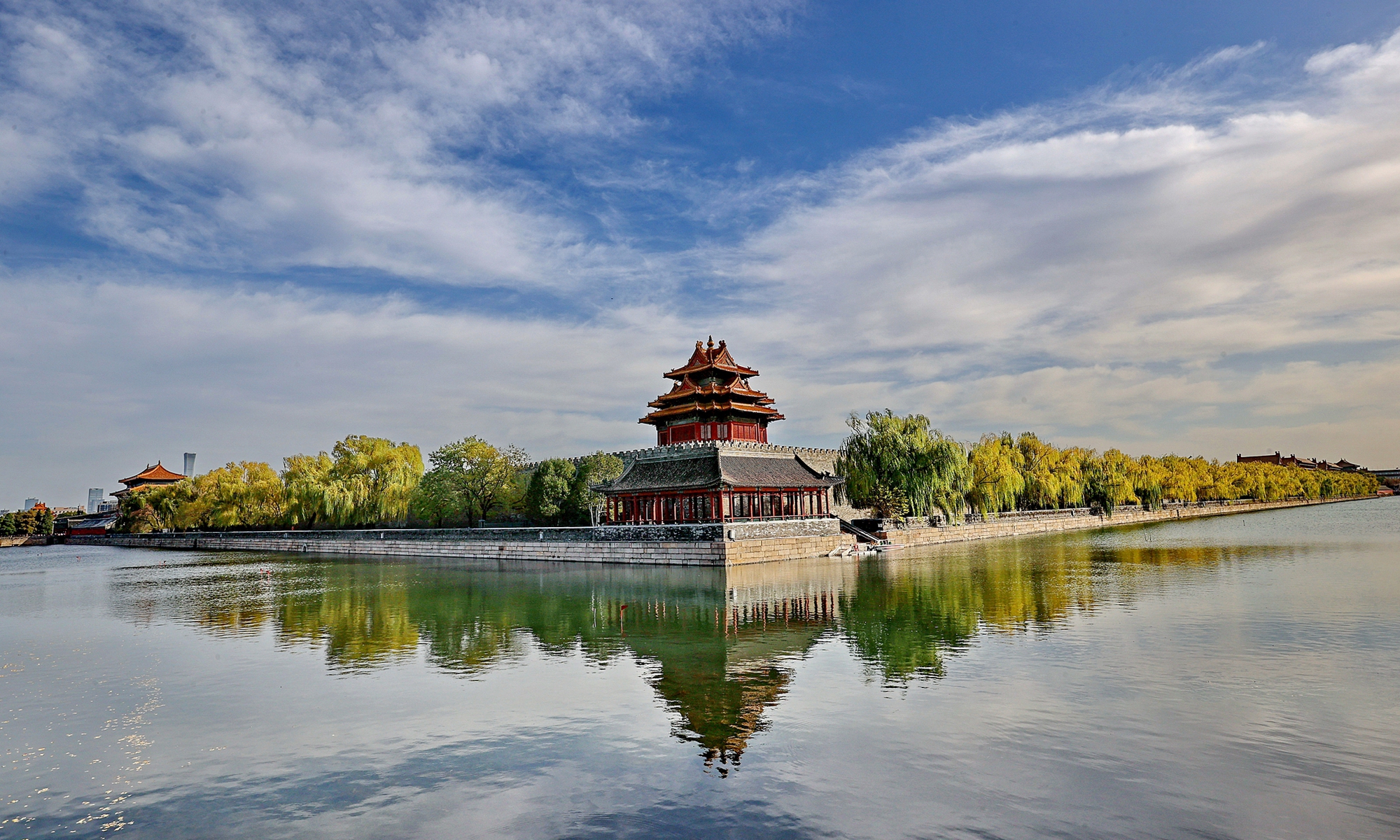
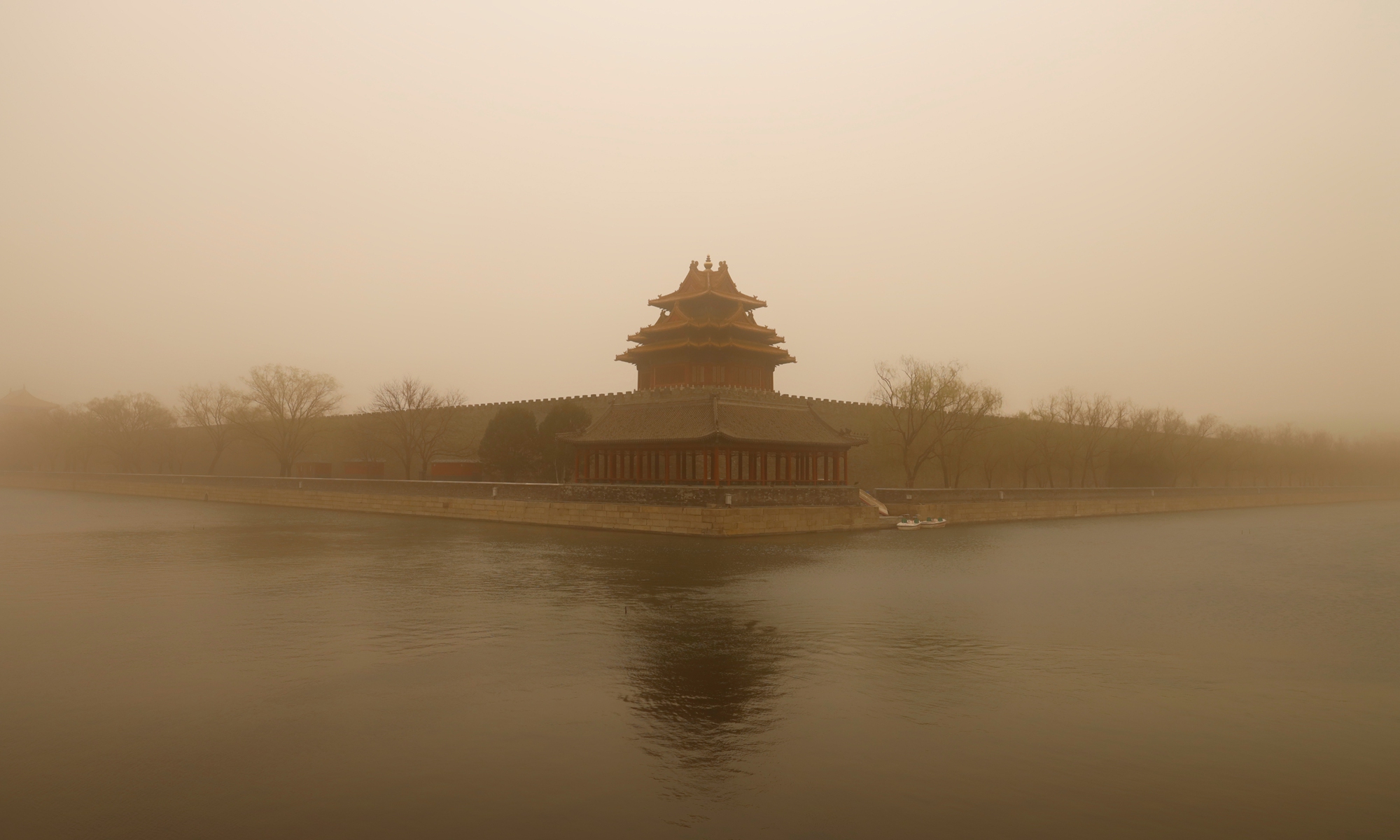
The turret of Beijing's Forbidden City in clear weather in 2024 (up) contrasts sharply with the smog-covered scene in 2013. Photos: VCG, Li Hao/GT
According to the Ministry of Ecology and Environment, during the 14th Five-Year Plan period (2021-25), the national PM2.5 concentration dropped by 20 percent, while the number of cities meeting air-quality standards increased from 206 to 246. Since the start of the period, PM2.5 concentrations in two key regions, the Beijing-Tianjin-Hebei region and surrounding areas, and the Fenwei Plain, have fallen by 27.7 percent and 32.1 percent, respectively.Moreover, 29 Chinese cities now have GDP exceeding 1 trillion yuan ($139 billion). In these cities, the average PM2.5 concentration stands at 27.8 micrograms per cubic meter, better than the national average, and all have seen significant improvement during the 14th Five-Year Plan period, showing that economic growth and the protection of blue skies can advance together, according to Li.
For environmentalist Ma Jun, also founder of the Blue Map app, these changes are reflected not only in official statistics but also in the public's daily experience.
He often describes the improvement in Beijing's air quality with a string of numbers: "89.5, 86, 81, 73, 58, 51, 42, 38, 33, 30, 32, 30.5, 27.5…" These are the annual average PM2.5 of the capital city in past years. To him and many environmental volunteers, these seemingly ordinary numbers trace the trajectory of China's air pollution control efforts.
Launched in 2014, the Blue Map app allows the public to check companies' emissions data in real time and submit "micro-reports" through social media. At the same time, more and more internet users have begun documenting the skies above their hometowns. So far, nearly 3 million "snapshots of blue skies" have been uploaded by netizens across various platforms.
"From the air-quality calendars shared by internet users, it is clear that blue skies are gradually shifting from a luxury to a new normal," Ma told the Global Times.
From coal dust to clear days
Behind this gradually bluer sky, each city has followed its own path and story of change. In Linfen, Shanxi Province in North China, a city once plagued by pollution due to its coal industry, the transformation has been particularly striking.
"When I was a child, many days the air was filled with black dust as we walked to school. The first thing we did after arriving was wash our faces and hands," recalled Lin Xiu, a Linfen resident in her 30s, who still remembers the air conditions of her childhood with lingering unease.
She later left her hometown to study and work elsewhere. But in recent years, every time she returns, she has clearly felt the changes. "There are more blue skies, more trees, and the whole city seems brighter," she told the Global Times.
Official data confirms this transformation. Over the past five years, Linfen has recorded the fastest improvement in air quality nationwide. In 2025, the city's PM2.5 concentration fell to 35.1 micrograms per cubic meter, down 46.5 percent from 2020, Xinhua reported.
Changes like those seen in Linfen are far from isolated cases. Instead, they represent a microcosm of China's systematic push to tackle air pollution.
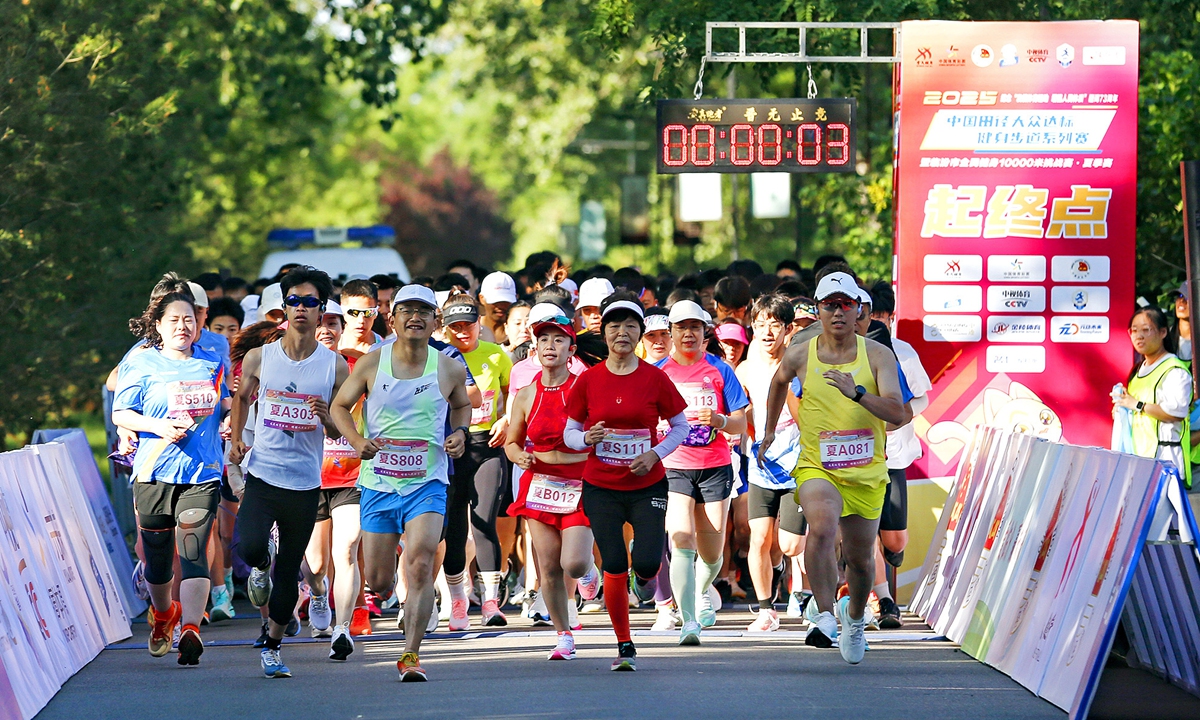
Runners take part in a marathon in Linfen, North China's Shanxi Province, in June 2025. The city has seen the biggest improvement in environmental quality in China over the past five years. Photo: VCG
According to Li, from a governance perspective, he noted, the first step has been continuously reducing pollutant emissions by adjusting industrial, energy and transportation structures, thereby cutting emissions at the source. Second, governance measures have become more precise, with differentiated measures targeting key regions, critical periods and major industries to improve efficiency. At the same time, policy tools, market mechanisms and technological innovation have worked together to form a governance framework in which governments, enterprises and the public all participate in tackling air pollution.Meanwhile, China has also carried out large-scale industrial upgrading and emission control in recent years. Key industries such as steel, power generation and cement have implemented ultra-low emission upgrades. The share of clean energy has continued to rise, while northern regions have promoted clean heating on a large scale. These measures have not only reduced pollution emissions but also driven industrial transformation and upgrading.
New chapter
China's progress in air pollution control has also drawn international attention.
Rejane Rocha, executive secretary of the China-Brazil Center for Climate Change and Innovative Energy Technologies, told the Global Times that the most tangible change she has observed during her visits to China over the past decade is the country's remarkable improvement in air quality, which she said reflects how quickly national plans can translate into real-world progress.
Although air quality has already seen significant improvement, China's battle to defend blue skies has now entered a critical phase.
Li noted at the press conference that China's air quality is currently in a transition from "significant improvement" to "fundamental improvement." As pollutant concentrations continue to fall, each further step toward improvement will become increasingly difficult.
Starting this March, revised ambient air quality standards officially came into effect, further tightening PM2.5-related indicators and setting higher targets for sustained improvements in air quality, according to the Guangming Daily.
At the same time, the environmental code, which is expected to be reviewed by the lawmakers during this year's two sessions, is also seen as an important step in improving China's ecological governance system.
For Yun Jianli, a volunteer who has long participated in environmental protection activities along the Hanjiang River in Central China's Hubei Province, such institutional progress offers a clearer foundation for public involvement in environmental protection.
"In the past, when dealing with some environmental issues, we often had to search across different laws to find a legal basis," Yun told the Global Times. "The code integrates these systems, providing clearer and more authoritative legal support for environmental actions."
In her view, provisions in the code concerning information disclosure and public participation will also encourage more people to take part in ecological protection, helping make environmental protection a truly shared social undertaking.
For Zou, these changes also mean a new mission of documentation.
After 13 years of photographing the sky, he had originally planned to conclude his project Beijing Air Now in 2026. But following suggestions from many friends and members of the public, he decided to continue.
"The decade from 2026 to 2035 will be a crucial period for building a Beautiful China," he said. "What began as a record of the changing smog conditions will gradually shift toward documenting a clearer goal, the skies of a Beautiful China in the era of the dual-carbon strategy."
If more than a decade ago people saw through his lens how a city struggled to shake off smog, in the coming decade he hopes to continue using the same approach to record the next chapter in the transformation of China's skies.
RELATED ARTICLES