IN-DEPTH / IN-DEPTH
CPC in Global Eyes: CPC has ‘scientific planning and responsive governance’: British recipient of Hainan Friendship Award
Get closer to feel
By in Haikou Published: Feb 26, 2026 09:41 PM

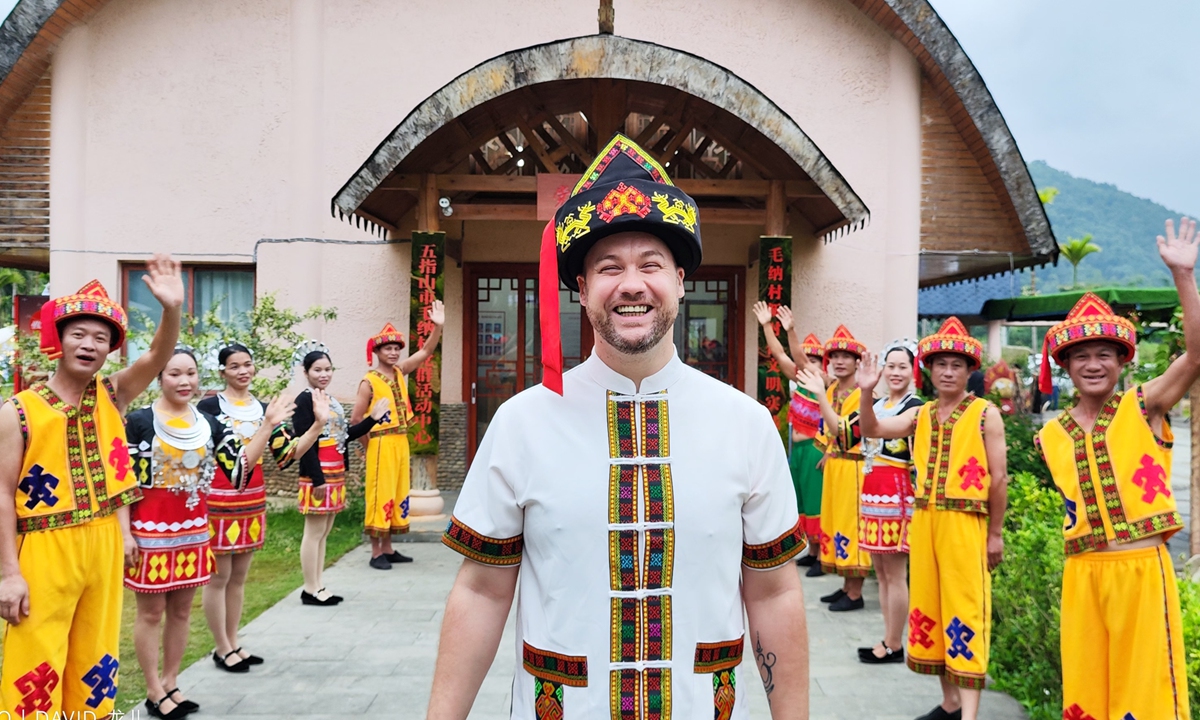
David Janke visits Maona village in Wuzhishan, South China's Hainan Province, to experience the lifestyle and customs of the Li ethnic group in May 2022. Photo: Courtesy of David Janke
Editor's Note:Chinese President Xi Jinping has pointed out, "to understand China today, one must learn to understand the Communist Party of China (CPC)." With the rapid development of China's economy and society, and the steady advancement of the Chinese path to modernization, the notable achievements of the CPC have drawn extensive international attention and scholarly interest. Against this backdrop, the Global Times has launched the "CPC in Global Eyes" column, focusing on the feelings, perspectives, and insights of international friends from various fields regarding the CPC's historical path and achievements.
They include those who have toured China; deeply study the CPC in academic fields; work, live, study, or do business in various fields in China; and who, though they have not visited China in person, pay close attention to the CPC's policies and developments. Through their vivid personal experiences, we aim to present a multifaceted overseas view of the CPC.
In the sixth installment of this series, we interviewed British entrepreneur David Janke, a recipient of the Hainan Friendship Award who has lived in South China's Hainan Province for several years. Through his long-term work and life in China, he has gained an immersive understanding of the practices and driving momentum of the Party-led effort to develop China and improve people's lives.
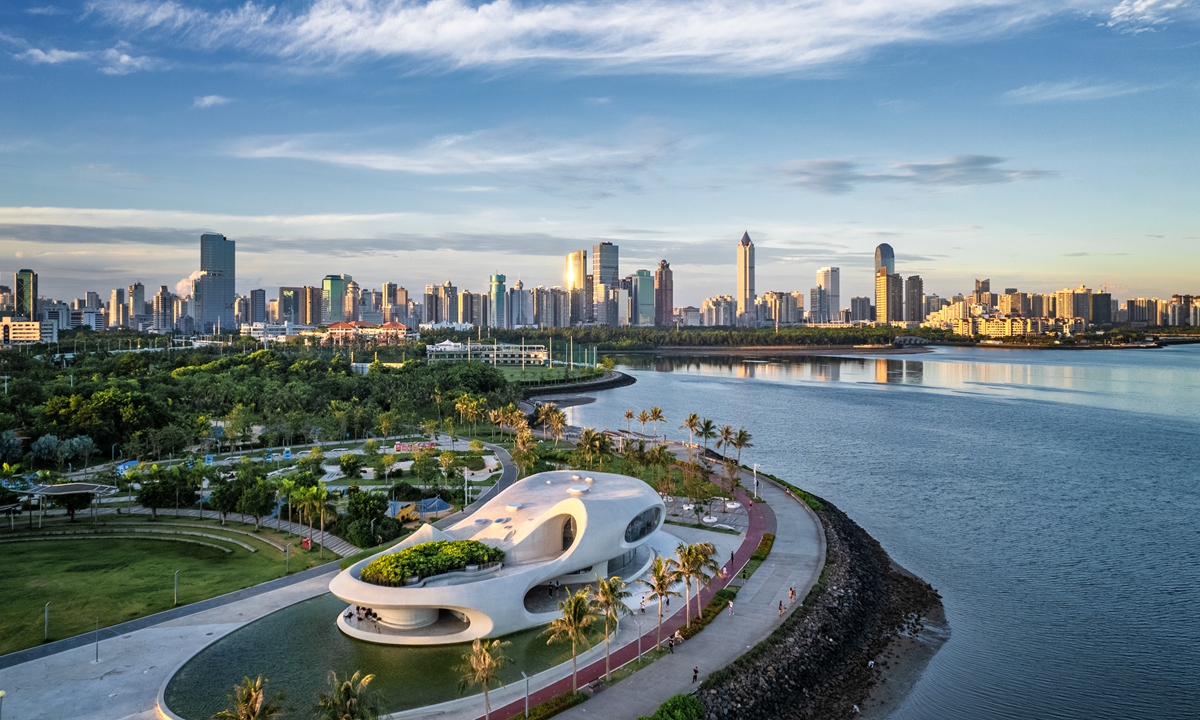
A view of Haikou, South China's Hainan Province Photo: VCG
The gentle breezes of early spring caress the eternally warm island of Hainan. On the balcony of an apartment in Haikou, capital city of South China's Hainan Province, David Janke stands at ease, gazing out at the nearby sea, a sheet of glinting blue. A few steps behind him, a bookshelf holds a neat row of English or bilingual editions - testaments to decades spent using language as a bridge between cultures.Janke is a British entrepreneur and the founder and owner of a translation firm based in Haikou. He has lived in China for almost 20 years, speaks fluent Putonghua, and has travelled the length and breadth of the country.
For years, Janke and his team have translated many Chinese books, reviewed the English versions of numerous materials, including official documents from Chinese authorities, and worked with CPC-led organizations and government agencies at various levels. Through the painstaking precision of translation and the small, revealing moments of everyday life, Janke feels he has developed a deeper understanding and a genuine appreciation of the CPC - its history, achievements, and the spirits that animate the world's largest ruling party.
"The CPC has done so much to ensure the people's livelihood, to shorten the gap socially, financially, and culturally," Janke told the Global Times. "I don't think China would be where it is today without the CPC."
Learning about the CPC
Janke's journey with China formally began in 2007. A student of Chinese studies at the University of Sheffield, he came to Nanjing University in East China's Jiangsu Province on an exchange program.
What was meant to be a one-year stay was completely transformed by the country's unique allure. As Janke recalled, at that time, he could already see China's potential. "Back then, 2007, that was what you're looking at [nearly] 30 years after the beginning of China's reform and opening up," he said. "You could already see that the future would be in China."
Janke decided not to return to the UK to finish his studies and instead completed his undergraduate degree at Nanjing University. After graduating, Janke's path took him to various Chinese cities, including Shanghai, and in 2020, he settled in Hainan.
Years in China have left Janke with a map of memories from across the country. Among his travels, his visits to China's revolutionary and patriotic-themed tourism sites gave him a visceral sense of the historical mission the CPC took on.
While studying in Nanjing, Janke made a special trip to the Memorial Hall of the Victims in Nanjing Massacre by Japanese Invaders. At the memorial, he was shaken by a wall inscribed with the names of the victims. "The wall of names is located on top of a mass burial site; that's very poignant," he said. "These were terrible sacrifices."
This dark chapter of history offered Janke a profound insight: it was precisely such national trauma that forged the CPC's mission to save the nation from peril. "The CPC was founded by patriots who had had enough of the injustices, [such as] the unequal treaties between China and foreign powers, and aggression from other nations, particularly Japan," he told the Global Times. "The CPC was founded to rescue China in a way. I believe that this is what it has ultimately done - rescued China.
So, when Haikou sounded air-raid sirens across the city on September 18, 2025 - the 94th anniversary of the September 18 Incident that marked the start of Japan's invasion of China - and pedestrians paused, standing in sudden silence, Janke composed a short poem on the spot to express how much he treasured peace. He wrote it in Chinese: "Where once the air was thick with smoke and gunfire; Today the clouds part and the sun finds its way; An ordinary sky, and how precious that ordinariness."
If sites like the Memorial Hall of the Victims in Nanjing Massacre by Japanese Invaders enabled Janke to learn about the CPC's founding resolve to save the nation, his visit to Guang'an in Southwest China's Sichuan Province, the hometown of Deng Xiaoping, the chief architect of China's reform and opening-up, showed him the Party's pragmatic sense of responsibility.
In August 2024, Janke traveled to Guang'an to work on the English translation for the local smart tour-guide system. There, he absorbed the contours of Deng's life and legacy. "Deng said, 'It doesn't matter if a cat is black or white, as long as it catches mice.' He was all about solving practical problems with practical solutions," said Janke. He believed this pragmatic spirit drove China's reform and opening-up and the progress that followed.
Translating governance philosophies
In early 2022, Janke set up his own translation firm to deliver precise translations for governments, businesses, and other clients. It is through the work of translating and proofreading official texts that his understanding of the CPC and its governing philosophy deepened - evolving from an initial impression into a systematic understanding.
Janke took part in the English-language review of works such as Xi Jinping: Walking Into the Worlds of Ordinary People and Water Governance in China: Perspectives of Xi Jinping.
Working with these texts allowed him to feel at close quarters the Party and its leaders' people-centered approach to governing.
"I read reports of Xi's life as a child and as a teenager growing up. His first Party job was Party secretary in a village. He himself experienced hardship and saw it firsthand," Janke said. "The Party leaders, from the top leader to the leaders in different regions and levels, they come from the people, work for the people, and they practice from the grass roots."
Janke mentioned the gap between words and actions in some Western political systems: "When it comes to election time, they announce big projects just to win people's votes. And then when they're actually in power, sometimes they stick to their word, sometimes they say 'no, this is too difficult.'"
In China, by contrast, the CPC does things not to win votes but to improve people's lives, said Janke. He also praised the Party's approach to scientific long-term planning. "It has five-year plans, and these five-year plans are generally very strictly followed," he told the Global Times. "It has scientific planning and responsive governance - where there is a need, it responds."
Janke himself has experienced the responsiveness and efficiency of Chinese administrative system and its officials. In 2024, for instance, Hainan authorities convened a discussion meeting for foreign residents to proactively solicit their needs and concerns. "They asked us, 'What do you need? What are your concerns?' 'We'll note them down and arrange for people to work on them, to address your needs and concerns, and to change things for the better," he recalled.
Another example occurred earlier, when Janke was preparing to launch a translation company. He submitted his documents through the local government's online registration platform and had the business officially registered in just one day. "They've worked hard to make sure that things like setting up a company are very easy, even for foreign nationals," he said.
Experiencing the real China

A view of Xiuying Port in Haikou, South China's Hainan Province. Photo: VCG
After putting down roots in Hainan, Janke wove his affection for this land into his professional life. Commissioned by the Foreign Affairs Office of Hainan Province, he led the translation and editing of A Guide to Hainan for Expats, a handbook packed with practical information on commonly used apps, payment methods, communications, and more. It serves as a navigational compass for foreigners seeking to integrate into life in Hainan.In 2024, Janke was awarded the Hainan Friendship Award, presented by the Hainan provincial government to recognize foreign experts who have contributed significantly to the province's economic and social development, as well as international exchanges and cooperation. Janke said he felt honored to receive the award, viewing it as a public recognition of his translation work.
What began as a casual interest in Chinese grew into a passion, and then into a life: over the last two decades, Janke has steadily deepened his understanding of China in all its facets. Living here for nearly 20 years, he has come to increasingly appreciate its safe and stable society, the efficiency of its technological advancements, and its ever-expanding openness to the world.
"It's very important to understand why the Party was founded, what its goals and ideals have been, how it has been maintained, and how the leadership of the CPC has ultimately resulted in everything we see and enjoy," Janke told the Global Times. "Nothing could have been done without the people, without the hard work of individuals across society. But this has all been done under the leadership of the CPC and through scientific approaches."
Using language as a bridge, Janke has spent his career advancing exchanges between China and other countries. He said he hopes more foreigners will move past media prejudices and experience the real China and the CPC for themselves.
"It has been 105 years since the founding of the CPC. While the political system may work differently [from those in many other countries], [it's important to] understand how that system benefits China - how it works in a Chinese context," he said. "Don't just let the media tell you China is bad; be more discerning."
RELATED ARTICLES