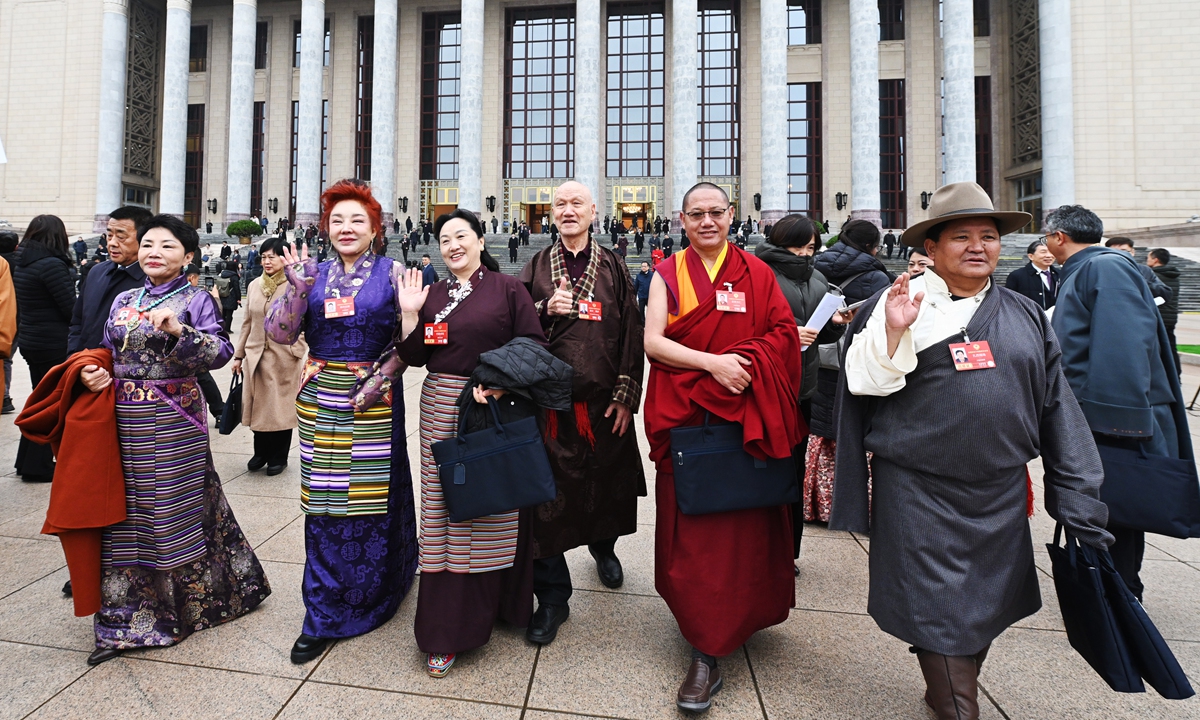
Deputies enter the Great Hall of the People for the preparatory meeting of the fourth session of the 14th National People's Congress in Beijing, March 4, 2026. Photo: VCG
Editor's Note:
As China convenes the 2026 two sessions - the annual meetings of China's top legislature and top political advisory body - China is expected to send strong and fresh signals on pushing high-quality development, leveraging greater policy and reform support to ensure steady economic growth and social progress.
In the "Understanding signals at two sessions" series, the Global Times (GT) invites internationally renowned scholars, policy observers and business leaders to interpret the key signals from the two sessions regarding China's domestic roadmap, covering advancements in whole-process people's democracy, high-quality development, high-level opening-up, major-country diplomacy and the improvement of people's wellbeing.
In the first piece of the series, Global Times reporter Ma Ruiqian interviewed Jean Pegouret (Pegouret), president and founder of the Saphir Eurasia Promotion agency and an expert on geopolitics, to discuss China's whole-process people's democracy, as well as how it has established an interactive mechanism between medium- and long-term planning and social demands.
GT: The fourth session of the 14th National People's Congress will kick off in Beijing on Thursday, after the fourth session of the 14th National Committee of the Chinese People's Political Consultative Conference began on Wednesday. As an important window for the world to observe China's whole-process people's democracy, how do you think the two sessions reflect this form of democracy?
Pegouret: The two sessions are a very important moment in China's governance. They are closely watched by leaders and decision-makers around the world because they define China's policy directions, especially now that it has become the world's leading power in terms of economic growth and social progress for its population.
China is not only the world's largest market, with its 1.4 billion people whose standard of living, in terms of purchasing power, has caught up with that of Western countries, but it has also significantly reduced inequality and poverty compared to those same countries.
The two sessions represent an example of democratic governance for the rest of the world. The decisions taken there are not, as in multiparty democracies, the result of long confrontations between parties whose goal is to assert their influence and to take or retain power. That is not the concern of the Communist Party of China (CPC), which is accountable only to the people.
The decisions adopted are the result of experience and experimentation, as affirmed by the third plenary session of the 11th CPC Central Committee: "Practice is the sole criterion for testing truth," rather than ideology or the struggle to seize power for the benefit of political and financial elites, often detached from the country and opposed to the people.
GT: Marking the start of the 15th Five-Year Plan (2026-30), the 2026 two sessions carry special expectations. From the perspective of long-term planning, how does the Chinese government, through the governance model of whole-process people's democracy, better align policies with long-term development goals and immediate public needs?
Pegouret: Through the governance model of whole-process people's democracy, the Chinese government has demonstrated that it can effectively align long-term development objectives with the immediate needs of the population by adopting an integrated and participatory approach.
Prior to formulating policies, the government consults various stakeholders - experts, representatives of industrial sectors, civil society organizations and ordinary citizens - in order to gather diverse opinions and ensure that policies reflect the concerns and aspirations of the people.
Citizens are encouraged to contribute through people's congresses, political consultations and online platforms. This direct participation helps ensure that real needs are properly understood.
Once policies are implemented, feedback mechanisms are used to assess their impact and adjust them where necessary, correcting possible shortcomings and ensuring they remain appropriate and effective.
Finally, the government formulates five-year plans and long-term strategies in a spirit of transparency and accountability.
This entire process enables the Chinese government both to meet the population's immediate needs and to ensure sustainable and harmonious growth.
GT: Whole-process people's democracy is considered as the most extensive, genuine and effective socialist democracy. How do you interpret these three features?
Pegouret: Whole-process people's democracy, as an important aspect of Chinese socialist democracy, is rooted in the action of the CPC in service of the people. The three features mentioned confirm this.
"The most extensive" indicates that all areas of state and social affairs are open to the participation of the people.
"The most genuine" means that, under the leadership of the CPC, the legitimate rights and interests of the people are protected, and that the people can express themselves through various channels rather than being subjected to decisions that run counter to their interests.
"The most effective" reflects the fact that China, under the leadership of the CPC, has achieved rapid and stable development marked by the quality and speed of decision-making, implementation and oversight.
GT: Some argue that existing Western democratic systems have "genetic defects." How do you view these "defects"? Compared with Western democracy, what are the differences and advantages of Chinese democracy?
Pegouret: Today in the West, republics and constitutional monarchies have become widespread, but they remain based on multiparty competition. The problem with this system is that those who debate and make decisions are designated through elections, and thus depend on satisfying their own voters and those who financially support their campaigns. Worse still, unelected financial interests can make and unmake governments or even render countries ungovernable.
In the name of freedom and the market, or of common rules within multinational unions, it is no longer possible in European countries, for example, to project the future through a five-year plan system, although such planning had proven effective after World War II.
By highlighting these shortcomings of Western democracies, one brings into relief the undeniable advantages of Chinese democracy in terms of stability and long-term planning.
GT: Democracy is an instrument for addressing the issues that concern the people. How has the whole-process people's democracy offered Chinese wisdom to solving the problems facing mankind?
Pegouret: In the Chinese system, the decision-making mechanism is scientific, democratic and rapid, rather than the result of ideological and partisan struggles. Under the leadership of the CPC, the interests of all parties are taken into account in order to achieve rapid and long-term development within the framework of the rule of law.
The country's resources are not wasted on prebends granted to elites dependent on their voters or financiers at the expense of the people. The ability of Chinese democracy to concentrate resources and time has made it possible to achieve major advances in quality of life and to provide valuable experience to the international community.
For several years, I have maintained that China has moved from the status of the "world's factory" to that of a "laboratory of ideas for the world." Therefore, I hope that cooperation between China and other countries will now increasingly prioritize governance. Let us not forget that the first Enlightenment century was inspired by China.
RELATED ARTICLES