Japan’s reported plan to boost Iwoto island military build-up signals resurgent militarism, undermining regional peace: expert
By Published: Mar 04, 2026 11:54 PM


latest news
Against the backdrop of strained China-Japan relations, Japan, per media disclosures, continues to amplify claims of "Chinese military threats" rhetoric to justify fortifying armed positions on Pacific islands. Chinese military analysts view Japan's persistent drive to bolster offensive forces as clear evidence of Tokyo's ongoing erosion of its "defense-only" doctrine, and a revival of militarist tendencies that would seriously endanger peace and stability across the Asia-Pacific.
Citing multiple sources close to the ministry, Japanese media Asahi Shimbun reported on Wednesday that Japan's Defense Ministry has decided to beef up its air base on Iwoto island, in response to "China's increasing military operations" in the Pacific. The report points to June 2025, when two Chinese aircraft operated in the Pacific and advanced east of the "second island chain."
According to the media, Japan's Defense Ministry is currently working to start studies in the new fiscal year aimed at strengthening the port facilities and runway on the island. Besides, to reinforce its surveillance and monitoring framework, the ministry is also considering installing a non-fixed pier that would allow large vessels to dock.
Permanently stationing Self-Defense Forces fighter jets on the island is also under Tokyo's consideration, Asahi Shimbun reported.
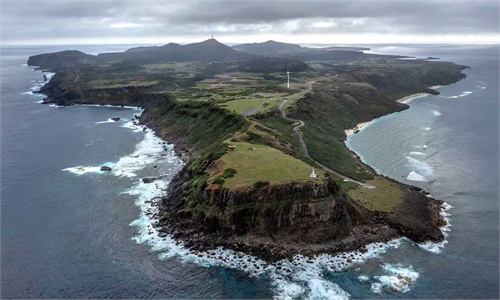
Iwoto island lies about 1,100 kilometers south of Tokyo, strategically situated right in the middle between Japan's home islands and the American base on Guam. It forms a key link in the northern portion of the "second island chain," looking west toward Okinawa and the "first island chain," and east across the open Western Pacific.
Despite that the Japanese source told media that Tokyo is focusing on "reinforcing defenses" in the southwestern region while also bolstering its capabilities on the "surveillance gap" of the Pacific side, analysts perceive an aggressive agenda at play. They argue that the orchestrated "China threat" rhetoric is little more than a convenient cover for Japan's push toward greater military assertiveness in the region.
"By building up military strength on an island over 1,000 kilometers from its home islands, Japan is engaging in anything but defense… is plainly an offensive forward-positioning maneuver," Chinese military affairs expert Zhang Junshe told the Global Times on Wednesday.
During World War II, the US army and Japanese fascist troops suffered devastating casualties in the Battle of Iwo Jima (Iwoto island). Today, Japan's renewed efforts to transform the island into a fortress on the "second island chain" evoke strong concerns that Japanese militarism is experiencing a resurgence and continued expansion, while also signaling deepening hostility toward China, Zhang added.
Japan's recent exposure of potential military moves came as part of a series of provocative actions by Japan that are stirring up regional tensions. On February 24, Japanese Defense Minister Shinjiro Koizumi claimed that Japan plans to deploy upgraded air defense missiles on westernmost island in Okinawa, within sight of China's Taiwan region.
Japan also held joint military drills with the US and the Philippines near the Bashi Channel, the waterway between the Philippines and Taiwan island, for the first time in the late February, according to the Japan Times.
Japan's Iwoto island rearmament plan exemplifies its active cooperation with the US' "Indo-Pacific" strategy, serving to strengthen efforts to contain and suppress China's development, Song Zhongping, another Chinese military affairs expert, told the Global Times on Wednesday.
"Historically a pivotal flashpoint in the US-Japan combat during World War II, Iwoto island sits at a vital midpoint linking Guam to the Ryukyu Islands," Song said. "Today's push to fortify the island embodies the springboard strategy, perfectly suiting US operational needs to disperse military assets and project power from forward positions."
Currently, Iwoto island has approximately 250 Japan's Maritime Self-Defense Force personnel and about 100 Air Self-Defense Force personnel stationed there. The central part of the island features a runway that is also used by the US military for carrier-based aircraft land-based takeoff and landing training, according to Japanese media.
It is not inconceivable that Japan would, in the coming years, deploy additional radar arrays and missile installations on the island, Zhang said.
Zhang warned that Japan's erosion of its "pacifist constitution" and "exclusive defense" doctrine would inevitably interfere with and threaten the normal maritime training operations and freedom of navigation of other regional countries' ships and aircraft, endangering regional peace and stability.
RELATED ARTICLES