China's top political advisory body starts annual session
Advantageous political consultative system gathers strength for advancing Chinese modernization: expert
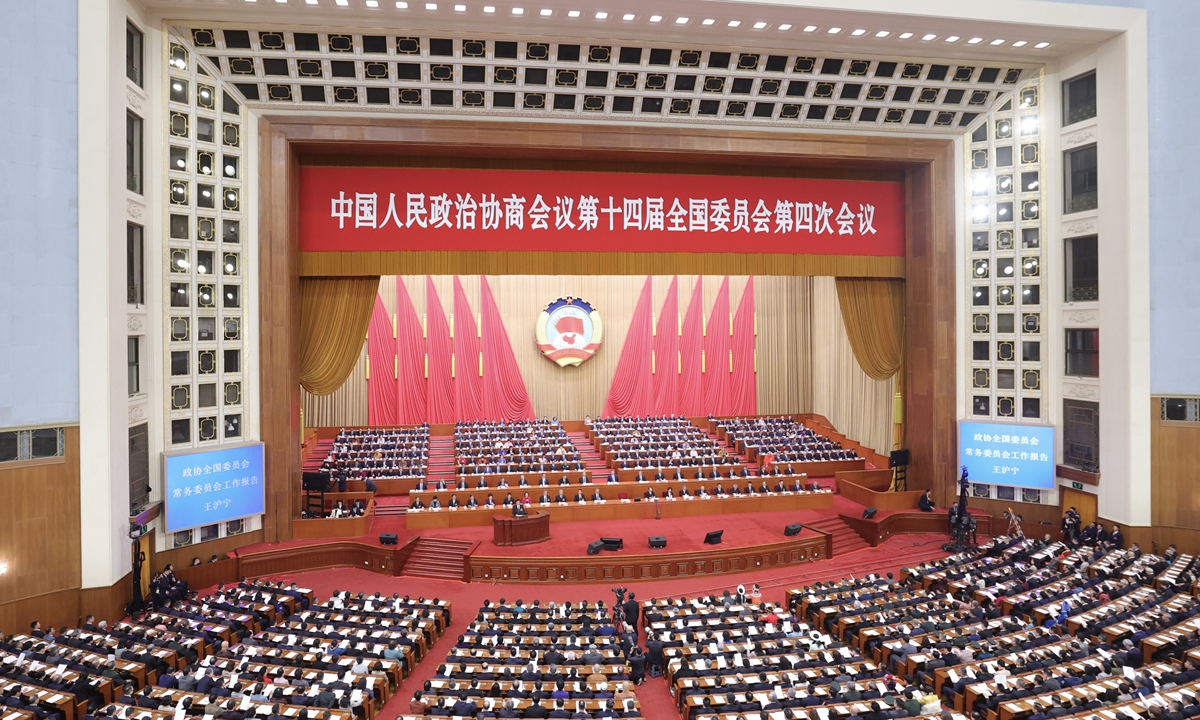
The opening meeting of the fourth session of the 14th Chinese People's Political Consultative Conference (CPPCC) National Committee is held at the Great Hall of the People in Beijing, March 4, 2026. Photo: cnsphoto
The Chinese People's Political Consultative Conference (CPPCC) National Committee, China's top political advisory body, opened its annual session on Wednesday in Beijing, the Xinhua News Agency reported.
Chinese President Xi Jinping, together with other leaders, attended the opening meeting of the fourth session of the 14th CPPCC National Committee at the Great Hall of the People.
According to Xinhua, the agenda for the session was reviewed and approved at the meeting. Wang Huning, chairman of the CPPCC National Committee, delivered a work report on behalf of the Standing Committee of the CPPCC National Committee.
A report on the handling of proposals submitted by political advisors since the last session of the CPPCC National Committee in March 2025 was presented at the meeting.
The CPPCC National Committee received 5,992 proposals from its members over the past year, of which 5,061 were accepted for processing. The response rate for the accepted proposals stood at 99.9 percent.
New achievements
The fourth session of the 14th CPPCC National Committee runs from Wednesday to March 11, spokesperson Liu Jieyi said at a news conference on Tuesday, Xinhua reported.
During the session, national political advisors will sit in on the fourth session of the 14th National People's Congress, the country's top legislature, which is scheduled to open on Thursday, hear and discuss documents including a government work report, and discuss a draft 15th Five-Year Plan for national economic and social development, according to Liu.
With the two sessions being a window to observe China's policy, multiple foreign media outlets have paid close attention to the event. Reporting on the opening of the 14th CPPCC National Committee, the Financial Times noted that CPPCC members float hundreds of proposals during the conference.
Reuters highlighted China's technology policies over the next five years, reporting on how China will "convert a wave of high-profile breakthroughs in artificial intelligence, space and robotics into industrial scale and capital market momentum."
"I will particularly be looking at the indications of what will be in China's 15th Five-Year Plan," John Ross, Senior Fellow at the Chongyang Institute for Financial Studies, Renmin University of China, told the Global Times.
"During the 14th Five-Year Plan period (2021-2025), China already succeeded in something which no other developing economy in history has ever achieved and that is to become a technological leader in a major series of industries. This overall economic framework allowed China to overcome negative trends produced by geopolitical actions of some other countries. I will therefore be particularly looking at how this successful integration of science and technology with production will be further developed in the 15th Five-Year Plan," he said.
Advancing Chinese modernization
Prior to the opening meeting on Wednesday, nine members of the 14th CPPCC National Committee from various sectors including agriculture, quantum computing, education, new energy vehicles and telecommunications attended a group interview in three batches at the Great Hall of the People in Beijing.
At the first meeting with the press, the representation of the political advisors, with one third of them coming from sci-tech related sectors, has underlined China's focus on economic security and technological advance in 2026, Cong Yi, a professor at the Tianjin School of Administration, told the Global Times on Wednesday.
Pan Jianwei, a member of the 14th CPPCC National Committee and an academician of the Chinese Academy of Sciences, introduced China's breakthroughs in quantum technology during the 14th Five-Year Plan, noting that the country's quantum communication sector maintains international leadership over the period, quantum computing firmly ranks among the world's first tier, and that multiple directions in quantum precision measurement have advanced into the international forefront.
Yang Jie, a member of the 14th CPPCC National Committee and former chairman of China Mobile, told reporters on Wednesday that in order to elevate the building of a modern industrial system to a new level, more targeted and coordinated efforts are needed.
He suggested efforts including building an intelligent and integrated information infrastructure, strengthening strategic emerging industries and future industries, deepening the empowerment of traditional industries through digital-intelligence technologies, advancing "AI Plus," and promoting the in-depth integration of technological and industrial innovation.
Zeng Yuqun, a member of the National Committee of the CPPCC and chairperson of CATL, stressed that homegrown innovation lies at the core of the rise of China's new-energy sector.
Other members of the CPPCC national committee took questions relating to national unity, the development of the sports sector and marine economy.
Unique advantage
While addressing hot-button social issues, CPPCC members also actively make proposals during the two sessions to contribute to the advancing of Chinese modernization in the upcoming five years.
China's political consultative system is also widely acclaimed as a unique advantage of China's political system.
The BBC reported on Wednesday that the CPPCC's 2,000-plus members are drawn from various sectors, and not just the Communist Party of China, and its discussions offer insight into key policy debates.
"This is an important component of the socialist political system with Chinese characteristics and a crucial form in developing whole-process people's democracy. This system possesses notable advantages, as it can broadly unite various democratic parties, pool wisdom, and gather strength for advancing Chinese modernization," Cong said.
Following the conclusion of the opening meeting, many Chinese and foreign journalists were seen thronging around members of the 14th CPPCC National Committee, eager to get a glimpse of the key policy priorities in China's 15th Five-Year Plan from their proposals.
"I'm particularly interested in what to expect from China in its next Five-Year Plan regarding its engagement with Latin America. China is one of Latin America's most important partners, and many countries in the region now treat China as a key economic partner," Bruno Falci, a correspondent for Latin American media teleSUR, told the Global Times.
RELATED ARTICLES