EC unveils ‘Made in EU’ industrial plan amid protectionism fears; Move could distort competition, harm ties with China: expert
Stricter local-content rules could distort competition, disrupt supply chains and harm China-EU trade ties: expert
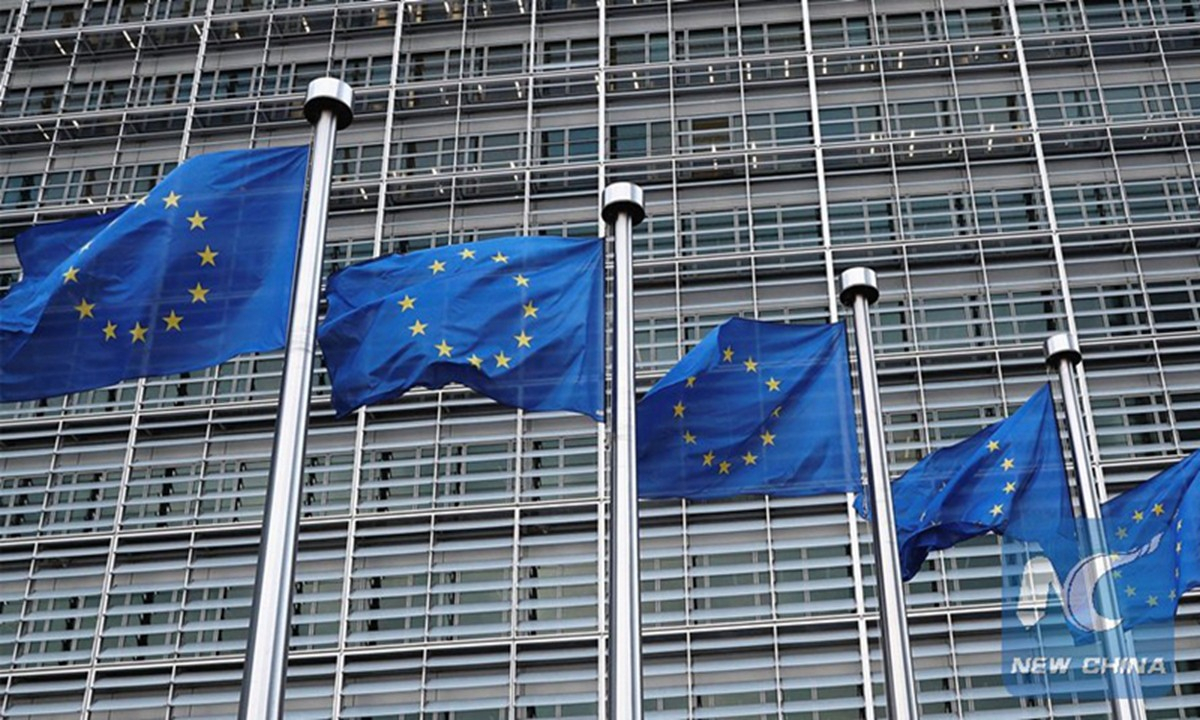
The European Union flags in front of EU headquarters in Brussels, Belgium. Photo: Xinhua
The European Commission (EC) on Wednesday unveiled controversial plans to prioritize "Made in EU" goods in public subsidies and procurement in a bid to boost the competitiveness of the bloc's manufacturing sector, even as deep divisions persist among member states. The move has drawn criticism from some of the EU's major trading economies.
A Chinese expert said that the proposal reflects the bloc's growing inclination toward industrial protectionism, warning that stricter local-content requirements could distort market competition, increase costs for downstream industries and risk triggering broader trade frictions globally.
The Industrial Accelerator Act (IAA) would introduce targeted European-content and low-carbon requirements for selected strategic sectors, including steel, cement, aluminum, automobiles and net-zero technologies, the EC said in a press release. The framework could later be extended to other energy-intensive industries such as chemicals.
The commission claimed that the move will "strengthen European production capacities and boost demand for European-made clean technologies and products," as Brussels seeks to raise manufacturing's share of the EU's gross domestic product to 20 percent by 2035.
The proposed law would also tighten conditions on foreign direct investment in emerging sectors such as batteries, electric vehicles, photovoltaics and critical raw materials. For projects exceeding 100 million euros ($108 million), the draft sets eligibility requirements including ensuring at least 50 percent EU-based employment and requiring technology and knowledge transfer, according to the press release.
The initiative reflects EU's concerns over declining industrial capacity and intensifying competition from external producers, said Jian Junbo, director of the Center for China-Europe Relations at Fudan University's Institute of International Studies. "The plan reflects a highly protectionist approach, as it represents greater government intervention in the market rather than allowing procurement and industrial cooperation to be guided by market forces," he noted.
The proposal, which is under the EU's Clean Industrial Deal, is still at an early legislative stage and must go through the European Parliament and the Council of the European Union before its adoption and entry into force.
While such protectionist policies may seem intended to protect Europe's interests, they could ultimately prove counterproductive if implemented, Jian cautioned, adding, "As EU-produced intermediate goods are often less cost-competitive, requiring their use could drive up production costs and ultimately erode the global competitiveness of European products."
Concerns over such protectionist industrial policies have already surfaced within the EU, while the move has also drawn criticism from some of the bloc's major trading partners.
According to Reuters in December 2025, nine member states - the Czech Republic, Estonia, Finland, Ireland, Latvia, Malta, Portugal, Sweden and Slovakia - said that any "Made in Europe" approach should be treated with "the highest possible caution," citing concerns over their potential impact on prices, supply chains and competition.
Markus Ferber, a member of the European Parliament, said that Europe's industry is burdened by high energy costs, excessive regulation and weak innovation momentum, and called for cutting red tape, making energy more competitive and concluding new free trade agreements, according to Xinhua.
Thilo Brodtmann, chief executive of the German Engineering Federation, which represents about 3,000 small and medium-sized companies, warned that a strong focus on local-content rules could "distract from Europe's real challenges," including high administrative costs, a weakened internal market and a lack of technological leadership, The Guardian reported.
The plans have prompted alarm among trading partners, including the UK, Japan and Turkey, according to The Guardian. The UK business secretary, Peter Kyle, urged the EU to stop "putting up barriers" during a visit to Brussels last week.
Although the draft does not explicitly target China, it was considered by some Western media outlets to be intended to "avoid reliance" on Chinese goods and help the continent "compete against China."
Intense competition from China has already seen Europe lose its once-thriving solar panel industry, per the Guardian. Stéphane Séjourné, the European Commission's vice-president in charge of industry, warned that "if we do nothing, then it's quite clear that very soon 100 percent of clean technology will be produced in China."
In response, the China Chamber of Commerce to the EU said on Thursday that although it recognizes the bloc's strategic objectives of enhancing competitiveness, advancing the green transition and safeguarding economic security, the group expressed serious concern and opposition over certain provisions of the proposal. "The current design of the bill could shift toward a more protectionist and exclusionary system, sending an uncertain signal to global investors, including Chinese enterprises," the business group said in a statement.
China's strengths in sectors such as clean energy, EVs and battery supply chains are the result of long-term market competition and sustained innovation, rather than unfair practices, it said, adding "Slowing European industries' access to China's mature supply chains could instead hinder the EU's own decarbonization efforts, leading to a lose-lose outcome."
Jian also cast doubt on whether the bill can be adopted in its current form, saying that the proposal still faces highly uncertain and may be substantially revised before finalization, as it does not align with the interests of many EU member states and industries.
RELATED ARTICLES