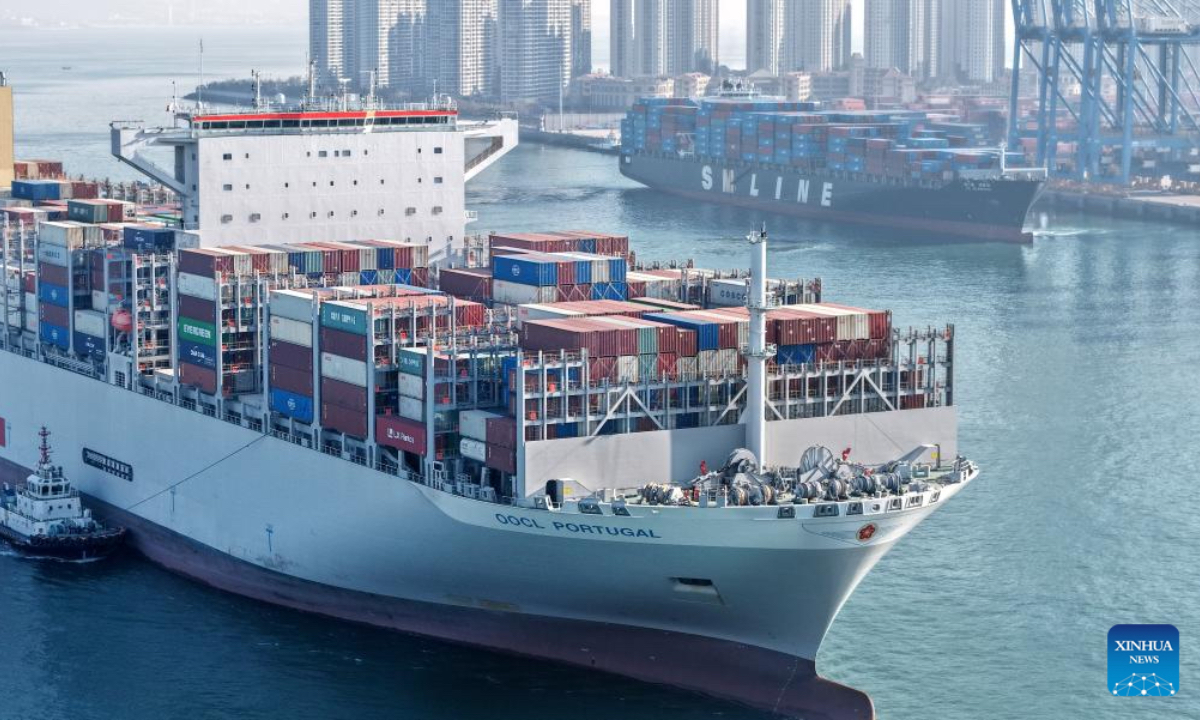
A drone photo taken on Dec. 4, 2025 shows cargo ships entering and departing from the Qianwan Container Terminal of Qingdao Port in east China's Shandong Province. With nearly 240 foreign trade routes, Qingdao Port connects over 700 ports in more than 180 countries and regions worldwide. (Xinhua/Li Ziheng)
Editor's Note:
The previous article in this series explained that in today's deeply interconnected global supply chains, trade imbalances are a natural result of market forces and the division of labor. Behind China's trade surplus figures lies its deep integration into the global industrial division of labor and its significant contribution to global economic and social development. It is worth emphasizing that China also hopes to achieve a balance in its imports and exports and a long-term equilibrium between global supply and demand in trade. However, this cannot be achieved by one country alone. If certain US and European countries cannot abandon their "zero-sum mindset" and continue to adopt double standards and impose unreasonable restrictions on China, hindering its ability to increase investment, engage in production cooperation, and expand high-level opening-up, such practices will only undermine the long-term openness, stability, and balance of global trade.
Double standards
Exaggerating China's trade surplus figures is just one manifestation of how the US and some European countries view China's development through a zero-sum lens.
In a recent article, Dong Zhiyong, dean of the School of Economics at Peking University, analyzed that Western media have mischaracterized China's provision of high-quality and affordable products to the world as "dumping" and "disrupting global prices and distorting markets," while also promoting the fallacy that "China's 'overcapacity' in new energy is threatening industries in other countries and impacting the global economy."
This narrative contradicts economic principles and objective reality. Such rhetoric, which politicizes and securitizes economic and trade issues, conceals the underlying motive of suppressing China's industrial development to secure more favorable competitive positions and market advantages for themselves, Dong noted.
In fact, every historical period has seen major surplus countries. Manufacturing powers like the UK, the US, Japan, and Germany have all followed the economic principle of "comparative advantage," becoming major exporters of manufactured goods and the primary sources of surpluses. The current exaggeration of China's trade surplus figures by the US and some European countries essentially reflects their own anxieties about efficiency and cognitive biases.
"China is crashing into the heart of the European industrial and innovation model," French President Emmanuel Macron claimed in a media interview on December 7.
Responding to this, Professor Ferdinand Dudenhöffer, director of the Center for Automotive Research in Germany, told the Global Times that he thinks Macron is wrong, and he sees the weaknesses of French industry, and when there is a weakness in a certain area in Europe, people are always quick to look for a scapegoat. But the weakness does not lie with others; it lies within ourselves, Dudenhöffer said.
He further explained that over the past 30 years, Europe has gradually fallen behind in cutting-edge scientific research. The key reason behind this is the lack of stability and long-term planning in European political decisions and research policies. In contrast, China holds significant systemic advantages in this regard.
Dudenhöffer noted that major technological innovations often require 20 to 30 years of research. In Germany and Europe, due to frequent election cycles, research directions change almost every four years, making it impossible to achieve such goals. Therefore, Germany should seriously reflect on itself and not rush to shift blame onto others, which applies to France as well, he said.
Beyond exaggerating surplus figures, another typical example of double standards by the US and some European countries is their increased subsidies for their own industries while accusing China of causing "overcapacity" through subsidies and unjustly criticizing China's industrial policies.
In global competition, China has gradually developed comparative advantages in manufacturing by improving infrastructure, cultivating human resources, and optimizing its industrial ecosystem - a process entirely in line with market principles.
However, the US and Europe are unwilling to acknowledge the achievements of a major developing country, distorting them as "unfair competition" and claiming that China's development inevitably comes at the expense of their own interests. This is not the reality; it is an oversimplified and narrow-minded interpretation of international economic and trade cooperation.
By cooperating with China, Europe can actually benefit and enhance its own strength, according to Dudenhöffer.
Using the automotive industry as an example, he said, for the German automotive industry, a world without China is unimaginable. Although the Chinese market is highly competitive for German companies at present, the German automotive industry would not survive without the Chinese market. Moreover, China is also a leader in future automotive technologies. Germany is learning from China in areas such as software, artificial intelligence, lithium-ion batteries, autonomous driving, and robotaxis.
Technology blockades
While accusing China of "only selling and not buying," the US and some European countries are imposing technology blockades against China under the pretext of so-called "national security," creating the absurd situation where "China wants to buy but is unable to."
Semiconductors are the most typical example. According to a Global Times review, taking Nvidia as an example: starting in 2022, the US banned the export of high-end AI chips like the A100 and H100 to China; in 2023, it included modified versions for the Chinese market, the A800 and H800, in the ban; and in 2025, it halted the export of the H20 chips. Looking at the Dutch company ASML: under US pressure in recent years, the Dutch government has consistently refused to approve the export of ASML's most advanced extreme ultraviolet (EUV) lithography machines to China. Starting in early 2024, even several of ASML's mid-range products could no longer be exported to China. In sectors like new energy and high-end manufacturing, the EU has obstructed fair competition for Chinese companies through technical standards barriers and market access restrictions.
More ironically, these blockades hurt the US and Europe first. For instance, Nvidia is losing the Chinese market. In its second fiscal quarter of 2026 (covering April 28 to July 27, 2025), Nvidia's revenue from China shrank from $3.667 billion to $2.769 billion. Nvidia CEO Jensen Huang has repeatedly lobbied the US government to ease restrictions, stating in October this year that export controls caused Nvidia's market share for high-end AI chips in China to drop from 95 percent to 0 percent, according to media reports.
In a December 12 interview with US media, ASML CEO Christophe Fouquet also said that excessive restrictions by the West would force China to completely break away from dependence on Western technology, spurring it to develop its own alternatives. In the long run, this would lead the West to completely lose China's vast market. In Europe, the EU's restrictions on Chinese electric vehicles have faced strong opposition from German automakers.
Expanding imports
In stark contrast to the trade protectionist practices of the US and some European countries, China has consistently adhered to expanding high-level opening-up, demonstrating the responsibility of a major country in proactively increasing imports.
Taking the automotive industry as an example, the European automotive sector is highly dependent on international markets. Last year, the industry generated a trade surplus of nearly 90 billion euros for the EU. In 2023, about 80 percent of cars produced in Germany were exported, while the Chinese market accounted for about one-third of global car sales.
Regarding tariff policies, data show that China's import tariffs on automobiles decreased from 25 percent in 2006 to 13.8 percent in 2018, with tariffs on parts and components at only 6 percent. Additionally, foreign ownership restrictions in the new-energy vehicle sector have been lifted.
China's Hainan Free Trade Port is set to launch island-wide independent customs operation on December 18. The proportion of tariff lines with zero-tariff products in Hainan Free Trade Port will increase from 21 percent to 74 percent.
As the world's second-largest consumer market and import market, China is the only developing country to host a national-level international import expo.
During this year's China International Import Expo (CIIE), several representatives of foreign enterprises told Global Times that China is a vast land of expanding openness and shared development opportunities. They expressed full confidence in China's future development and a firm commitment to expanding cooperation with China.
Supportive environment
Surpluses themselves do not determine the world's direction; what determines it is how people understand surpluses, how they face interdependence, and how they choose to deepen cooperation amid structural changes. It is worth emphasizing that China has never deliberately pursued a trade surplus. China also hopes to see a balance in its imports and exports and a long-term equilibrium between global supply and demand in trade, experts said.
Huo Jianguo, a vice chairman of the China Society for World Trade Organization Studies in Beijing, told the Global Times that trade balance is related to investment. Achieving genuine trade balance solely by increasing imports and reducing exports is difficult. A surplus country can make new contributions to economic development elsewhere by expanding investment or transforming part of its exports into a model of local production and supply, ultimately benefiting all economies.
However, this cannot rely solely on the efforts of the surplus country; it requires overall improvement in the international trade environment. Trade protectionist practices, particularly the restrictive measures imposed by the US and some European countries on China's trade and investment, only distort international supply and demand relationships, he said.
Gao Lingyun, a researcher at the Chinese Academy of Social Sciences' Institute of World Economics and Politics in Beijing, explained to the Global Times that China has always maintained an open and inclusive attitude toward emerging technologies. Moreover, China's ultra-large market can provide ample development space for global innovation - allowing various innovative technologies to undergo continuous testing and application here. Through ongoing market feedback and iterative optimization, they ultimately achieve commercial profitability.
"Once a company establishes a foothold in the Chinese market and secures stable returns, the maturity of its technology and its adaptability to the market will be fully validated, thereby forming a strong competitive advantage in other global markets," Gao said.
Experts noted that if the US and Europe persist in their zero-sum mindset, they will ultimately miss development opportunities.
Zhou Mi, a senior researcher at the Chinese Academy of International Trade and Economic Cooperation, told the Global Times that whether it is imposing additional tariffs, restricting exports and technology transfers, or making unfounded accusations and attacks against companies, such actions fundamentally violate the basic principles of fair competition.
If the US and Europe genuinely wish to foster a fairer competitive environment and allow the market to play a decisive role in resource allocation, they should abandon unilateral intervention, reduce artificial distortions in market operations, and help the market achieve more efficient and sustainable development based on full competition, Zhou said.
Conclusion:
This two-part series has explained that China's surplus arises in accordance with economic laws, reflecting the enhancement of China's production and manufacturing capabilities and the deep division of labor in global industrial chains. The US and some European countries, driven by their own efficiency anxieties and cognitive biases, are adopting double standards and restrictive measures against China, which will only artificially distort the international trade order. Only within an open global market and a friendly trade environment can all economies jointly ensure long-term trade balance and shared benefits.
RELATED ARTICLES