China sets 4.5-5% GDP growth target for 2026 while striving to achieve better results in practice
Range 'allows policy flexibility', signals confidence in stable growth despite global headwinds: experts
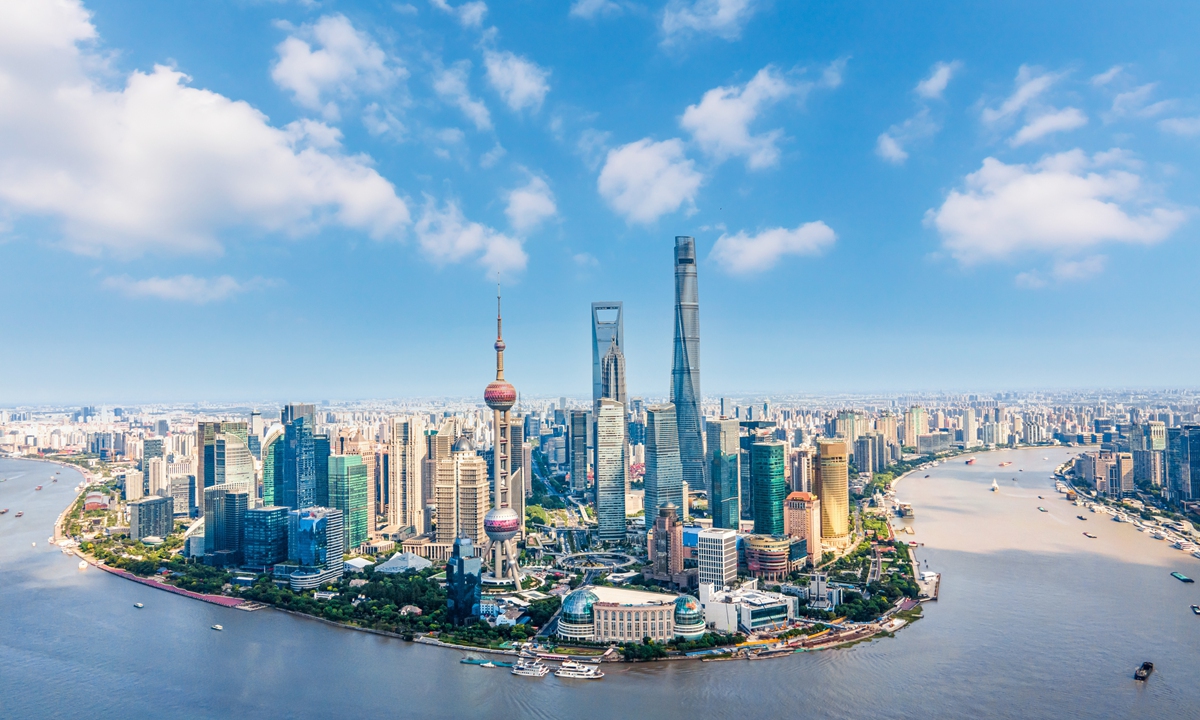
A view of the Lujiazui area in Shanghai Photo: VCG
China targets economic growth of 4.5 percent to 5 percent this year and will strive for better in practice, according to a Government Work Report submitted Thursday to the country's top legislature for deliberation.
The annual growth target was unveiled in the Government Work Report delivered by Premier Li Qiang to the National People's Congress (NPC), the national legislature, which began its annual session on Thursday morning.
Over the next five years, China expects to keep its GDP growth within an appropriate range, with annual growth rates to be determined in light of actual conditions, according to the report.
This will lay a solid foundation for achieving the goal of doubling China's 2020 per capita GDP by 2035 to reach the level of a moderately developed country, the report said.
The target of 4.5 percent to 5 percent economic growth for 2026, while striving to achieve better results in practice, is intended to strike a balance between what is needed and what is feasible, said Shen Danyang, head of the group responsible for drafting this year's government work report, according to Xinhua.
The setting of the economic growth target for 2026 is "proactive and pragmatic", reflecting a broad assessment of domestic conditions and shifts in the external environment, Shen said.
Analysts said that the target range reflects a more prudent assessment of global uncertainties, and allows greater policy flexibility to focus on high-quality development while still signaling policymakers' confidence in maintaining stable growth in the world's second-largest economy amid rising global risks and turmoil.
Flexibility allowed
This is not the first time China has set its GDP growth target in the form of a range. For example, in 2016, a target range was set at 6.5 to 7 percent. In 2019, the target was set at 6 to 6.5 percent.
Lawmakers, national political advisors, analysts as well as executives of multinationals said that the targeted growth range is set to ensure the Chinese economy gets off to a good start in the inaugural year of the 15th Five-Year Plan period (2026-30), and the figure is of paramount importance to pinpointing new growth engines and maintaining stable and sustained economic growth.
NPC deputy Yu Miaojie, president of Liaoning University, told the Global Times on Thursday that a growth target range of 4.5 percent to 5 percent allows greater policy flexibility, enabling localities to focus on high-quality economic growth as their primary goal and, more importantly, place greater focus on people's livelihoods.
"Maintaining an annual economic growth rate within this range reflects the stability of China's economy," Yu said, noting the steady track record of economic growth in the past several years.
Amid escalating geopolitical conflicts and growing global turmoil, China's economy has maintained stable and sustained growth, driven by the country's economic resilience and social stability, Yu said.
Denis Depoux, global managing director of strategy consulting firm Roland Berger, told the Global Times on Thursday that it is crucial to understand that this "growth consensus" is not a sign of weakness but a necessary trade-off to achieve higher-priority objectives.
"In the context of rising global uncertainty, the growth target creates fiscal and political buffers for China to drive reform and address real problems without the pressure of chasing high growth at all costs. It allows for a significant reallocation of capital away from inefficient investments and toward the real needs of the economy, namely technology and people," Depoux said.
Still, China's GDP growth target range, if achieved, would largely surpass the world's average growth rate in 2026 with the world economy facing unprecedented geopolitical and economic challenges and turmoil, analysts said.
China's newly announced growth range for 2026 is a firm answer to the "China peak theory" and the Chinese economy is expected to serve as a source of stability for the global economy, they noted.
Notably, the Chinese economy is projected to grow faster in 2026 than the US, Japan and the Euro area, according to the International Monetary Fund (IMF), with the US economy projected to grow 2.4 percent in 2026, 0.7 percent for Japan and 1.3 percent for the Euro area.
The projected pace would also be among the highest for major economies globally, Shen said.
"The growth target is definitely achievable - the target is set in a very practical and realistic way," Yin Tongyue, a National People's Congress deputy and chairman of Chinese automaker Chery Holding Group Co, told the Global Times as he walked out the Great Hall of the People after listening to the delivery of the Government Work Report in Beijing on Thursday.
Pragmatic approach
Foreign media outlets closely followed China's GDP growth target, with several reports noting that the target range is the lowest range in decades, but creates flexibility for reforms.
Reuters reported that a "lower growth target gives Beijing more flexibility to implement reforms that make the world's second-largest economy less reliant on exports for growth", while the Guardian reported that the figure "reflects an economic strategy that is shifting away from export-led growth to a model that leaders hope will be more resilient to external shocks."
The Wall Street Journal wrote that the "less ambitious growth target also gives Chinese leaders some room to maneuver the economy through complicated geopolitical terrain" and the unchanged deficit target should "give policymakers ample room to rev up government spending if needed."
This is to do with the stage of economic development, as economic growth cannot sustain a continuously high speed, Qu Yongyi, a researcher with the Institute of Industrial Economics of the Chinese Academy of Social Sciences and a national political advisor, told the Global Times on Thursday. "This target range reflects that the government is not solely pursuing GDP growth but is placing greater emphasis on high-quality development."
Tian Xuan, an NPC deputy and a Boya Distinguished Professor of Finance at Peking University, told the Global Times on Thursday that the GDP growth target range is not about "slowing down growth" but rather a "recalibration" of the pace of development.
"It represents the optimal solution found between long-term goals and immediate challenges - one that both upholds the baseline needed to achieve the 2035 vision and reflects a pragmatic approach to development," Tian said. "The modest downward adjustment is not a simple numerical change, but a pragmatic step grounded in economic reality and a move tailored precisely to long-term development goals."
The "range-based regulation" sets a lower bound for growth while preserving upward flexibility and sufficient room for policy maneuvering — all to safeguard the certainty of high-quality development. This also means that achieving the target will be anything but easy; it will require sustained and arduous effort, The People's Daily noted in a commentary published on Thursday.
The commentary, titled China has set an economic growth target of 4.5 percent to 5 percent this year. How should we view it, said that to make further progress from an already high level, we must emphasize both quantity and, more importantly, quality. Can we go even faster? It's not that we cannot; it's that we choose not to. The very "first lesson of the new year" stressed curbing impulsive pursuit of governance achievements, carrying profound significance.
"Pursuing genuine and unvarnished growth, and advancing high-quality, sustainable development." This demonstrates the determination to forge ahead despite pressure and strive for innovation and high quality, it said.
RELATED ARTICLES