While global attention focuses on Iran, Japan's LDP recommends easing arms export rules to PM; a serious departure from pacifist path: expert
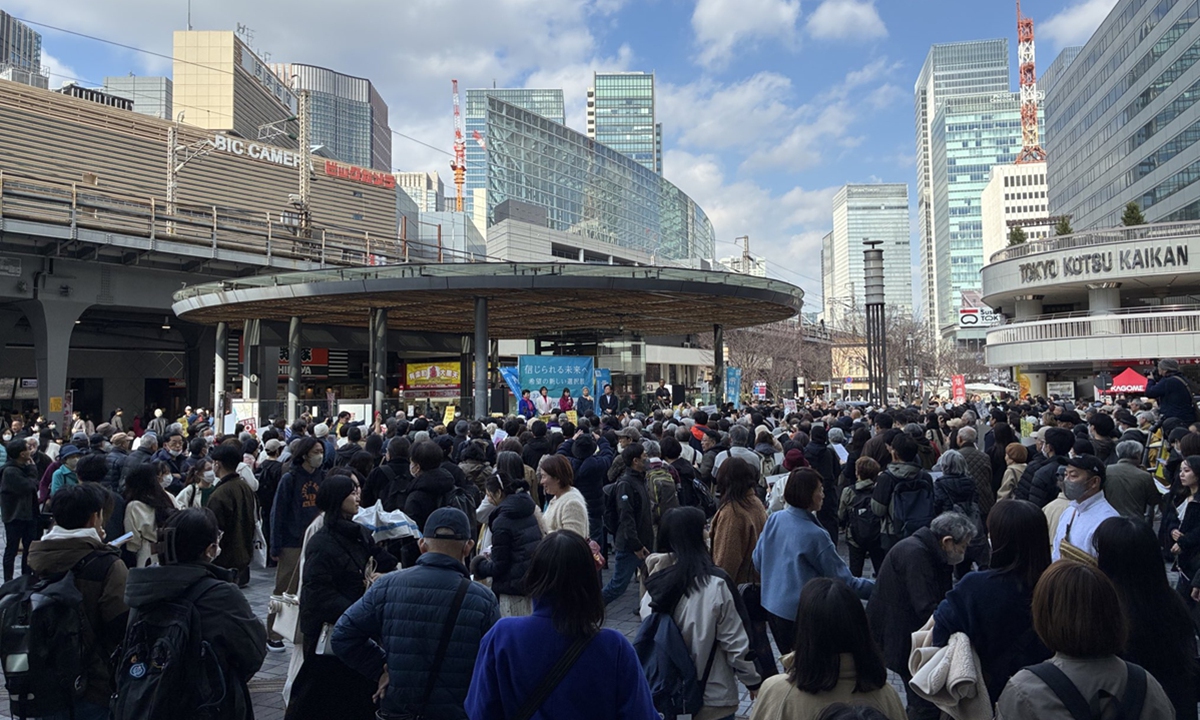
Representatives of Citizens' Alliance, the Japanese Communist Party, the Constitutional Democratic Party, the Social Democratic Party and the New Socialist Party hold a street rally and press conference in Tokyo, Japan, on February 22, opposing the Sanae Takaichi administration's push to revise Article 9 of the Constitution. Photo: Screenshot from website
While global attention remains largely focused on the escalating tensions in the Middle East, Japan appears to be quietly pressing the accelerator on efforts to loosen its long-standing restrictions on arms exports, as it is reportedly advancing the policy step by step.Days after Japan's ruling Liberal Democratic Party (LDP) approved a draft proposal on February 25 to ease restrictions on defense equipment exports, party officials on Friday brought the proposal to Prime Minister Sanae Takaichi, calling for easing export rules, including allowing in principle the overseas transfer of lethal weapons such as fighter jets and destroyers, Kyodo News reported.
The proposal would abolish the current "five categories" framework that limits exports to non-combat purposes and ironically leave room for exceptional transfers even to countries engaged in conflict under so-called "special circumstances considering Japan's security needs." The government plans to revise the operational guidelines of the Three Principles on Transfer of Defense Equipment and Technology as early as this spring based on the proposal, according to the report.
Japan's move represents a serious departure from the country's postwar identity as a so-called pacifist nation and poses a direct challenge to the international order established after World War II, Lü Chao, a professor at the Liaoning Academy of Social Sciences, told the Global Times on Friday
By allowing the export of offensive weapons such as fighter jets and introducing potential exceptions that could permit arms sales even to countries involved in conflicts, Japan's move poses risks of transforming itself from a defeated country once subject to strict international oversight into a supplier of offensive weapons, Lü said, adding that such a shift could significantly undermine regional security and stability and warrants close attention from the international community.
Notably, the move is also drawing criticism from many in Japan. Domestic criticism had already surfaced during earlier discussions of the proposal. In a February 25 report, Kyodo News reported that opposition parties warned that the policy shift could allow arms exports to countries engaged in combat based on political decisions and called for careful deliberation.
The Japanese Communist Party has also criticized the proposal. In its policy platform released earlier this year, the party warned that the government is seeking to fully lift the long-standing restrictions on arms exports, a policy previously maintained on the grounds that such transfers could fuel international conflicts.
The party argued that such a move would abandon Japan's identity as a pacifist nation under Article 9 of the Constitution and risk turning the country into a "merchant of death" state, adding that as the only country to have suffered atomic bombings in war, Japan should not pursue policies that contribute to military expansion.
Japan's other recent exposure of potential military moves came as part of a series of provocative actions by Japan that are stirring up regional tensions. On February 24, Japanese Defense Minister Shinjiro Koizumi claimed that Japan plans to deploy upgraded air defense missiles on westernmost island in Okinawa, within sight of China's Taiwan region, as previously reported by the Global Times.
Citing multiple sources close to the ministry, Japanese media Asahi Shimbun reported on Wednesday that Japan's Defense Ministry has decided to beef up its air base on Iwoto island, in response to "China's increasing military operations" in the Pacific. Japan also held joint military drills with the US and the Philippines near the Bashi Channel, the waterway between the Philippines and Taiwan island, for the first time in the late February, according to the Japan Times.
Japan's push to loosen arms export restrictions also reflects long-standing pressure from its defense industry as well as the temptation of expanding overseas arms markets. Although military-related exports had continued in limited forms under postwar restrictions and international oversight, the new proposal would significantly loosen those constraints, according to Lü, pointing out serious security risks such a move poses.
Regarding a media inquiry that Japan's ruling LDP has approved the proposal calling the government to ease the rules of limiting defense equipment exports, making it possible to export lethal weapons that were previously not permitted, Chinese Foreign Ministry spokesperson Mao Ning said at routine press briefing on February 25 that the Chinese Foreign Ministry has noted the report and has serious concern over the move.
Mao said that due to Japan's history of aggression, its moves in military and security areas have been closely watched by its Asian neighbors and the international community. In recent years, Japan has been revamping its security and defense policies, its officials clamored for the possession of nuclear weapons, and the country sought to revise the three Non-Nuclear Principles and lift restrictions on the export of weapons, the spokesperson noted.
The latest move has once again laid bare the Japanese right-wing forces' ambitions to breach the postwar international order, break free from domestic laws and remilitarize Japan. The international community needs to stay on high alert, jointly safeguard the outcomes of the victory in WWII and the postwar international order, and firmly reject reckless moves of Japanese neo-militarism, said Mao.
RELATED ARTICLES