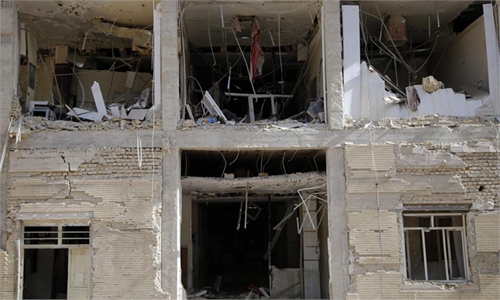
US-Israel war against Iran enters Day 7 amid thick smoke in Tehran and fears of another Middle East quagmire for Washington
Asymmetric warfare makes it difficult for US to achieve a quick and decisive victory: expert


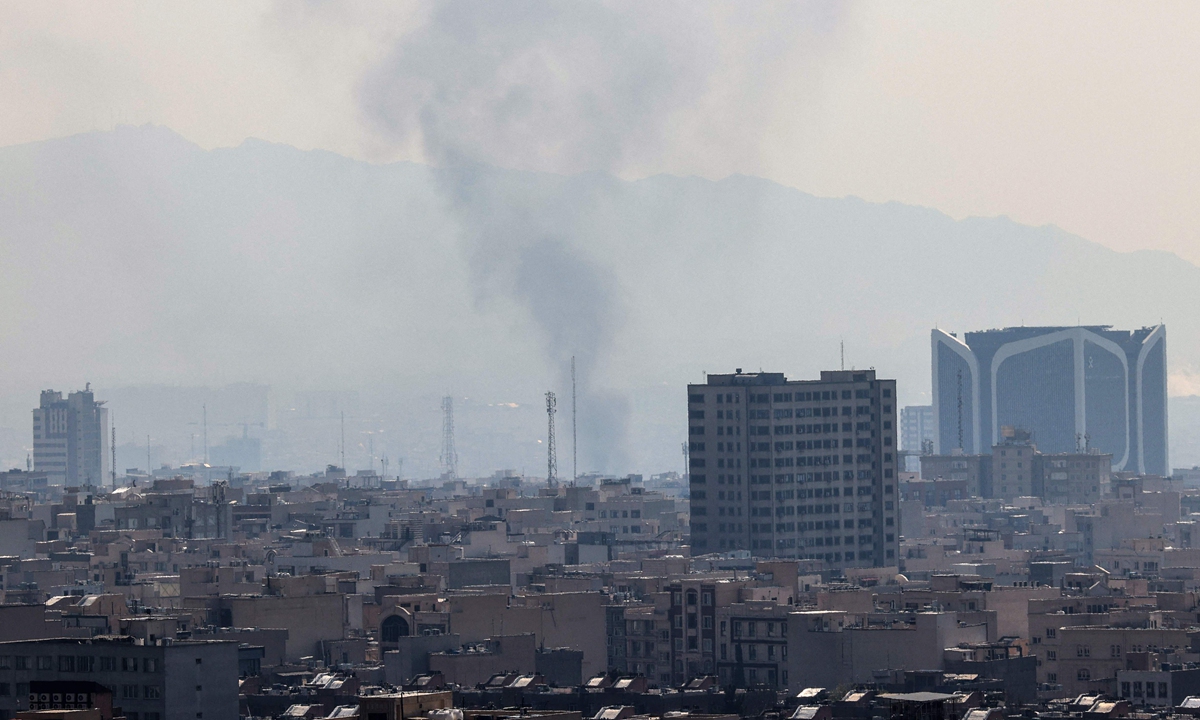
Smoke rises from the site of airstrikes in a central area of the Iranian capital Tehran on March 6, 2026. Photo: VCG
With thick smoke and explosions engulfing Tehran, the joint US-Israeli military operation against Iran has entered its one-week mark. Meanwhile, in Washington, concerns are mounting over whether the US is being dragged into another Middle East quagmire and the enormous military expenditures involved.In the past week, barrages of missiles, waves of airstrikes, AI-assisted precision targeting, and killing of the top leadership have fallen far short of US-Israel's goal of "regime change" in Tehran. Instead, the campaign has ignited an even fiercer spirit of resistance within Iran.
In addition, the ever-widening spillover of the conflict is gravely disrupting regional security and constitutes a serious threat to the global economy, maritime passage security, and energy security.
Tit-for-tat exchanges
Day seven began with midnight strikes. Massive explosions rocked several sites in Tehran overnight, including residential neighborhoods and areas near Tehran University, according to Al Jazeera. The network also reported that Hezbollah positions in Lebanon have become targets, as Israeli forces intensified strikes there.
Israel's military says its air force hit six Iranian missile launchers overnight, and also destroyed three advanced Iranian defense systems in recent strikes.
Following days of warfare, both the US and Israeli sides have indicated that Iran's military capabilities have been significantly weakened.
According to Al Jazeera, US President Donald Trump said Iran is being "demolished… ahead of schedule and at levels people have never seen before," claiming the country now has "no air force, no air defense."
Adm. Brad Cooper, commander of US Central Command, stated on Thursday (local time) that over the past 72 hours, US bomber forces had struck nearly 200 targets in Iran.
Israel's military chief, Lieutenant General Eyal Zamir, warned on Friday that the US-Israeli campaign against Iran was entering "the next phase" and would "further dismantle the regime and its military capabilities", according to Al Jazeera.
Yet Tehran continues to project defiance, vowing to persist in the fight. In a statement, the Islamic Revolution Guards Corps (IRGC) said Friday that they have launched a wave of drones and missiles at targets in Tel Aviv on Friday.
The Iranian army reported that its forces have also launched drone attacks on US bases in Kuwait and Iraq, as well as various Israeli targets. It also struck a US oil tanker in the northern Gulf with missiles, per Xinhua.
Top Iranian official Ali Larijani said on Thursday that his country is prepared to confront a possible invasion from the US, pledging to capture and kill US troops if they enter the country.
In a statement, Brigadier General Ali Mohammad Naeini, spokesperson for the IRGC, affirmed that Iran is fully prepared for a "prolonged war" and is set to introduce advanced weaponry that has not yet been used in the conflict.
Despite Iran's clear military inferiority, its adoption of asymmetric warfare tactics has made it difficult for the US to achieve a quick and decisive victory, Chinese military affairs expert Zhang Junshe told the Global Times on Friday.
According to the expert, Iran has concealed its surviving forces in underground missile bases located in the mountainous regions of its southwest, thereby evading US and Israeli strikes. At the same time, it has launched counterattacks using cruise missiles, ballistic missiles and drones. Moreover, by rallying its allies within the "Axis of Resistance", Iran has carried out retaliatory strikes against US military bases and Israeli targets.
Iran has launched over 500 ballistic and cruise missiles and over 2,000 drones since the start of the war, an Iranian military source told the Iranian Fars news agency.
Despite multiple rounds of intense strikes, the US and Israel have failed to compel Iran to submit, with Tehran's counteroffensives displaying resilience, Zhang noted. "The US and Israel have not succeeded in fully crippling Iran's command-and-control architecture or its intelligence networks," he added.
At least 1,332 people in Iran have been killed by the US-Israeli attacks since February 28, according to the Iranian Red Crescent.
Despite the ferocity of the strikes, assessments shared with The Washington Post by European and Arab officials on Thursday indicate no significant defections within regime ranks or widespread popular uprising.
On Friday, Iranian President Masoud Pezeshkian said in an X post that "Some countries have begun mediation efforts. Let's be clear: we are committed to lasting peace in the region yet we have no hesitation in defending our nation's dignity & sovereignty. Mediation should address those who underestimated the Iranian people and ignited this conflict."
Surging doubt and cost
Although US House lawmakers narrowly rejected (212-219) an effort on Thursday to halt the war with Iran, public support for the conflict remains low. Some are questioning whether the intervention truly upholds the "America First" principle that propelled President Trump to victory in the election, with growing fears that it risks dragging the US into yet another protracted and costly Middle East quagmire.
A Reuters/Ipsos poll released on Monday showed only 27 percent of respondents supporting the US-Israeli attacks, with 43 percent disapproving.
Politico reported, citing an obtained notification, that US Central Command is requesting that the Pentagon deploy additional military intelligence officers to its headquarters in Tampa, Florida, to support operations against Iran "for at least 100 days but likely through September", far beyond President Trump's initial four-week timeline.
A Thursday Bloomberg report quoted a source as saying that some Pentagon officials are questioning the US strategy amid concerns over depleting limited stocks of key munitions and uncertainty regarding the operation's ultimate goals.
The Wall Street Journal noted signs of escalating funding needs for the military operation. In a Thursday report, citing sources, the paper said Pentagon officials are preparing plans to replenish US munitions expended in the past week's fighting. Lawmakers in Congress and defense industry officials anticipate a forthcoming funding request from the Pentagon to cover war-related costs.
An analysis by Washington-based think tank the Center for Strategic and International Studies (CSIS) underlined the colossal cost of the war: it is estimated to have cost Washington $3.7 billion so far in its first 100 hours alone, or nearly $900 million a day, Al Jazeera reported on Friday.
Based on an analysis by Elaine McCusker, a senior Pentagon budget official during the first Trump administration, the first four days of strikes against Iran are estimated to have cost nearly $11 billion.
The report said the Trump administration might decide to ask for a supplemental appropriation to cover the war, but "any funding action will become a focal point for opposition to the war."
According to Liu Zhongmin, a professor at the Middle East Studies Institute of Shanghai International Studies University, after one week of warfare, the conflict has entered a critical stalemate phase. However, without launching a ground invasion, it is extremely difficult for US and Israel to achieve their objective of toppling the Iranian regime.
"Whether the US becomes mired in a quagmire depends on American strategic decision-making and the degree of damage inflicted on the US by Iran's counterattacks," said Liu, "judging from White House Middle East policy and Trump's personal style, there is a risk of getting bogged down, but it may not be particularly high."
It is possible that, once it becomes clear regime change in Iran is unattainable and the cost becomes extremely unaffordable, the US will seek to end the conflict and declare "victory", said the expert.
As the US-Israeli war against Iran enters its seventh day, US deputy chief of staff Dan Scavino released a video clip on X showing Christian pastors gathered in the Oval Office with their hands laying on the US leader to pray for Trump and the US armed forces.
When asked about US strategy and objectives, Richard Fontaine, CEO of the Center for a New American Security and former adviser to Senator John McCain, told Bloomberg: the risk is that "if you don't know what you're fighting for, then among other things you don't know when you've attained it—and you don't know when to stop."
RELATED ARTICLES