Addressing essential demand in real-world scenarios 'core competitiveness' for China's AI technology to go global: NPC deputy and industry insider on China-US AI competition
By and Chen Zishuai Published: Mar 07, 2026 11:46 AM

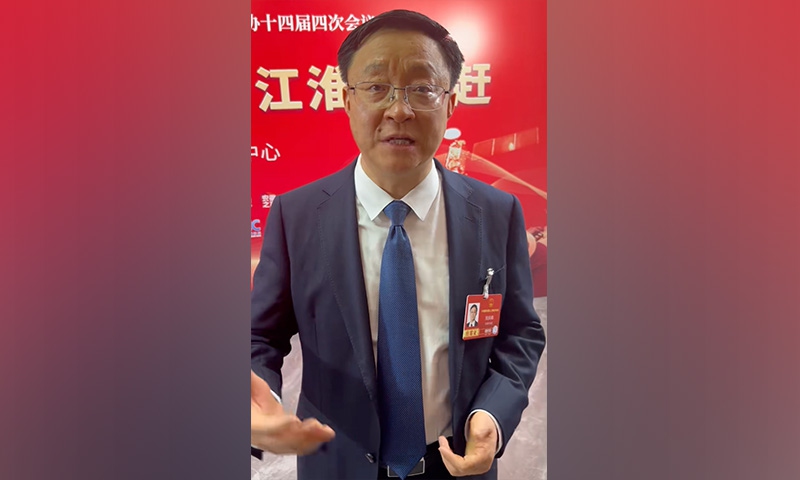
Liu Qingfeng, a deputy to 14th National People’s Congress and chairman of Chinese tech firm iFLYTEK, speaks with the Global Times on March 6, 2026, during the ongoing “two sessions.” Photo: Chen Qingqing/GT
China's artificial intelligence (AI) technology can address the "essential demand" in key real-world scenarios, which constitutes the core competitiveness for us to expand globally. Looking ahead, we must also strive to take the lead in breakthroughs in foundational technological innovation, Liu Qingfeng, a deputy to 14th National People's Congress and chairman of Chinese tech firm iFLYTEK, told the Global Times on the sidelines of the ongoing "two sessions."
At present, an increasing number of Chinese AI products are entering the global stage and competing directly with top international technologies. Liu told the Global Times that for China's large models or artificial intelligence to "go global," the first requirement is the ability to compete with the US in multilingual capabilities.
Beyond improving base models and general capabilities, the key lies in solving the "essential demand" problems in real-world scenarios. This is the core competitiveness for China in promoting large models and related industries globally, Liu said.
In key sectors such as automobiles, energy, education, and healthcare, he noted, Chinese models have comparative advantages over their US counterparts in addressing practical needs in application scenarios.
Liu also pointed out that China holds clear advantages internationally in the area of open source. "In the future, I think China will certainly take the lead in integrating AI software and hardware, and in achieving more efficient and lower-cost commercial applications of AI, thereby gaining the early dividends from the global commercialization of this new wave of the AI industry."
The crucial question in the future competition between China and the US [in AI], is which country can achieve the next major breakthroughs in foundational technological innovation first, Liu said.
Therefore, we must maintain a strong sense of urgency and fully recognize that there is still a certain gap between China and the US in overall scientific research capacity. In the field of AI, we need focused, high-intensity investment, like a sharp spearhead and concentrated pressure, to seek breakthroughs, he said.
RELATED ARTICLES